

Motmot

Namaqua Dove vs Burchell's Sandgrouse

Oena capensis versus Pterocles burchelli

Play a quiz with Namaqua Dove and Burchell's Sandgrouse
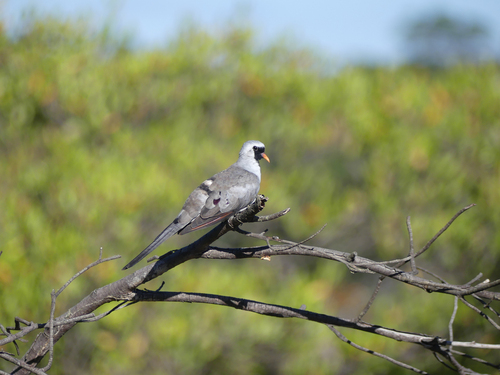
Namaqua Dove (Oena capensis) Namaqua Dove
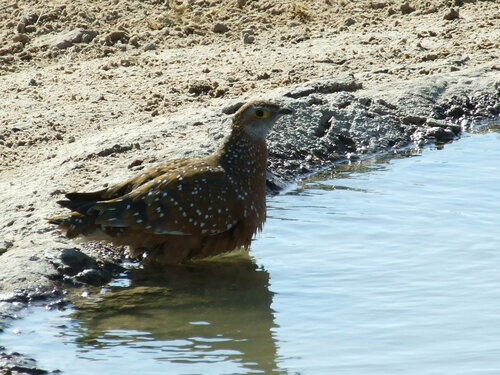
Burchell's Sandgrouse (Pterocles burchelli) Burchell's Sandgrouse

Media

Loading…

In short

The most reliable way to separate Namaqua Dove from Burchell's Sandgrouse is by overall structure and tail shape: Namaqua Dove is a tiny, slender pigeon with a strikingly long, thin, black-tipped tail, while Burchell's Sandgrouse is much larger, chunkier, and lacks the dove's long tail. In flight, adult male Namaqua Doves show chestnut primaries and a very long, pointed tail, while Burchell's Sandgrouse has a more compact profile and lacks any long tail streamers. Juvenile Namaqua Doves have dark blotches on the wings and shoulders, which can be a pitfall, but the species' size and tail remain distinctive. Both species may be seen in arid regions, but their structure and flight style are quite different, and careful attention to tail length and body size will resolve most confusion.

Identification tips

  1. Tail length and shape: Namaqua Dove of all ages has a very long, thin, black-tipped tail that extends well past the wingtips both perched and in flight; Burchell's Sandgrouse lacks any such tail extension and appears short-tailed and compact.
  2. Size: Namaqua Dove is tiny (36g), less than a quarter the mass of Burchell's Sandgrouse (181.5g); in the field, the dove looks delicate and small, while the sandgrouse is robust and pigeon-sized or larger.
  3. Flight profile: In flight, Namaqua Dove shows a slim, elongated shape with the tail streaming behind; Burchell's Sandgrouse is more compact, with a shorter tail and a heavier, more direct flight.
  4. Wing pattern (juveniles): Juvenile Namaqua Doves have dark blotches on the wings and shoulders, but still show the long tail; Burchell's Sandgrouse juveniles do not show such blotching or tail length.
  5. Adult male face pattern: Male Namaqua Dove has a striking black face, throat, and breast, plus a yellow and red bill; Burchell's Sandgrouse never shows black on the face or such a bill.
  6. Female/immature face: Female and immature Namaqua Doves lack the black face but still have a red-based grey bill and the long tail; Burchell's Sandgrouse lacks any facial contrast or colored bill.
  7. Primary color in flight: Namaqua Dove shows chestnut primary feathers in flight (all ages); Burchell's Sandgrouse does not show chestnut in the wings.
  8. Belly color: Namaqua Dove has a white belly, contrasting with grey upperparts; Burchell's Sandgrouse is more uniformly earth-toned below.
  9. Bill color: Namaqua Dove's bill is yellow and red in adult males, red-based grey in females/immatures; Burchell's Sandgrouse has a less colorful, more cryptic bill.
  10. Group size: Namaqua Doves are usually solitary or in pairs; Burchell's Sandgrouse often in flocks, especially at water.
  11. Behavior: Namaqua Doves walk with a delicate, pigeon-like gait and flick their long tails; sandgrouse walk more heavily and do not flick the tail.
  12. Habitat context: Both species occur in arid regions, but sandgrouse are more tied to open, treeless ground and are often seen in groups at waterholes.
  13. Voice: If heard, Namaqua Dove gives a soft, mournful double hoo; sandgrouse vocalizations are not described here.
  14. Perched posture: Namaqua Dove perches with the long tail drooping well below the branch or wire; sandgrouse perches more upright and short-tailed.
  15. Pitfall: Juvenile Namaqua Doves' wing blotches can confuse, but tail length and overall size remain reliable.

Size

Namaqua Dove is dramatically smaller, weighing about 36g, compared to Burchell's Sandgrouse at roughly 181.5g—over five times heavier. The dove is also much more slender and delicate, with a length of about 22 cm and a wingspan of 28–33 cm, while the sandgrouse is bulkier and more robust overall. In the field, the dove's tiny size and long, needle-like tail stand out, especially when seen alongside other birds or on open ground.

Plumage

Juvenile Namaqua Doves have dark blotches on the wings and shoulders, which can cause confusion at a distance or in poor light, but even young birds retain the species' long, pointed tail and overall slim shape. Adult male Namaqua Doves are mostly grey with a white belly, chestnut primaries visible in flight, and a distinctive black face, throat, and breast, plus a yellow and red bill. Females and immatures lack the black on the face and breast, and their bills are red-based grey. Burchell's Sandgrouse, by contrast, lacks any long tail streamers and does not show chestnut in the primaries; its plumage is adapted for camouflage in arid environments and is generally more cryptic and earth-toned, without the dove's sharp contrast or facial markings. In flight, the sandgrouse appears compact and lacks the dove's long, trailing tail.

Behaviour

Namaqua Doves are often seen singly or in pairs, moving with a delicate, pigeon-like walk and frequently flicking their long tails. Their flight is swift and direct, with the long tail trailing behind. Burchell's Sandgrouse is more likely to be encountered in groups, especially when flying to water, and has a fast, direct flight but with a much shorter tail and a heavier, more robust jizz. Sandgrouse often flush in flocks and settle quickly, while Namaqua Doves are more solitary and less likely to be seen in large numbers.

Habitat

Both species inhabit arid and semi-arid regions of southern Africa, so habitat alone is not diagnostic. However, Burchell's Sandgrouse is more strictly associated with open, dry grassland and semi-desert, often far from trees, while Namaqua Dove can be found in a wider range of open country, including areas with scattered bushes and near waterholes. Both may be seen on the ground, but the sandgrouse is more likely to be found in larger groups at water sources.

Voice

Namaqua Dove gives a quiet, short, double hoo, higher on the longer second note (kuh-whooo), which is mournful and frequently repeated. Burchell's Sandgrouse's vocalizations are not described in the provided notes, so voice is not a reliable separator here.

Submit a better description

Use the same sections as the comparison. Your text is published immediately.

The most reliable way to separate Namaqua Dove from Burchell's Sandgrouse is by overall structure and tail shape: Namaqua Dove is a tiny, slender pigeon with a strikingly long, thin, black-tipped tail, while Burchell's Sandgrouse is much larger, chunkier, and lacks the dove's long tail. In flight, adult male Namaqua Doves show chestnut primaries and a very long, pointed tail, while Burchell's Sandgrouse has a more compact profile and lacks any long tail streamers. Juvenile Namaqua Doves have dark blotches on the wings and shoulders, which can be a pitfall, but the species' size and tail remain distinctive. Both species may be seen in arid regions, but their structure and flight style are quite different, and careful attention to tail length and body size will resolve most confusion.

  1. Tail length and shape: Namaqua Dove of all ages has a very long, thin, black-tipped tail that extends well past the wingtips both perched and in flight; Burchell's Sandgrouse lacks any such tail extension and appears short-tailed and compact.
  2. Size: Namaqua Dove is tiny (36g), less than a quarter the mass of Burchell's Sandgrouse (181.5g); in the field, the dove looks delicate and small, while the sandgrouse is robust and pigeon-sized or larger.
  3. Flight profile: In flight, Namaqua Dove shows a slim, elongated shape with the tail streaming behind; Burchell's Sandgrouse is more compact, with a shorter tail and a heavier, more direct flight.
  4. Wing pattern (juveniles): Juvenile Namaqua Doves have dark blotches on the wings and shoulders, but still show the long tail; Burchell's Sandgrouse juveniles do not show such blotching or tail length.
  5. Adult male face pattern: Male Namaqua Dove has a striking black face, throat, and breast, plus a yellow and red bill; Burchell's Sandgrouse never shows black on the face or such a bill.
  6. Female/immature face: Female and immature Namaqua Doves lack the black face but still have a red-based grey bill and the long tail; Burchell's Sandgrouse lacks any facial contrast or colored bill.
  7. Primary color in flight: Namaqua Dove shows chestnut primary feathers in flight (all ages); Burchell's Sandgrouse does not show chestnut in the wings.
  8. Belly color: Namaqua Dove has a white belly, contrasting with grey upperparts; Burchell's Sandgrouse is more uniformly earth-toned below.
  9. Bill color: Namaqua Dove's bill is yellow and red in adult males, red-based grey in females/immatures; Burchell's Sandgrouse has a less colorful, more cryptic bill.
  10. Group size: Namaqua Doves are usually solitary or in pairs; Burchell's Sandgrouse often in flocks, especially at water.
  11. Behavior: Namaqua Doves walk with a delicate, pigeon-like gait and flick their long tails; sandgrouse walk more heavily and do not flick the tail.
  12. Habitat context: Both species occur in arid regions, but sandgrouse are more tied to open, treeless ground and are often seen in groups at waterholes.
  13. Voice: If heard, Namaqua Dove gives a soft, mournful double hoo; sandgrouse vocalizations are not described here.
  14. Perched posture: Namaqua Dove perches with the long tail drooping well below the branch or wire; sandgrouse perches more upright and short-tailed.
  15. Pitfall: Juvenile Namaqua Doves' wing blotches can confuse, but tail length and overall size remain reliable.

Namaqua Dove is dramatically smaller, weighing about 36g, compared to Burchell's Sandgrouse at roughly 181.5g—over five times heavier. The dove is also much more slender and delicate, with a length of about 22 cm and a wingspan of 28–33 cm, while the sandgrouse is bulkier and more robust overall. In the field, the dove's tiny size and long, needle-like tail stand out, especially when seen alongside other birds or on open ground.

Juvenile Namaqua Doves have dark blotches on the wings and shoulders, which can cause confusion at a distance or in poor light, but even young birds retain the species' long, pointed tail and overall slim shape. Adult male Namaqua Doves are mostly grey with a white belly, chestnut primaries visible in flight, and a distinctive black face, throat, and breast, plus a yellow and red bill. Females and immatures lack the black on the face and breast, and their bills are red-based grey. Burchell's Sandgrouse, by contrast, lacks any long tail streamers and does not show chestnut in the primaries; its plumage is adapted for camouflage in arid environments and is generally more cryptic and earth-toned, without the dove's sharp contrast or facial markings. In flight, the sandgrouse appears compact and lacks the dove's long, trailing tail.

Namaqua Doves are often seen singly or in pairs, moving with a delicate, pigeon-like walk and frequently flicking their long tails. Their flight is swift and direct, with the long tail trailing behind. Burchell's Sandgrouse is more likely to be encountered in groups, especially when flying to water, and has a fast, direct flight but with a much shorter tail and a heavier, more robust jizz. Sandgrouse often flush in flocks and settle quickly, while Namaqua Doves are more solitary and less likely to be seen in large numbers.

Both species inhabit arid and semi-arid regions of southern Africa, so habitat alone is not diagnostic. However, Burchell's Sandgrouse is more strictly associated with open, dry grassland and semi-desert, often far from trees, while Namaqua Dove can be found in a wider range of open country, including areas with scattered bushes and near waterholes. Both may be seen on the ground, but the sandgrouse is more likely to be found in larger groups at water sources.

Namaqua Dove gives a quiet, short, double hoo, higher on the longer second note (kuh-whooo), which is mournful and frequently repeated. Burchell's Sandgrouse's vocalizations are not described in the provided notes, so voice is not a reliable separator here.

Discard your changes?

You have unsaved edits. If you leave now, those changes will be lost.

Namaqua Dove · Burchell's Sandgrouse · My Tricky Birds