

Nacunda Nighthawk vs Short-tailed Nighthawk
Chordeiles nacunda versus Lurocalis semitorquatus
Play a quiz with Nacunda Nighthawk and Short-tailed Nighthawk
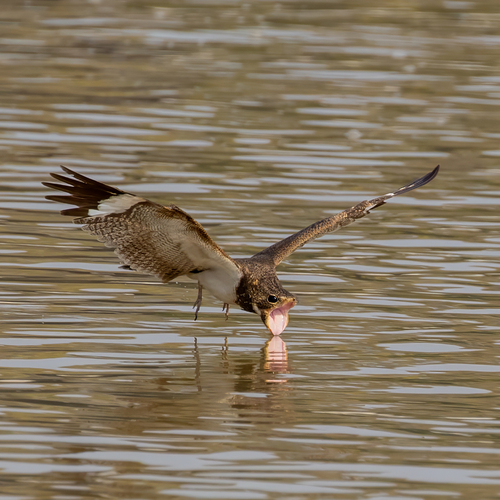 Nacunda Nighthawk
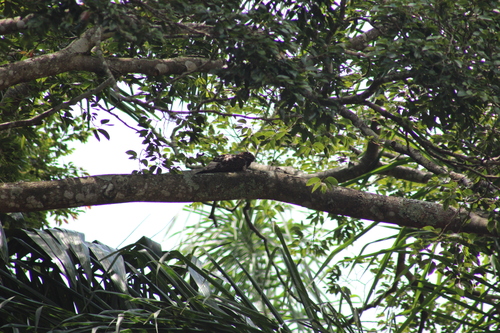 Short-tailed Nighthawk
In short
The most reliable field mark to separate Nacunda Nighthawk from Short-tailed Nighthawk is overall size and structure: Nacunda is dramatically larger, with a massive head, long legs, and a pale, contrasting plumage, while Short-tailed is smaller, darker, and lacks bold white wing markings. In flight, Nacunda’s black primaries stand out against a very pale body, while Short-tailed shows uniformly dark wings with muted spotting and a notably short tail. On the ground, Nacunda is much more likely to be seen standing upright, thanks to its long tarsi. If you see a huge, pale nightjar with a big head and strong black-and-white contrast, it’s Nacunda; a smaller, compact, dark bird with a stubby tail and no white in the wing is Short-tailed.
Identification tips
- Size is the quickest separator: If the bird looks huge for a nightjar, it is almost certainly Nacunda. Short-tailed is large for a nightjar but much smaller than Nacunda.
- Head and leg structure: Nacunda has a massive head and unusually long legs for a nightjar, often standing upright on the ground. Short-tailed has a proportionally smaller head and is rarely seen standing.
- Tail shape and length: Short-tailed Nighthawk has a notably short tail—look for a stubby-tailed appearance in flight or perched. Nacunda’s tail is proportionate to its large body.
- Wing pattern in flight: Nacunda shows bold black primaries contrasting with a pale body and wings. Short-tailed’s wings are uniformly dark with only subtle, muted spots—no bold white or black patches.
- Plumage contrast: Nacunda is overall pale, especially on the body and underparts, with strong black-and-white contrast. Short-tailed is dark brown to blackish above, with rufous and buff speckles, and the underparts are tawny buff with brown bars.
- White in the wing: Unlike many nighthawks, Short-tailed lacks any bold white markings in the wing—this is a key point. Nacunda’s black primaries stand out against the pale wing.
- Ground behavior: If you see a nightjar standing upright on open ground, especially in daylight, it is far more likely to be Nacunda. Short-tailed is almost never seen this way.
- Habitat context: Open grasslands, savannas, and degraded fields favor Nacunda. Forest edges, clearings, and riverbanks in lowland rainforest are more likely to hold Short-tailed.
- Flight style: Nacunda’s flight is powerful, slow, and broad-winged, matching its size. Short-tailed is more agile and compact, with a quick, short-winged jizz.
- Tail pattern: Short-tailed’s tail is brown with tawny/grayish bars and a narrow pale band at the tip—look for this if the tail is visible. Nacunda’s tail is less distinctly marked.
- Underpart color: Nacunda is pale below; Short-tailed is buff/tawny with brown barring.
- Vocalizations: If you hear the repeated 'ewIT' or 'g'wik' calls, you are likely hearing Short-tailed; Nacunda’s voice is not described here.
- Geographic overlap: Both species can occur in northern South America and Trinidad and Tobago, but Nacunda is absent from dense forest interiors, while Short-tailed is rare in open country.
- Subspecies variation: Short-tailed shows some variation in spotting and barring by subspecies, but none approach the bold contrast of Nacunda.
- Pitfalls: Immature or worn birds of either species are not described in detail, but the structural and size differences are so strong that confusion is unlikely if these are carefully assessed.
Size
Nacunda Nighthawk is by far the larger species, measuring 27.5–32 cm in length and averaging 159 g in mass (range 130–188 g). Short-tailed Nighthawk is much smaller, at 19–21 cm and around 80–89 g. The difference is striking in the field: Nacunda looks massive and heavy, with a big head and long legs, while Short-tailed is compact, with a short tail and less bulk overall. If both are seen together, Nacunda dwarfs Short-tailed.
Plumage
No age-specific upperwing patterns are described for either species, but adult plumage is distinctive. Nacunda Nighthawk is pale overall with a highly contrasting pattern: the body is light, and the primaries are black, creating a bold black-and-white effect in flight. Short-tailed Nighthawk is much darker, with upperparts and wings dark brown to blackish, speckled with rufous and buff, but lacking any bold white markings on the wings. Its tail is short, brown with tawny or grayish bars and a narrow pale band at the tip. The underparts of Short-tailed are also darker, with a mix of brown, buff, and tawny barring, while Nacunda’s paleness extends below. The lack of any white wing patches in Short-tailed is a key difference from many other nighthawks, and especially from the strikingly pale-winged Nacunda.
Behaviour
Nacunda Nighthawk is unusual among nightjars for its partially diurnal habits and frequent ground-standing behavior, enabled by its long tarsi. It is often seen upright on open ground, not just at dusk or dawn. Short-tailed Nighthawk is a more typical aerial insectivore, foraging mostly at dusk and rarely seen on the ground. In flight, Nacunda appears large and powerful, with slow, strong wingbeats and a broad wingspan, while Short-tailed is more compact and agile, with a noticeably short tail and less imposing flight profile.
Habitat
Nacunda Nighthawk favors open habitats such as dry savannas, seasonally wet or flooded grasslands, and heavily degraded former forests across much of South America. It is more likely to be found in open country than in dense forest. Short-tailed Nighthawk, in contrast, is primarily a bird of lowland evergreen forest, but can also be found in clearings, river edges, old plantations, and secondary forest. Its range is broader, including Central America and much of northern and central South America, but it avoids the open habitats preferred by Nacunda.
Voice
Short-tailed Nighthawk has a distinctive call, varying by subspecies but typically described as a repeated 'ewIT ... ewIT ... ewIT ...' or a sharp, liquid 'g'wik' or 'gweek', given both in flight and when perched. There is no vocalization information provided for Nacunda Nighthawk in the notes, so voice is not a reliable separator unless Short-tailed is calling.
Nacunda Nighthawk · Short-tailed Nighthawk · My Tricky Birds