

Mute Swan vs Whooper Swan
Cygnus olor versus Cygnus cygnus
Play a quiz with Mute Swan and Whooper Swan
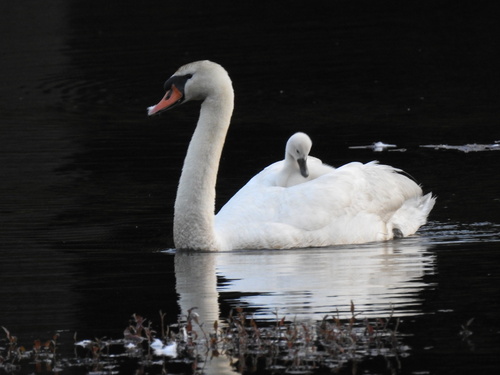 Mute Swan
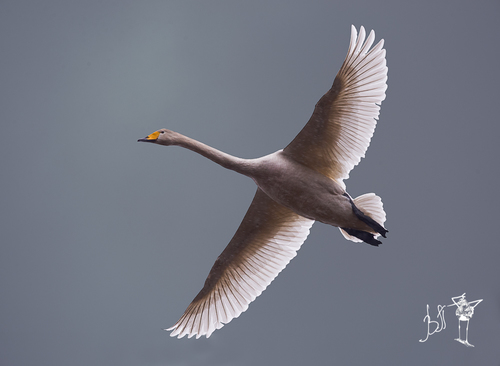 Whooper Swan
In short
The most reliable field mark between Mute Swan and Whooper Swan is the bill color and pattern: adult Mute Swans have a bright orange bill with a prominent black knob at the base, while adult Whooper Swans show a mostly yellow bill with a straight border between yellow and black, lacking a knob. Juveniles are trickier, but Whooper Swan cygnets are more uniformly pale grey, while Mute Swan cygnets are usually a mix of grey or buff and white, with a dull greyish-black bill. In flight or on water, tail shape and head profile are also useful: Mute Swan has a longer, pointed tail and a gently curved 'S'-shaped neck, while Whooper Swan has a shorter, rounded tail and a straighter, more angular head and neck. Both are very large white swans, but their structure and bill pattern are the best field clues.
Identification tips
- Bill color and pattern (adults): Mute Swan shows a bright orange bill with a large black knob at the base; Whooper Swan has a mostly yellow bill with a straight edge to the black tip and no knob. This is the most reliable field mark for adults.
- Bill shape and size: Whooper Swan's bill is longer and more wedge-shaped, with a straight line between yellow and black; Mute Swan's bill is shorter, deeper, and has a pronounced knob at the base (especially in males).
- Head and neck profile: Mute Swan has a gently curved 'S'-shaped neck and a rounded head, often held arched; Whooper Swan has a straighter neck and a more angular, wedge-shaped head, giving a different jizz.
- Tail shape: Mute Swan has a long, pointed (triangular) tail, which is obvious when up-ended or in flight; Whooper Swan's tail is shorter and rounded. This is useful for all ages, especially when birds are feeding with their heads underwater.
- Juvenile plumage: Whooper Swan juveniles are uniform pale grey to greyish-brown, with pinkish and blackish-grey bills; Mute Swan juveniles are patchy grey/buff and white, sometimes all white, with a dull greyish-black bill. As Mute Swan juveniles age, they become more brown-and-white, while Whooper juveniles remain evenly colored.
- Adult plumage: Both are white, but Whooper Swan may show rusty staining on the head/neck from feeding in certain waters. This is not a reliable separator, but can help support an ID.
- Leg color: Both have dark legs; not a useful separator.
- Flight jizz: Mute Swan flies with a long neck held in a gentle curve and a pointed tail; Whooper Swan flies with a straighter neck and rounded tail. Both have powerful, steady wingbeats.
- Vocalization: Mute Swan is mostly silent or hisses; Whooper Swan is noisy, with loud trumpeting calls, especially in flocks or in flight.
- Aggression: Mute Swans are notably aggressive, especially in the breeding season, and may attack other birds or even people; Whooper Swans are less aggressive and more social.
- Habitat context: Mute Swans are common in urban parks and lowland lakes; Whooper Swans prefer wilder, open wetlands and are more migratory, often seen in flocks in winter.
- Season and range: In North America, Mute Swan is common and Whooper Swan is a rare vagrant. In Eurasia, both can occur, but Whooper Swan is more likely in northern or wild habitats, especially in winter.
- Sex differences: Male Mute Swans have a larger bill knob than females; this does not apply to Whooper Swan.
- Size: Both are huge swans, with overlapping size ranges; size is not a reliable separator unless birds are side-by-side.
- Pitfalls: Beware of young Mute Swans with dull bills and patchy plumage, which can look similar to young Whooper Swans. Focus on bill shape/pattern, tail shape, and head/neck profile for best separation.
Size
Both species are among the largest flying birds, and their size overlaps considerably. Adult Whooper Swans average slightly heavier (mean body mass ~11,375 g vs. ~10,735 g for Mute Swan) [wikidata], but this difference is not reliable in the field. Length and wingspan are similar, with Whooper Swan possibly having a slightly longer wingspan (205–275 cm vs. 200–240 cm for Mute Swan) [wikipedia]. Males of both species are larger than females. Size alone is not a safe separator unless birds are side-by-side.
Plumage
- Juveniles (cygnets/first-year): Whooper Swan juveniles are uniform pale grey to greyish-brown all over, including the head and neck, and their bills are pinkish with blackish-grey, lacking any orange or knob. Mute Swan cygnets are typically a mix of grey or buff and white, sometimes all white (leucistic), and have a dull greyish-black bill. As they age, Mute Swan juveniles show a patchier brown-and-white appearance, while Whooper Swan juveniles remain more evenly colored.
- Adults: Both are pure white overall. Mute Swan has a bright orange bill with a large black knob at the base and black around the nostrils; legs are dark grey. Whooper Swan has a mostly yellow bill with a straight border to the black tip and no knob; legs are also dark. Whooper Swan adults may show rusty staining on the head and neck from feeding in tannin-rich waters, but this is variable and not always present.
- Tail: Mute Swan has a longer, pointed (triangular) tail, while Whooper Swan's tail is shorter and rounded—a useful mark when birds are up-ended feeding.
Behaviour
Mute Swans are often more aggressive, especially when defending nests or young, and may attack other waterbirds or even small boats. Whooper Swans are social and communicate with head bobs and wing flaps, especially before taking flight as a flock. Both species can be seen swimming, feeding, or flying in open water, but Mute Swans are more likely to be seen alone or in pairs during the breeding season, while Whooper Swans are often in family groups or flocks, especially in winter.
Habitat
Both species use lakes, rivers, and wetlands, but Mute Swan is more likely in lowland, human-altered habitats (parks, urban lakes) and is resident or only locally migratory. Whooper Swan breeds in northern Eurasia and is seen in more natural, open wetlands, often as a winter visitor further south. In North America, Mute Swan is the only expected species outside rare vagrant Whooper Swans.
Voice
Mute Swan is mostly silent, giving only occasional hissing or grunting sounds, especially when threatened. Whooper Swan is very vocal, with loud, resonant trumpeting calls ("kloo-kloo-kloo") in groups of three or four, often heard in flight or when flocking. Voice is a strong separator if birds are calling.