

Mute Swan vs Bewick's Swan
Cygnus olor versus Cygnus columbianus
Play a quiz with Mute Swan and Bewick's Swan
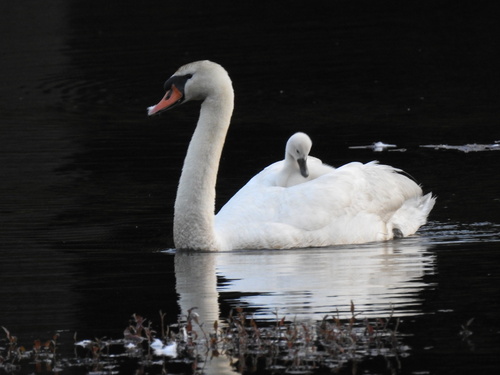 Mute Swan
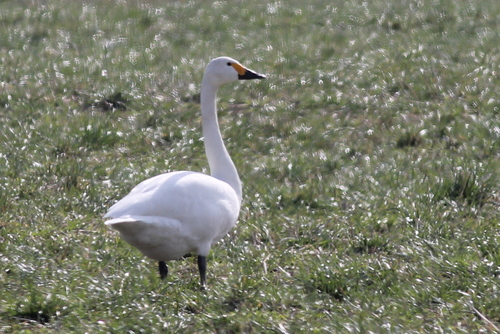 Bewick's Swan
In short
The most reliable way to separate Mute Swan from Bewick's Swan in the field is by bill color and structure: adult Mute Swans have a bright orange bill with a prominent black knob at the base, while Bewick's Swans show a mostly black bill with a variable yellow patch and lack the knob. Mute Swans are also much larger and bulkier, with a longer neck and heavier build, whereas Bewick's Swans look noticeably smaller and shorter-necked, sometimes recalling a large white goose. Juvenile birds of both species are duller and greyer, but the bill color difference is still useful: young Mute Swans have a greyish-black bill, while young Bewick's Swans show a black bill with some yellow. In flight or on water, pay attention to the overall size, neck length, and bill pattern for the most reliable separation.
Identification tips
- Bill color and structure (adults): Mute Swan has a bright orange bill with a prominent black knob at the base; Bewick's Swan has a mostly black bill with a variable yellow patch and no knob. This is the single most reliable field mark for adults.
- Bill color (juveniles): Young Mute Swans have a dull greyish-black bill with no yellow; young Bewick's Swans show a mostly black bill with some yellow at the base, even before full adult plumage.
- Size and bulk: Mute Swan is much larger and heavier than Bewick's Swan. If seen together, the difference is striking. If alone, look for the long, thick neck and massive body of Mute Swan versus the shorter, more goose-like proportions of Bewick's Swan.
- Neck length and posture: Mute Swan has a long, often arched neck, especially when swimming. Bewick's Swan has a shorter neck, usually held straighter and more upright.
- Head and bill shape: Mute Swan's head is smoothly rounded with a heavy bill and prominent knob. Bewick's Swan has a more rounded head but with a smaller, finer bill and no knob.
- Leg color: Mute Swan has dark grey legs; Bewick's Swan has solid black legs. This can help at close range, but is less useful at a distance.
- Plumage (adults): Both are white, but Mute Swan is always pure white as an adult, while Bewick's Swan may show a rusty or golden wash on the head and neck in iron-rich waters.
- Plumage (immatures): Juvenile Mute Swans are grey to buff overall, especially in the first year. Juvenile Bewick's Swans are white with dull grey on the head and neck, but never as uniformly grey as young Mute Swans.
- Behavior: Mute Swan is highly territorial and aggressive, often seen chasing other birds or displaying with arched wings. Bewick's Swan is more social and less aggressive.
- Vocalization: Mute Swan is usually silent or hisses; Bewick's Swan is noisy, with bugling and honking calls, especially in flight.
- Habitat: Mute Swan is common in urban parks, ornamental lakes, and slow rivers. Bewick's Swan prefers open wetlands, estuaries, and flooded fields, especially in winter.
- Flight jizz: In flight, Mute Swan appears heavier and slower, with deep, powerful wingbeats. Bewick's Swan is lighter and more agile, with quicker wingbeats and a less ponderous flight.
- Group structure: Mute Swans are often seen singly or in pairs, especially in breeding season. Bewick's Swans are usually in family groups or larger flocks outside the breeding season.
- Seasonal context: If seen in summer in Western Europe, a large white swan is almost certainly a Mute Swan. Bewick's Swan is a winter visitor and absent in summer from most of its wintering range.
- Pitfalls: Beware of leucistic or unusually pale juvenile Mute Swans, which can appear whiter than normal, but will still lack yellow on the bill and show the heavy structure and knob.
Size
Mute Swan is substantially larger and heavier than Bewick's Swan. Mute Swan averages about 147.5 cm in length and 10,735 g in mass, making it one of the heaviest flying birds. Bewick's Swan is much smaller, averaging 6,781.5 g, and measures 115–140 cm in length. This size difference is apparent in direct comparison or when familiar with both species: Mute Swan is bulkier, with a longer neck and a more imposing presence both on water and in flight. Bewick's Swan is more compact and lighter, with a shorter neck and a less massive body.
Plumage
Both species are entirely white as adults, but age-specific differences are important. Juvenile Mute Swans (cygnets) are grey to buff overall, with a dull greyish-black bill, and do not attain full white plumage until after their first year. Juvenile Bewick's Swans are also white mixed with dull grey, especially on the head and neck, but their bill is mostly black with some yellow even when young. In all ages, Mute Swan lacks any yellow on the bill, while Bewick's Swan always shows at least some yellow at the bill base. No distinctive upperwing pattern or flight mark is described for either species at any age, so separation relies on bill and structure rather than wing pattern. Both species have dark legs, but Mute Swan's are dark grey and Bewick's Swan's are solid black. In some habitats, Bewick's Swan can show a rusty or golden wash on the head and neck due to iron-rich water, which is not seen in Mute Swan.
Behaviour
Mute Swans are notably aggressive, especially when defending nests or young, and may chase or attack other waterfowl or even small boats. They often swim with their necks arched and wings raised in a threat display. Bewick's Swans are less aggressive and more social, often seen in family groups or mixed flocks, and do not show the same territorial behavior. Both species feed in shallow water, but Mute Swans may be seen carrying cygnets on their backs, a behavior not described for Bewick's Swan.
Habitat
Mute Swan is native to Europe and parts of Asia, but is now widespread and often found on lakes, slow rivers, and park ponds, especially in human-altered landscapes. Bewick's Swan breeds in the Arctic and winters in temperate regions of Europe and Asia, favoring large open wetlands, estuaries, and flooded fields during migration and winter. While there is some overlap in wintering areas, Mute Swan is more likely in urban or suburban settings, while Bewick's Swan prefers wilder, more open habitats.
Voice
Mute Swan is mostly silent, as its name suggests, but may hiss or make snorting noises when threatened. Bewick's Swan is much more vocal, with a range of bugling, honking, and trumpeting calls, especially in flight or when in flocks. If you hear loud, musical calls from a flock of swans, you are likely hearing Bewick's, not Mute Swan.