

Mrs. Gould's Sunbird vs Green-tailed Sunbird
Aethopyga gouldiae versus Aethopyga nipalensis
Play a quiz with Mrs. Gould's Sunbird and Green-tailed Sunbird
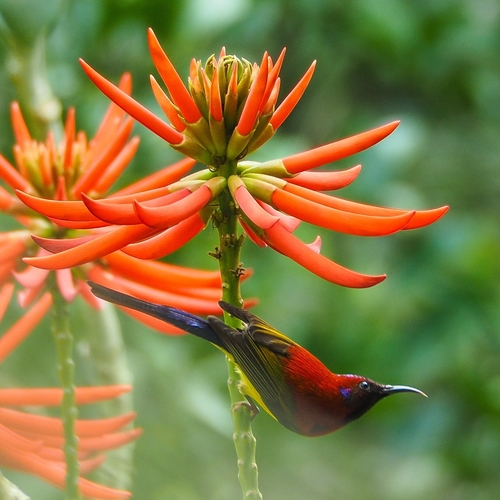 Mrs. Gould's Sunbird
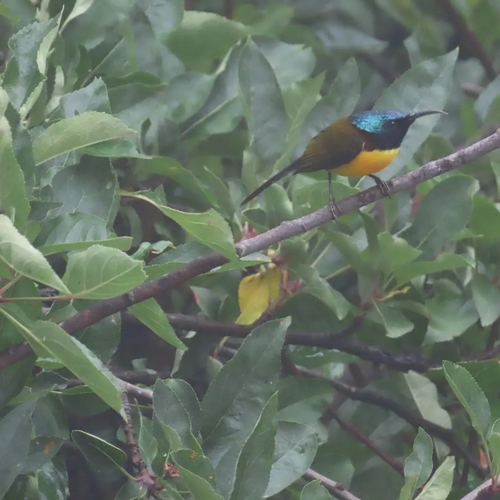 Green-tailed Sunbird
In short
The most reliable way to separate Mrs. Gould's Sunbird from the Green-tailed Sunbird is by focusing on the adult male's head and back coloration: Mrs. Gould's has a striking deep violet crown and throat with a bright red to scarlet mantle, while Green-tailed Sunbird males show a yellow back and green tail, lacking the violet and scarlet combination. Females of both species are duller, but Mrs. Gould's is more uniformly olive-green above and greyish-yellow below, while Green-tailed Sunbird females have a more distinct yellow back and green tail. Size and structure are similar, so plumage—especially in males—is your best field clue. Juvenile and immature plumages are not detailed in the sources, so caution is needed with non-adult birds. Habitat overlap is broad, but Green-tailed Sunbird is more tied to higher montane forests.
Identification tips
- Adult male head and mantle coloration: Mrs. Gould's Sunbird males show a deep violet crown and throat with a bright red to scarlet mantle and nape—this combination is unique and not matched by Green-tailed Sunbird males, which have a yellow back and green tail.
- Back and tail color in males: Green-tailed Sunbird males have a yellow back and green tail, lacking the violet and scarlet of Mrs. Gould's; always check for these colors when viewing from above or behind.
- Female plumage: Female Mrs. Gould's is deep olive-green above and greyish-yellow below, while Green-tailed Sunbird females are more yellow-backed with a green tail—look for the yellow back as a clue for Green-tailed.
- Subspecies variation in Mrs. Gould's: Some Mrs. Gould's subspecies (e.g., A. g. dabryii) have a scarlet breast, while others (A. g. gouldiae) have a yellow breast with or without a red stripe—do not rely solely on breast color, especially in areas of overlap.
- Bill structure: Both species have similarly down-curved, pointed bills typical of sunbirds; bill shape is not a reliable separator.
- Size: Mrs. Gould's Sunbird is slightly larger on average, but overlap is considerable and not useful for field separation.
- Tail pattern: Mrs. Gould's has a bright blue tail covert fading to dark purple at the tip; Green-tailed Sunbird's tail is green—this may help in good light or close views.
- Iris and tarsus color: Mrs. Gould's has a deep brown iris and black tarsus; these are subtle and rarely diagnostic in the field.
- Juvenile/immature birds: No detailed information is available for separating immature or juvenile plumages; caution is advised, and identification may not be possible without adult plumage features.
- Habitat context: If in high-elevation mossy forests (above 1800 m), Green-tailed Sunbird is more likely, but Mrs. Gould's can also occur in similar areas—do not rely solely on habitat.
- Behavior: Both species behave similarly, actively feeding on nectar and insects, often hovering or clinging to flowers; behavior is not a separator.
- Flight views: No distinctive wing or flight pattern differences are described for either species; focus on plumage and structure.
- Seasonal variation: Both species are resident or altitudinal migrants in parts of their range, but seasonal plumage changes are not described; assume adult males are always distinctive if present.
- Voice: No vocal differences are provided in the sources; do not rely on song or call for separation.
- Mixed flocks: Both species may occur together, especially in overlapping ranges—always check multiple field marks and do not rely on a single feature.
Size
Both species are small sunbirds with overlapping measurements, but Mrs. Gould's Sunbird is slightly larger on average. Adult male Mrs. Gould's measures 131–160 mm in length with a wing length of 51–58 mm and tail 64–88 mm, while females are 91–111 mm long with a wing of 45–54 mm and tail 30.5–40 mm. Green-tailed Sunbird's precise measurements are not given, but there is no evidence of a significant size difference in the field. Bill length and structure are similar (both 13–17 mm), so size is not a reliable separator.
Plumage
Adult males are most easily separated: Mrs. Gould's Sunbird has a deep violet forehead, crown, supercilium, and throat, with bright red to scarlet on the face, nape, and mantle, sometimes with blue on the auriculars and sides. Its belly is yellowish-green and the tail covert is bright blue, fading to dark purple at the tip. In contrast, Green-tailed Sunbird males (not described in detail here, but implied by the name and typical field marks) have a yellow back and green tail, lacking the violet and scarlet head and mantle of Mrs. Gould's. Female Mrs. Gould's is deep olive-green above and greyish-yellow below, while Green-tailed Sunbird females are more yellow-backed with a green tail. Subspecies of Mrs. Gould's may show breast color variation (scarlet or yellow with/without a red stripe), so always check the head and mantle for violet and scarlet in males. Juvenile and immature plumages are not described, so separation in those ages is uncertain.
Behaviour
Both species are active nectar feeders with similar feeding behavior, often seen hovering or clinging to flowers. No behavioral differences are noted in the sources that would reliably separate them in the field.
Habitat
Both species occur in forests and shrublands from the southern Himalayas to Southeast Asia, but Green-tailed Sunbird is more closely associated with temperate and montane forests, especially at higher elevations (noted from 1825 to 3350 meters in Szechwan and Yunnan). Mrs. Gould's Sunbird also occupies forests and shrublands but is not as strictly montane. Overlap is extensive, so habitat alone is not diagnostic, but Green-tailed Sunbird may be more expected at higher elevations and in mossy mountain woods.
Mrs. Gould's Sunbird · Green-tailed Sunbird · My Tricky Birds