

Mottled Spinetail vs Common Swift
Telacanthura ussheri versus Apus apus
Play a quiz with Mottled Spinetail and Common Swift
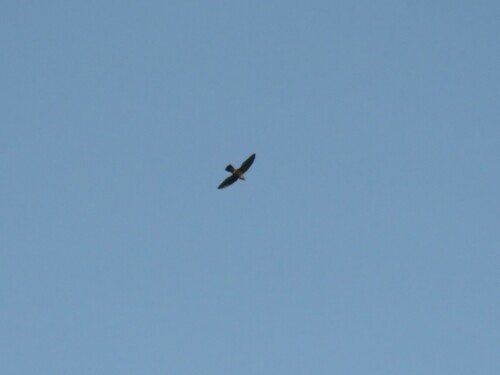 Mottled Spinetail
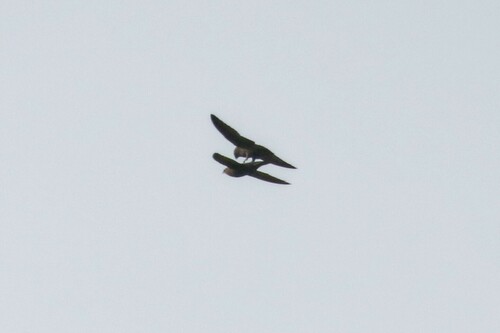 Common Swift
In short
The most reliable field mark between Mottled Spinetail and Common Swift is the presence of a pale mottled pattern on the underparts and rump of the Mottled Spinetail, which is absent in the uniformly dark Common Swift. In flight, Common Swift shows a consistently dark, almost blackish-brown body with only a small, often hidden, pale throat patch, while Mottled Spinetail displays a more contrasting, mottled appearance. Structurally, Mottled Spinetail has a shorter, squarer tail and a chunkier body compared to the long, scythe-winged, and deeply forked tail of Common Swift. These differences are visible in all ages, but are especially helpful when viewing birds in flight with binoculars.
Identification tips
- Underpart pattern: Mottled Spinetail shows a pale, mottled or spotted pattern on the underparts and rump, visible in flight and at rest. Common Swift is uniformly dark except for a small, pale throat patch, which is often hard to see unless very close.
- Rump contrast: Look for a contrasting pale rump on Mottled Spinetail, absent in Common Swift.
- Tail shape: Common Swift has a long, deeply forked tail, often held closed to appear pointed. Mottled Spinetail’s tail is shorter and squarer, sometimes with spiny tips (not always visible at a distance).
- Wing shape: Common Swift’s wings are long, narrow, and strongly curved, giving a crescent or boomerang shape in flight. Mottled Spinetail’s wings are shorter and less curved, contributing to a chunkier, less aerodynamic look.
- Overall jizz: Common Swift appears sleek, streamlined, and fast, with rapid, direct flight. Mottled Spinetail is more compact, with a slightly heavier, fluttery flight style.
- Size impression: Common Swift is larger and longer-winged; Mottled Spinetail is smaller and stockier. This is most apparent when both species are seen together, but can be judged with experience.
- Throat patch: The pale throat of Common Swift is small and usually not visible unless the bird is close and well-lit. Do not rely on this mark alone.
- Vocalization: Screaming flocks are a hallmark of Common Swift. Mottled Spinetail is much quieter; if you hear loud, piercing screams, Common Swift is likely.
- Group size: Large, noisy flocks suggest Common Swift, especially in migration. Mottled Spinetail is more often seen singly or in small groups.
- Habitat context: In open country, towns, or over water in Africa, especially in large numbers, Common Swift is more likely. In wooded or forested areas, especially in the African interior, Mottled Spinetail is more probable.
- Geographical context: If you are in Europe or Asia, only Common Swift is present. In sub-Saharan Africa, both can occur, but Mottled Spinetail is resident and Common Swift is a migrant (mainly September–April).
- Perched views: Rare for both, but if seen, note the tail: Common Swift’s is longer and more deeply forked, while Mottled Spinetail’s is shorter and squarer.
- Flight style: Common Swift is fast and direct, often gliding on stiff wings. Mottled Spinetail has a more fluttery, less direct flight.
- Pitfalls: Do not confuse the pale throat of Common Swift for the more extensive pale mottling of Mottled Spinetail. Lighting and distance can obscure these marks, so use structure and flight style as backup.
- No strong age/sex differences: Both species show similar plumage across ages and sexes for field purposes, so these marks are reliable year-round.
Size
Common Swift is slightly larger, measuring 16–17 cm in length with a wingspan of 38–40 cm [wikipedia]. Mottled Spinetail is generally smaller and more compact, though exact measurements are not provided in the sources. In the field, Common Swift appears longer-winged and more streamlined, while Mottled Spinetail looks chunkier and shorter-tailed.
Plumage
Age-specific wing or upperwing pattern differences are not described in the sources for either species, so focus is on overall plumage. Mottled Spinetail of all ages shows a distinctive mottled or pale-spotted pattern on the underparts and rump, setting it apart from the Common Swift, which is uniformly dark brown to blackish except for a small, pale throat patch that is often hard to see at a distance [wikipedia]. The Common Swift’s plumage is consistent across ages and seasons, lacking any mottling or pale rump. Both species have dark upperwings, but the Mottled Spinetail’s contrasting body and rump are visible in flight, while the Common Swift maintains a uniform dark appearance.
Behaviour
Both species are highly aerial, spending most of their time on the wing. However, Common Swift is renowned for its almost continuous flight, rarely perching except at the nest, and often forms large, noisy flocks, especially during migration [wikipedia]. Mottled Spinetail may be seen in smaller groups and, while also highly aerial, is less likely to be encountered in the large, screaming parties typical of Common Swift. In flight, Common Swift’s long, sickle-shaped wings and fast, direct flight contrast with the more compact, slightly fluttery flight of Mottled Spinetail.
Habitat
Mottled Spinetail is found across a wide swath of sub-Saharan Africa, often in wooded or forested areas, and is more likely to be encountered in the African interior [wikipedia]. Common Swift breeds across Europe and Asia and winters in Africa, often seen over urban areas, open country, and near water during migration [wikipedia]. In Africa, overlap is possible during the Common Swift’s winter stay, but habitat preference may help: Common Swift is more likely over open landscapes and towns, while Mottled Spinetail favors wooded regions.
Voice
Common Swift is very vocal, producing loud, piercing screams, often in flocks, with both sexes calling but females at a higher pitch [wikipedia]. Mottled Spinetail is much quieter and less conspicuous vocally, so a flock of screaming swifts is far more likely to be Common Swift.