

Moseley's Rockhopper Penguin vs Snares Penguin
Eudyptes moseleyi versus Eudyptes robustus
Play a quiz with Moseley's Rockhopper Penguin and Snares Penguin
 Moseley's Rockhopper Penguin
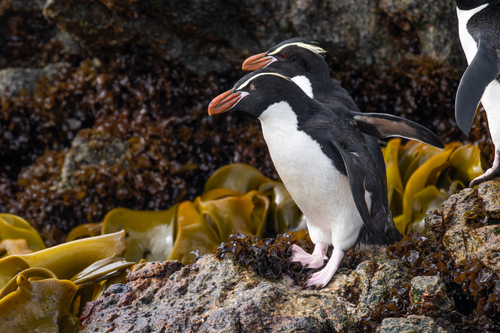 Snares Penguin
In short
The most reliable field mark between Moseley's Rockhopper Penguin and Snares Penguin is the length and prominence of the yellow crest plumes: Moseley's Rockhopper has much longer, more extravagant yellow tassels above the eye, while Snares Penguin's crest is shorter and starts at the bill base. In close views, the fleshy gape margin is larger and more colorful in Moseley's Rockhopper, whereas Snares Penguin shows a distinct patch of pink skin at the bill base. Both are striking black-and-white penguins with yellow crests, but differences in facial skin, crest shape, and subtle size distinctions are key. Juvenile and immature plumages are not described in detail for either species, so focus on adult facial and crest features for separation.
Identification tips
- Crest length and shape: Moseley's Rockhopper Penguin has much longer, bushier yellow crest plumes extending well behind the head; Snares Penguin's yellow crest is shorter and starts at the bill base, ending at the back of the head. This is the most reliable field mark in adults.
- Gape margin: Look for the size and color of the fleshy margin at the base of the bill. Moseley's Rockhopper shows a larger, more colorful gape margin, while Snares Penguin has a distinct patch of pink skin at the bill base.
- Superciliary stripe: The yellow line above the eye is more prominent and extends further in front of the eye in Moseley's Rockhopper; in Snares Penguin, it is less pronounced.
- Bill structure and color: Snares Penguin's bill is thick and reddish-brown with a pink base, while Moseley's Rockhopper's bill is less robust and the pink at the base is less obvious.
- Facial skin: The pink skin patch at the base of the bill is a good mark for Snares Penguin, especially at close range.
- Underwing pattern: Not useful for separating these two species, as Snares Penguin shows individual variation and no diagnostic pattern is described for Moseley's Rockhopper.
- Juvenile/immature plumage: No distinctive age-specific wing or flight patterns are described for either species, so do not rely on these for separation.
- Behavior at colony: Both species display similar upright, wing-flapping behaviors, but Snares Penguin males are noted for chest-pumping displays during courtship. Moseley's Rockhopper uses different head ornament displays, but these are subtle and not easily observed.
- Geographic context: If seen on the Snares Islands, it is Snares Penguin; elsewhere in the southern Atlantic or Indian Oceans, especially on Tristan da Cunha or Gough Island, it is Moseley's Rockhopper.
- Size: Both are medium-sized crested penguins; size is not a reliable separator in the field.
- Voice: Calls are not distinctive enough for field separation without extensive experience.
- Pitfalls: Both species have similar overall coloration (black upperparts, white underparts, yellow crest), so misidentification is easy at a distance or in poor light. Focus on crest length and facial skin details.
- Season: No seasonal plumage differences are described that aid separation; both retain their crests year-round.
- Sex: No sexual dimorphism in plumage or structure is described for either species; both sexes look alike.
- Colony density: Both breed in dense colonies, so social context is not helpful for separation.
Size
Direct size comparison is limited by available data. Snares Penguin has a documented average body mass of about 323.5 g [wikidata], but this is likely an error or an outlier, as typical adult Snares Penguins weigh between 2.5–4 kg and measure 50–70 cm in length [wikipedia]. Moseley's Rockhopper Penguin is described as larger than other rockhopper forms, but no precise mass or length is given. In the field, size difference is subtle and not a reliable separator; both are medium-sized crested penguins and overlap considerably in apparent bulk and height.
Plumage
No detailed information is available on juvenile or immature wing patterns for either species, so separation relies on adult plumage. Moseley's Rockhopper Penguin shows very long, bushy yellow crest plumes that extend well past the back of the head, and a broad, pale fleshy margin at the gape. The superciliary stripe (the yellow line above the eye) is also larger and more prominent in front of the eye. Snares Penguin has a bright yellow crest that starts at the base of the bill and runs above the eye but is shorter and less extravagant, ending at the back of the head. The Snares Penguin's bill base is marked by a patch of pink skin, which is not as pronounced in Moseley's Rockhopper. Both species have black upperparts and white underparts, but the pattern under the wings is variable in Snares Penguin and not useful for identification. In summary, focus on the length and shape of the yellow crest, the color and size of the gape margin, and the presence of pink skin at the bill base.
Behaviour
Both species breed in dense colonies and show similar crested penguin behaviors: upright posture, wing-flapping displays, and elaborate courtship rituals involving head movements and vocalizations. Snares Penguin males display by standing erect with wings spread and pumping their chest, while Moseley's Rockhopper uses different songs and head ornament displays during courtship. These behavioral differences are subtle and not easily observed unless witnessing breeding displays up close. Foraging and chick-feeding strategies are broadly similar, with both species shifting diet seasonally.
Habitat
Moseley's Rockhopper Penguin breeds on islands in the southern Atlantic and Indian Oceans, often on cliffs or inland slopes. Snares Penguin is restricted to the Snares Islands off southern New Zealand, breeding in dense colonies on forested or rocky terrain. In the field, the location is often the best clue: Snares Penguin is only found on the Snares Islands, while Moseley's Rockhopper is absent from New Zealand waters. Overlap is virtually impossible in the wild, so context and geography are strong separators.
Voice
Both species are noisy, especially at colonies, but their calls are not described in detail for field separation. Snares Penguin produces a wide range of sounds, from hisses and explosive cries to braying and trumpeting, but these are difficult to distinguish from other crested penguins without experience. Moseley's Rockhopper uses different songs in its mating displays, but no specifics are given. Vocalizations are not a reliable field mark for separating these two species.
Moseley's Rockhopper Penguin · Snares Penguin · My Tricky Birds