

Motmot

Montagu's Harrier vs Red Kite

Circus pygargus versus Milvus milvus

Play a quiz with Montagu's Harrier and Red Kite
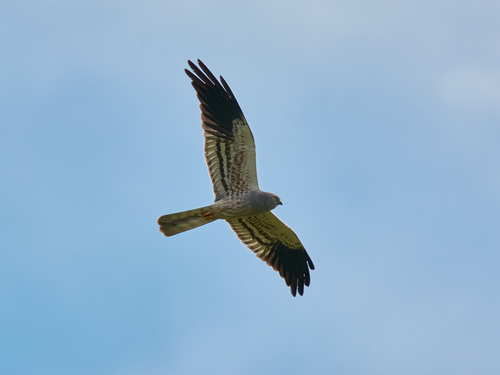
Montagu's Harrier (Circus pygargus) Montagu's Harrier
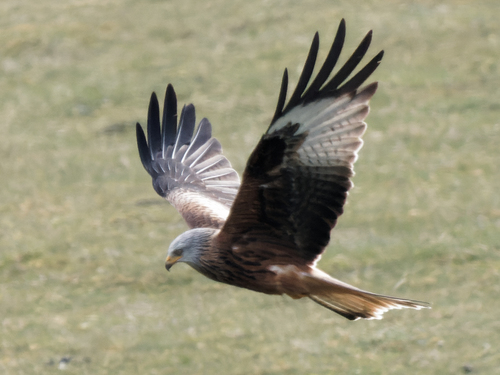
Red Kite (Milvus milvus) Red Kite

Media

Loading…

In short

The most reliable field mark to separate Montagu's Harrier from Red Kite is the tail: Montagu's Harrier (all ages) has a long, straight-edged tail, while Red Kite shows a deeply forked tail, especially obvious in adults. Juvenile Red Kites have a less forked tail, but still more notched than the harrier. In flight, Montagu's Harrier is notably slimmer, with long, narrow, pointed wings, and a buoyant, elastic flight style, compared to the broader, fingered wings and languid soaring of the Red Kite. Plumage differences are also strong: Red Kite adults and juveniles are rufous with pale head and contrasting white patches in the primaries, while Montagu's Harrier females and juveniles are brownish above and paler below, lacking rufous tones and white wing panels. Size is a major clue: Red Kite is much larger and heavier than Montagu's Harrier.

Identification tips

  1. Tail shape is the most reliable mark: Red Kite (all ages) has a long, deeply forked tail (less forked in juveniles, but still not square), while Montagu's Harrier has a long, straight-edged tail with only a slight notch. This is obvious in flight and when perched.
  2. Wing shape and flight style: Montagu's Harrier has long, narrow, pointed wings and a very slim, buoyant appearance in flight, with elastic, tern-like wingbeats. Red Kite's wings are broad, with long 'fingers' (primary tips), and it soars with languid, steady glides, often twisting its tail.
  3. Upperwing pattern in juveniles: Juvenile Red Kite shows a pale line across the greater coverts on both upper- and underwing, and a dark subterminal band on a notched tail. Juvenile Montagu's Harrier lacks these pale lines and has uniformly red-brown underwing coverts.
  4. Adult plumage: Adult Red Kite is rufous overall, with a pale head, black breast streaks, white primary panels, and a deeply forked tail. Adult Montagu's Harrier male is pale grey with black wingtips and black secondary bands; female is brown above, pale yellow-brown below with streaks and spots, and both have a white rump.
  5. Juvenile plumage: Juvenile Montagu's Harrier is uniformly red-brown below, lacking spots or rufous tones, and has no pale wing lines or white primary panels. Juvenile Red Kite is paler, with a buff breast and belly, and always shows some rufous and a pale head.
  6. Rufous tones: Only Red Kite (all ages) is rufous above and below; Montagu's Harrier is never rufous, being grey or brown above and pale below.
  7. White wing panels: Red Kite (especially adult) shows obvious white patches in the primaries, contrasting with black wingtips and dark secondaries. Montagu's Harrier never shows this pattern.
  8. White rump: Montagu's Harrier (all ages) has a white upper tail coverts ('rump'), visible in flight. Red Kite lacks a white rump.
  9. Head color: Red Kite (all ages) has a pale, often silvery head, especially in adults. Montagu's Harrier has a brown or grey head, never pale or silvery.
  10. Size: Red Kite is much larger and heavier than Montagu's Harrier. If seen together or with other raptors, Red Kite will appear bulkier and longer-winged.
  11. Perched jizz: Perched Red Kite is large, long-tailed, and often sits hunched. Montagu's Harrier is slimmer, upright, and more delicate.
  12. Flight behavior: Montagu's Harrier hunts low over fields with buoyant, elastic wingbeats; Red Kite soars high, rarely quarters low over fields like a harrier.
  13. Habitat: Montagu's Harrier is strictly a bird of open country; Red Kite prefers mixed farmland and woodland, often near villages.
  14. Melanistic forms: Melanistic Montagu's Harrier is very dark, but still lacks the rufous and white pattern of Red Kite. Red Kite rarely shows leucism (white birds), but these are extremely rare.
  15. Voice: Red Kite gives a thin piping call, but vocalizations are rarely helpful for separation in the field.

Size

Red Kite is substantially larger and heavier than Montagu's Harrier. Red Kite measures 60–70 cm in length with a 175–195 cm wingspan and weighs 800–1300 g (average 1122 g), while Montagu's Harrier is 43–47 cm long with a 97–115 cm wingspan and weighs 265–345 g (average 315.5 g). The Red Kite's tail alone is nearly as long as the harrier's entire body. In the field, this size difference is striking: Red Kite appears much bulkier and longer-winged, while Montagu's Harrier is slim and delicate.

Plumage

Juvenile and immature Red Kites can be separated from Montagu's Harrier by their overall rufous coloration, pale head, and a long, narrow pale line formed by pale tips to all greater coverts on both upper- and underwing. Juvenile Red Kites also show a less deeply forked tail with a dark subterminal band and pale breast and belly, but still appear warmer and more patterned than juvenile Montagu's Harrier, which is uniformly red-brown below and lacks spots or rufous tones. Adult Red Kites are even more rufous, with black breast streaks, white primary panels, and a deeply forked tail. Adult Montagu's Harrier males are pale grey with black wingtips and black secondary bands, while females are brown above, pale yellow-brown below with streaks and spots, and both sexes show a white rump. Montagu's Harrier never shows the rufous tones or white primary panels of Red Kite. The pale collar of female/juvenile Pallid Harrier (not Red Kite) is absent in Montagu's. Melanistic Montagu's Harriers are very dark, but still lack the rufous and white pattern of Red Kite.

Behaviour

Montagu's Harrier hunts with low, buoyant, elastic wingbeats over open country, often holding its wings in a marked dihedral and gliding with a tern-like elegance. Red Kite soars on long, angled wings, often twisting its deeply forked tail to steer, and is more likely to be seen circling high or gliding with minimal wingbeats. Perched, Red Kite appears large and long-tailed, while Montagu's Harrier is more slender and upright. Montagu's Harrier is a long-distance migrant, while Red Kite is mostly resident or only locally migratory.

Habitat

Montagu's Harrier breeds in large open areas such as grasslands and agricultural fields across the Palearctic, and winters in Africa and parts of Asia. Red Kite is restricted to Europe, favoring open woodland, farmland, and mixed countryside, often near human habitation. While both can be seen over open country, Red Kite is more likely in wooded or mixed landscapes, and Montagu's Harrier is strictly a bird of open, treeless habitats.

Voice

Red Kite gives a thin piping call, less mewling than a buzzard, but vocalizations are not a reliable field separation from Montagu's Harrier, which is generally silent or gives only weak calls.

Submit a better description

Use the same sections as the comparison. Your text is published immediately.

The most reliable field mark to separate Montagu's Harrier from Red Kite is the tail: Montagu's Harrier (all ages) has a long, straight-edged tail, while Red Kite shows a deeply forked tail, especially obvious in adults. Juvenile Red Kites have a less forked tail, but still more notched than the harrier. In flight, Montagu's Harrier is notably slimmer, with long, narrow, pointed wings, and a buoyant, elastic flight style, compared to the broader, fingered wings and languid soaring of the Red Kite. Plumage differences are also strong: Red Kite adults and juveniles are rufous with pale head and contrasting white patches in the primaries, while Montagu's Harrier females and juveniles are brownish above and paler below, lacking rufous tones and white wing panels. Size is a major clue: Red Kite is much larger and heavier than Montagu's Harrier.

  1. Tail shape is the most reliable mark: Red Kite (all ages) has a long, deeply forked tail (less forked in juveniles, but still not square), while Montagu's Harrier has a long, straight-edged tail with only a slight notch. This is obvious in flight and when perched.
  2. Wing shape and flight style: Montagu's Harrier has long, narrow, pointed wings and a very slim, buoyant appearance in flight, with elastic, tern-like wingbeats. Red Kite's wings are broad, with long 'fingers' (primary tips), and it soars with languid, steady glides, often twisting its tail.
  3. Upperwing pattern in juveniles: Juvenile Red Kite shows a pale line across the greater coverts on both upper- and underwing, and a dark subterminal band on a notched tail. Juvenile Montagu's Harrier lacks these pale lines and has uniformly red-brown underwing coverts.
  4. Adult plumage: Adult Red Kite is rufous overall, with a pale head, black breast streaks, white primary panels, and a deeply forked tail. Adult Montagu's Harrier male is pale grey with black wingtips and black secondary bands; female is brown above, pale yellow-brown below with streaks and spots, and both have a white rump.
  5. Juvenile plumage: Juvenile Montagu's Harrier is uniformly red-brown below, lacking spots or rufous tones, and has no pale wing lines or white primary panels. Juvenile Red Kite is paler, with a buff breast and belly, and always shows some rufous and a pale head.
  6. Rufous tones: Only Red Kite (all ages) is rufous above and below; Montagu's Harrier is never rufous, being grey or brown above and pale below.
  7. White wing panels: Red Kite (especially adult) shows obvious white patches in the primaries, contrasting with black wingtips and dark secondaries. Montagu's Harrier never shows this pattern.
  8. White rump: Montagu's Harrier (all ages) has a white upper tail coverts ('rump'), visible in flight. Red Kite lacks a white rump.
  9. Head color: Red Kite (all ages) has a pale, often silvery head, especially in adults. Montagu's Harrier has a brown or grey head, never pale or silvery.
  10. Size: Red Kite is much larger and heavier than Montagu's Harrier. If seen together or with other raptors, Red Kite will appear bulkier and longer-winged.
  11. Perched jizz: Perched Red Kite is large, long-tailed, and often sits hunched. Montagu's Harrier is slimmer, upright, and more delicate.
  12. Flight behavior: Montagu's Harrier hunts low over fields with buoyant, elastic wingbeats; Red Kite soars high, rarely quarters low over fields like a harrier.
  13. Habitat: Montagu's Harrier is strictly a bird of open country; Red Kite prefers mixed farmland and woodland, often near villages.
  14. Melanistic forms: Melanistic Montagu's Harrier is very dark, but still lacks the rufous and white pattern of Red Kite. Red Kite rarely shows leucism (white birds), but these are extremely rare.
  15. Voice: Red Kite gives a thin piping call, but vocalizations are rarely helpful for separation in the field.

Red Kite is substantially larger and heavier than Montagu's Harrier. Red Kite measures 60–70 cm in length with a 175–195 cm wingspan and weighs 800–1300 g (average 1122 g), while Montagu's Harrier is 43–47 cm long with a 97–115 cm wingspan and weighs 265–345 g (average 315.5 g). The Red Kite's tail alone is nearly as long as the harrier's entire body. In the field, this size difference is striking: Red Kite appears much bulkier and longer-winged, while Montagu's Harrier is slim and delicate.

Juvenile and immature Red Kites can be separated from Montagu's Harrier by their overall rufous coloration, pale head, and a long, narrow pale line formed by pale tips to all greater coverts on both upper- and underwing. Juvenile Red Kites also show a less deeply forked tail with a dark subterminal band and pale breast and belly, but still appear warmer and more patterned than juvenile Montagu's Harrier, which is uniformly red-brown below and lacks spots or rufous tones. Adult Red Kites are even more rufous, with black breast streaks, white primary panels, and a deeply forked tail. Adult Montagu's Harrier males are pale grey with black wingtips and black secondary bands, while females are brown above, pale yellow-brown below with streaks and spots, and both sexes show a white rump. Montagu's Harrier never shows the rufous tones or white primary panels of Red Kite. The pale collar of female/juvenile Pallid Harrier (not Red Kite) is absent in Montagu's. Melanistic Montagu's Harriers are very dark, but still lack the rufous and white pattern of Red Kite.

Montagu's Harrier hunts with low, buoyant, elastic wingbeats over open country, often holding its wings in a marked dihedral and gliding with a tern-like elegance. Red Kite soars on long, angled wings, often twisting its deeply forked tail to steer, and is more likely to be seen circling high or gliding with minimal wingbeats. Perched, Red Kite appears large and long-tailed, while Montagu's Harrier is more slender and upright. Montagu's Harrier is a long-distance migrant, while Red Kite is mostly resident or only locally migratory.

Montagu's Harrier breeds in large open areas such as grasslands and agricultural fields across the Palearctic, and winters in Africa and parts of Asia. Red Kite is restricted to Europe, favoring open woodland, farmland, and mixed countryside, often near human habitation. While both can be seen over open country, Red Kite is more likely in wooded or mixed landscapes, and Montagu's Harrier is strictly a bird of open, treeless habitats.

Red Kite gives a thin piping call, less mewling than a buzzard, but vocalizations are not a reliable field separation from Montagu's Harrier, which is generally silent or gives only weak calls.

Discard your changes?

You have unsaved edits. If you leave now, those changes will be lost.

Montagu's Harrier · Red Kite · My Tricky Birds