

Moltoni's Warbler vs Western Subalpine Warbler
Curruca subalpina versus Curruca iberiae
Play a quiz with Moltoni's Warbler and Western Subalpine Warbler
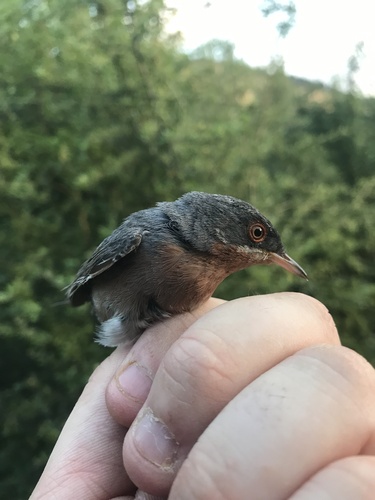 Moltoni's Warbler
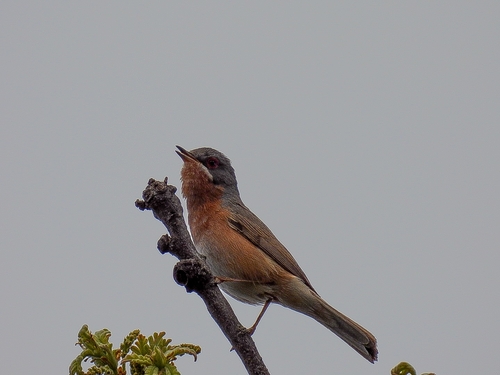 Western Subalpine Warbler
In short
The most reliable field mark to separate Moltoni's Warbler from Western Subalpine Warbler is the color of the adult male's underparts: Moltoni's shows a salmon-pink wash, while Western Subalpine Warbler males have distinctly orange or brick-red underparts. Females and juveniles of both species are extremely similar and nearly indistinguishable by plumage alone, making identification in these ages challenging without vocal cues. Vocalizations are a key separator: Moltoni's has a faster, higher-pitched, insect-like song compared to the Western's fast, rattling, but lower-pitched song. Range can also help, as Moltoni's is restricted to Italy and nearby islands, while Western Subalpine Warbler occurs in southernmost mainland Europe and northwest Africa. Structural differences are not documented as diagnostic between these two.
Identification tips
- Adult male underparts color: In spring and summer, check the color of the underparts. Salmon-pink (Moltoni's) vs. orange/brick-red (Western Subalpine). This is the single most reliable visual mark for adult males.
- White malar streaks ('moustaches'): Both species' adult males show this feature, so it is not diagnostic for separation.
- Back and head color: Both have grey backs and heads in adult males; do not use this for separation.
- Females and juveniles: These are nearly identical in both species—brownish above, greyer head, whitish below with possible pink flush. Do not rely on plumage for separation in these ages.
- Upperwing/flight pattern: No known differences in wing pattern or flight marks for any age; do not use this feature.
- Song: If you hear a fast, high-pitched, insect-like song with a dry 'trill zerr', suspect Moltoni's. If the song is fast, rattling, and more reminiscent of Lesser Whitethroat, suspect Western Subalpine. This is especially important for females and juveniles.
- Call notes: The dry 'trill zerr' is included in Moltoni's song, but both species may give similar dry calls; use with caution.
- Range: If you are in Italy or the Tyrrhenian islands, Moltoni's is likely. In southernmost mainland Europe or northwest Africa, Western Subalpine is expected. Always consider vagrancy and overlap.
- Habitat: Both species use similar Mediterranean scrub and bushy habitats; habitat alone is not diagnostic.
- Season: During migration, both species may occur outside their core breeding ranges, increasing the risk of confusion, especially among immatures.
- Structural features: No documented differences in bill shape, tail length, or primary projection; do not use structure for separation.
- Mixed flocks: If you encounter a group of 'subalpine warblers' outside the core range of either species, rely on song or adult male underparts color for identification.
- Moult and wear: No information suggests differences in moult timing or worn plumage that would aid separation.
- Pitfalls: Do not attempt to separate females or juveniles by plumage alone; misidentification is likely without song or range context.
- Photographs: For photo ID, ensure underpart color is not distorted by lighting—salmon-pink can appear orange in strong light, and vice versa.
Size
Both species are small warblers of the genus Curruca, and the available sources do not indicate any meaningful difference in size or mass between Moltoni's and Western Subalpine Warbler. In the field, their proportions and overall size are essentially identical and not useful for separation.
Plumage
- Adult males: The key difference is underpart color. Moltoni's Warbler males have salmon-pink underparts, while Western Subalpine Warbler males show orange to brick-red underparts. Both have grey backs and heads, and white malar streaks ('moustaches').
- Females and juveniles: Both are brownish above with a greyer head and whitish below, sometimes with a pink flush. No reliable plumage differences are described for these ages; they are essentially indistinguishable in the field by plumage alone.
- Upperwing/flight pattern: No distinctive juvenile or immature wing pattern differences are documented between these two species; both lack unique upperwing marks that would allow separation in flight at younger ages.
Behaviour
No behavioral differences are documented that would reliably separate these two species in the field. Both are typical small warblers, moving actively through low shrubs and bushes, and do not show any known differences in flight style, tail movement, or feeding behavior.
Habitat
Moltoni's Warbler is restricted to Italy and the islands of the Tyrrhenian Sea, while Western Subalpine Warbler is found in southernmost mainland Europe and northwest Africa. Both species occupy similar habitats: scrub, low bushes, and Mediterranean-type vegetation. In overlapping regions, habitat is not a reliable separator, but range is often helpful.
Voice
Vocalizations are a primary field separator. Moltoni's Warbler has a song that is faster-paced and higher-pitched than Western Subalpine Warbler, described as a rapid succession of insect-like notes, often including a dry 'trill zerr' call. Western Subalpine Warbler's song is fast and rattling, but lower-pitched and more similar to Lesser Whitethroat. Calls and songs are best used to separate females and juveniles, which are otherwise nearly identical in appearance.
Moltoni's Warbler · Western Subalpine Warbler · My Tricky Birds