

Mistle Thrush vs Ring Ouzel
Turdus viscivorus versus Turdus torquatus
Play a quiz with Mistle Thrush and Ring Ouzel
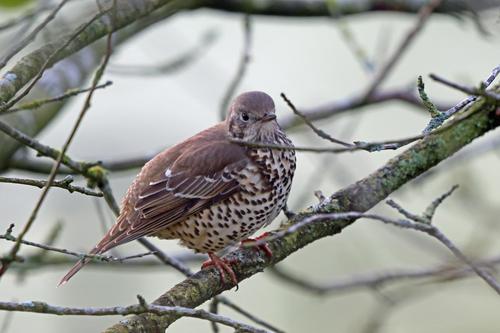 Mistle Thrush
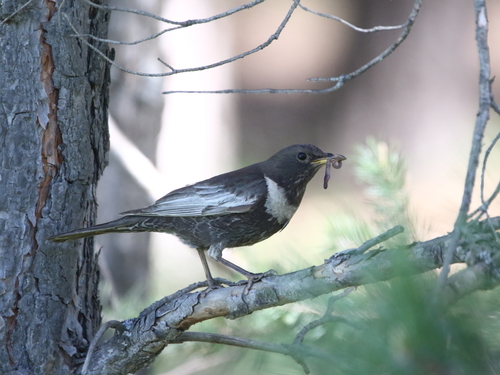 Ring Ouzel
In short
The most reliable field mark to separate Mistle Thrush from Ring Ouzel is the presence of a bold white crescent across the breast in adult Ring Ouzels, which is never shown by Mistle Thrush. Juvenile and female Ring Ouzels may have a faint or absent crescent, but they are still much darker overall than Mistle Thrush and often show a pale wing panel. Mistle Thrush is much larger, paler, and browner, with round, irregular black spots on a buff or off-white belly and a longer tail. In flight or at a distance, size, posture, and the lack of any white breast band are key for Mistle Thrush, while the ouzel’s dark, almost black plumage and white crescent (if visible) are diagnostic. Both species are Turdus thrushes, but confusion is most likely with female or juvenile Ring Ouzels, especially in poor light or at range.
Identification tips
- White breast crescent: Adult Ring Ouzel (especially males) always shows a bold white crescent across the breast; Mistle Thrush never does. In females and juveniles, the crescent may be faint or absent, but some pale marking is usually visible in first-winter males.
- Overall darkness: Ring Ouzel is much darker overall, appearing blackish (male) or dark brown (female/juvenile), while Mistle Thrush is pale grey-brown above and buff or off-white below.
- Spotting vs. scaling: Mistle Thrush has round, irregular black spots on the underparts; Ring Ouzel has fine greyish scaling on the belly and upperparts, but not the bold, round spots of Mistle Thrush.
- Wing panel: Ring Ouzel (especially males and some first-winters) shows a pale wing panel formed by pale edges to wing feathers, visible at rest and in flight; Mistle Thrush lacks this feature.
- Tail pattern: Mistle Thrush has a long tail with white tips to the outer feathers, visible in flight or when fanned; Ring Ouzel does not show this.
- Underwing color: Mistle Thrush has white underwing coverts, which can be striking in flight; Ring Ouzel's underwing is not as pale or contrasting.
- Size and structure: Mistle Thrush is much larger, bulkier, and longer-tailed, with a more upright stance; Ring Ouzel is slimmer, shorter-tailed, and closer in size to a Blackbird.
- Juvenile confusion: Juvenile Ring Ouzel lacks the white crescent and can be confused with Mistle Thrush, but is always much darker and shows a pale wing panel. Juvenile Mistle Thrush is paler, with creamy teardrop marks above and smaller, round spots below.
- Bill color: Ring Ouzel has a yellow bill (especially in males), while Mistle Thrush has a blackish bill with a yellowish base to the lower mandible.
- Leg color: Mistle Thrush has yellowish-brown legs and feet; Ring Ouzel's legs are greyish brown.
- Habitat: Mistle Thrush is usually in open woodland, parks, or fields; Ring Ouzel prefers upland, rocky, or mountainous habitats, especially in the breeding season.
- Behavior: Mistle Thrush is bolder, often seen in open, upright, and sometimes in flocks; Ring Ouzel is shyer, more solitary, and quick to flush.
- Flight style: Mistle Thrush has an undulating, bounding flight with glides; Ring Ouzel is more direct and swift.
- Sex differences: Both male and female Mistle Thrush look similar; in Ring Ouzel, males are blacker with a bolder crescent, females browner with a duller crescent.
- Seasonal context: Ring Ouzel is mainly seen on migration or in upland breeding areas; Mistle Thrush is present year-round in much of its range, often in lower, more open habitats.
Size
Mistle Thrush is noticeably larger and bulkier than Ring Ouzel. Mistle Thrush measures 27–28 cm in length with a 45 cm wingspan and averages around 130 g, while Ring Ouzel is 23–24 cm long and weighs 90–138 g. In the field, Mistle Thrush appears longer-tailed, stockier, and stands more upright, while Ring Ouzel is slimmer and closer in size to a Blackbird. If seen together, the size difference is striking, but beware of lone birds where size can be hard to judge.
Plumage
Juvenile and first-winter birds: Ring Ouzel juveniles resemble dull female ouzels, with brownish plumage and a faint or missing breast crescent, but they still show a paler wing panel and are much darker overall than Mistle Thrush. Mistle Thrush juveniles are paler brown above with creamy teardrop centers to feathers and smaller, round black spots on yellowish underparts. By first winter, Mistle Thrush is almost adult-like but retains a buffier tone below.
Adults: Adult Ring Ouzel males are almost black with a striking white breast crescent, pale edges to wing feathers (sometimes forming a pale panel), and narrow greyish scaling on the upperparts and belly. Females are browner, with a duller crescent, but still much darker than Mistle Thrush. Mistle Thrush adults are pale grey-brown above, with a yellowish-buff breast, off-white belly, and round, irregular black spots (never heart-shaped or in neat rows). The tail is long with white tips to outer feathers, and the underwing coverts are white. Both sexes are similar in Mistle Thrush.
In flight: Mistle Thrush shows a pale, almost white underwing and long tail; Ring Ouzel may show a pale wing panel, especially in males, and always looks much darker overall.
Behaviour
Mistle Thrush is more terrestrial, often seen upright and alert on open ground, sometimes in flocks in late summer or autumn. It hops with head up and flicks wings and tail when excited. Ring Ouzel is shyer, often found singly or in small groups, and prefers upland or rocky habitats. It is less likely to be seen in open fields and is more wary, flying off quickly when disturbed. In flight, Mistle Thrush has an undulating, bounding flight with glides, while Ring Ouzel is more direct and swift.
Habitat
Mistle Thrush is widespread across Europe, temperate Asia, and North Africa, commonly found in open woodlands, parks, and sometimes gardens, especially outside the breeding season. It is a year-round resident in much of its range, though northern populations migrate. Ring Ouzel is mainly European and favors upland, rocky, or mountainous areas, especially during breeding. It is a migrant, often seen in passage in lowland areas but breeds in more remote, higher ground. Overlap is possible on migration, but habitat preference is usually a strong clue.