

Mississippi Kite vs Northern Harrier
Ictinia mississippiensis versus Circus hudsonius
Play a quiz with Mississippi Kite and Northern Harrier
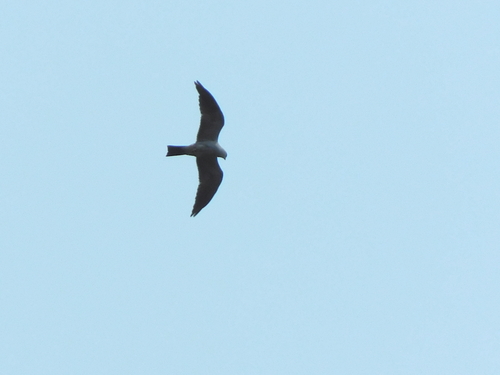 Mississippi Kite
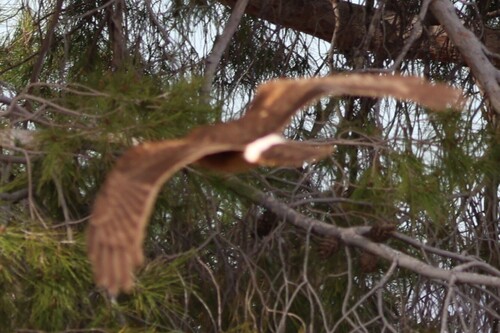 Northern Harrier
In short
The most reliable field mark between Mississippi Kite and Northern Harrier is the combination of structure and flight style: Mississippi Kite is compact and buoyant with narrow, pointed wings and a short, squared-off tail, while Northern Harrier is lankier with long, broad wings held in a shallow V and a long, rounded tail. Juvenile and female harriers show a distinct white rump patch in all plumages, which Mississippi Kite never shows. Adult Mississippi Kites are smooth gray with pale heads, while harriers are more patterned and variable by age and sex. Both species can be seen gliding over open country, but their shape, flight style, and key plumage marks are the best field clues.
Identification tips
- White rump patch (Harrier only): All ages and sexes of Northern Harrier show a bold white rump at the base of the tail, visible in flight and often when perched. Mississippi Kite never shows this mark.
- Wing and tail shape: Mississippi Kite has narrow, pointed wings and a short, squared-off tail, giving a compact, falcon-like look. Northern Harrier has long, broad wings (not pointed) and a long, rounded tail, making it look lanky and elongated.
- Flight style: Kites soar and float high, often in groups, with steady, buoyant wingbeats and little tilting. Harriers fly low over fields in a distinctive, tilting, searching manner with wings held in a shallow V.
- Plumage (adult): Adult Mississippi Kites are smooth gray with a pale head and underparts, and red eyes. Adult male harriers are pale gray above and below with black wingtips and a white rump. Adult female harriers are brown above, streaked below, and also show the white rump.
- Plumage (immature): Immature kites are brownish but still lack strong patterning and the white rump. Juvenile harriers are rich brown above, buffy or rufous below, and always have the white rump.
- Facial disc (Harrier only): Northern Harrier has an owl-like facial disc, giving the face a flat, round look, especially at close range. Kites have a smooth, falcon-like face.
- Perched posture: Kites perch upright on exposed branches or wires, looking compact. Harriers perch low on the ground or on posts, appearing long-winged and long-tailed.
- Group behavior: Kites often soar in loose groups, especially during migration. Harriers are usually solitary or in loose association with other raptors.
- Habitat: Kites are more likely in open woodlands, shelterbelts, or urban edges, especially in the southern/central U.S. Harriers are tied to open fields, marshes, and grasslands.
- Bill and head: Kites have a small, hooked bill and a relatively small head. Harriers have a more pronounced facial disc and a proportionally larger head.
- Eye color: Adult Mississippi Kites have striking red eyes. Harrier eye color is less distinctive in the field.
- Seasonal context: If seen in summer in the southern U.S., Mississippi Kite is more likely; in northern U.S. or Canada, especially over open marsh, Northern Harrier is expected.
- Vocalizations: Only useful if you hear sharp 'kek' calls (harrier); otherwise, both are generally silent.
- Sexual dimorphism (Harrier): Male and female harriers differ strongly in plumage; kites are similar between sexes.
- Pitfall: Immature kites may appear brownish but never show the white rump or the harrier's long, tilting flight.
Size
Mississippi Kite is smaller and more compact, with a typical body mass around 278 g [wikidata], a length of 30–37 cm, and a wingspan of about 90 cm [wikipedia]. Northern Harrier is noticeably larger and longer-winged, with males averaging 350 g and females up to 530 g, a length of 41–52 cm, and a wingspan of 97–122 cm [wikipedia]. Harrier's long tail and wings make it look rangier and more elongated in flight or perched.
Plumage
Juvenile and female Northern Harriers are brown above with a strongly contrasting white rump patch visible in all ages and sexes, especially in flight. Adult males are pale gray above and below with black wingtips and also show the white rump. Mississippi Kite adults are smooth grayish-blue with a paler, almost silvery head and underparts, and lack any white rump. Their wings are uniformly gray with no strong pattern, and the tail is dark and squared. Immature kites are browner but still lack the harrier's white rump and are more uniform below. In all ages, harriers are more patterned and variable, while kites are sleek and plain.
Behaviour
Mississippi Kite is graceful and buoyant, often floating or circling high with minimal wingbeats, sometimes in groups. They have narrow, pointed wings and a short, squared tail, giving a swift-like silhouette. Northern Harrier hunts low over fields and marshes with wings held in a shallow V, gliding and tilting with a buoyant but more erratic, searching flight. Harriers often quarter low over the ground, sometimes hovering briefly, and rarely soar high in groups like kites.
Habitat
Mississippi Kite prefers open woodlands, shelterbelts, and edges near grasslands, often seen over towns and parks in the southern and central U.S. Northern Harrier is a bird of open country—marshes, grasslands, and prairies—rarely perching in trees and more often seen flying low over fields. Overlap can occur in migration, but harriers are more strictly tied to open, wet, or grassy habitats.
Voice
Northern Harrier is mostly silent but may give sharp 'kek' notes, especially during breeding or when alarmed. Mississippi Kite is generally quiet and not known for distinctive calls in the field. Voice is rarely a useful separator unless harrier is vocalizing.