

Middle Spotted Woodpecker vs White-backed Woodpecker
Dendrocoptes medius versus Dendrocopos leucotos
Play a quiz with Middle Spotted Woodpecker and White-backed Woodpecker
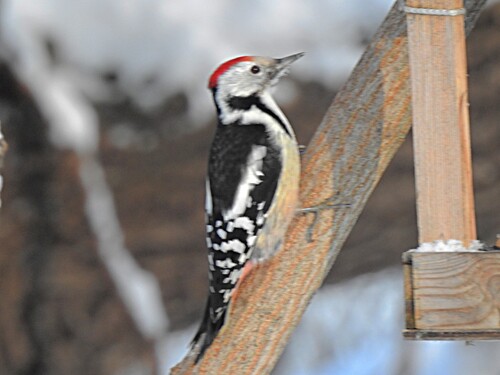 Middle Spotted Woodpecker
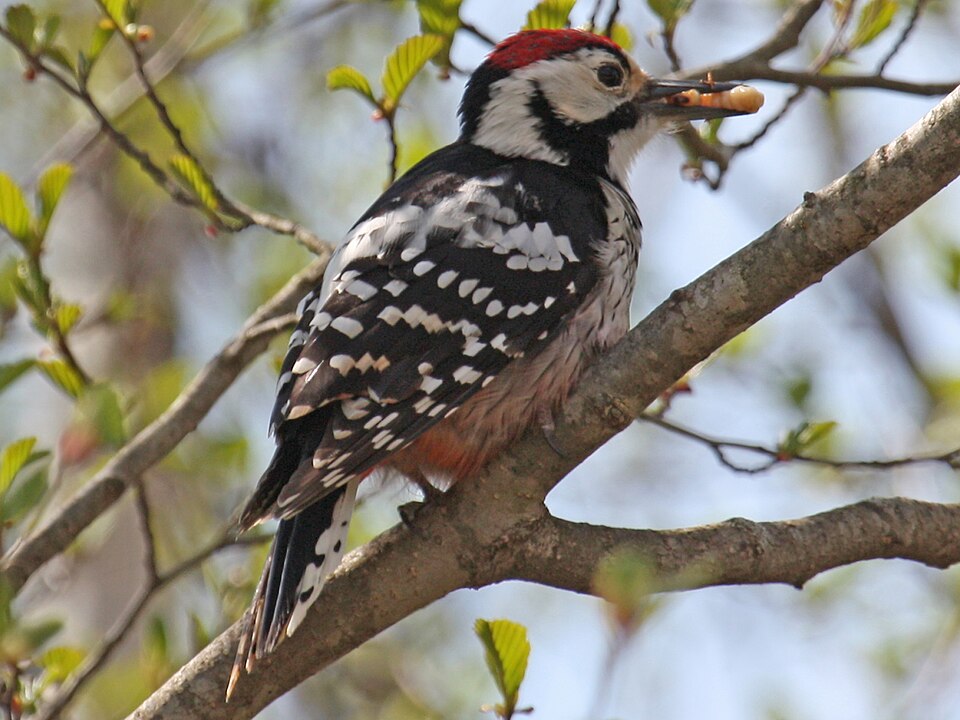 White-backed Woodpecker
In short
The most reliable field mark to separate Middle Spotted Woodpecker from White-backed Woodpecker is the presence of a solid red crown on adult Middle Spotted (both sexes), versus a red crown only on male White-backed (females have a black crown), and the absence of a black moustachial stripe in Middle Spotted. In flight or perched, White-backed Woodpecker shows a strikingly white lower back and broad white bars (not spots) across the wings, while Middle Spotted has oval white wing patches and less extensive white on the back. Bill size and head shape also differ: Middle Spotted appears smaller-headed with a short, slender bill, while White-backed is larger and more robust. Juvenile confusion is possible, but the combination of head pattern and wing markings remains diagnostic.
Identification tips
- Crown color (adults): Middle Spotted Woodpecker always shows a solid red crown in both sexes; White-backed Woodpecker has a red crown only in males, with females showing a black crown. This is the quickest head-on separation in adults.
- Moustachial stripe: Middle Spotted lacks a black moustachial stripe entirely, giving a pale, open-faced look. White-backed has a distinct black moustachial stripe, which is visible in both sexes and all ages.
- Back pattern: White-backed Woodpecker has a striking white lower back, forming a broad, clean patch visible in flight and often when perched. Middle Spotted has a mostly black back with only white oval wing patches, never a white lower back.
- Wing pattern (all ages): Middle Spotted shows white oval patches on the wings and white barring, while White-backed displays white bars (not spots) across the wings. In flight, the difference between bars (White-backed) and spots/patches (Middle Spotted) is diagnostic.
- Bill size and shape: Middle Spotted has a noticeably short, slender bill and a more rounded, pale head, making it look daintier. White-backed is larger-billed and more robust-headed, especially apparent when seen side-by-side or with reference to tree size.
- Flank streaking: Middle Spotted has dark streaks on the flanks, which are absent or much less marked in White-backed.
- Vent color: Middle Spotted shows a pink vent; this is less prominent or absent in White-backed, but can be hard to see in the field.
- Size impression: White-backed is significantly larger and bulkier, with a longer wingspan. If seen together or with a known reference, this is a strong supporting mark.
- Sexing pitfalls: Only male White-backed has a red crown; females have a black crown, so a red-crowned woodpecker is not always a male in this pair. Middle Spotted always has a red crown regardless of sex.
- Juvenile confusion: Juvenile Middle Spotted may be confused with Syrian or Great Spotted Woodpecker, but the lack of a black moustachial stripe and the red crown without black sides help separate it from White-backed juveniles, which retain the white lower back and barred wings.
- Drumming and calls: If you hear very loud drumming or the 'kiuk'/'kweek' calls, suspect White-backed. Middle Spotted's vocalizations are not described here, so use caution with sound alone.
- Perched vs. flight views: In flight, focus on the back and wing pattern: White-backed's white lower back and barred wings stand out, while Middle Spotted shows a darker back with oval white patches.
- Head shape: Middle Spotted has a more rounded, pale head, which can help in close views. White-backed's head is proportionally larger and more robust.
- Contextual clues: If you see a woodpecker foraging on thick deadwood or hear very loud drumming, lean toward White-backed; if on thin branches or with a delicate jizz, consider Middle Spotted.
- When marks fail: In poor light or distant views, rely on the combination of crown color, back pattern, and overall size rather than a single feature.
Size
White-backed Woodpecker is distinctly larger, at 24–26 cm in length with a 38–40 cm wingspan, making it the largest spotted woodpecker in the western Palearctic. Middle Spotted Woodpecker is smaller, 20–22 cm long, and appears even smaller due to its proportionally shorter, thinner bill and more rounded, pale head. In direct comparison, White-backed's bulk and longer wings are evident, especially in flight or when both species are seen at the same feeding site.
Plumage
-
Juvenile/immature birds: Both species can resemble Great Spotted Woodpecker, but Middle Spotted juveniles lack a black moustachial stripe and have a red crown without black borders. White-backed juveniles (like adults) show a white lower back and white bars across the wings, not oval spots. This upperwing pattern is visible in flight and when perched with wings closed.
-
Adults: Middle Spotted Woodpecker shows a solid red crown (both sexes), no black moustachial stripe, white oval wing patches, and a pink vent. Flanks have dark streaks. White-backed Woodpecker males have a red crown, females a black crown; both sexes have a white lower back, white bars across the wings, and lack the oval wing patches of Middle Spotted. The moustachial stripe is present in White-backed, and the underparts are less streaked than in Middle Spotted.
Behaviour
Both species forage on tree trunks and branches, but White-backed Woodpecker, being larger, often works on thicker trunks and deadwood, sometimes scaling bark. Middle Spotted is more agile, often feeding on thinner branches and twigs. Drumming by White-backed males is described as very loud, which may help in detection. No unique behavioral separation is noted beyond these tendencies.
Habitat
No diagnostic habitat separation is provided in the notes. Both species occur in mature woodland settings, but habitat is not a reliable field mark based on the provided sources.
Voice
White-backed Woodpecker has a very loud drumming (by males) and calls including a soft 'kiuk' and a longer 'kweek.' No vocal details are given for Middle Spotted Woodpecker in the notes, so vocalization is only useful if the loud drumming or specific calls of White-backed are heard.
Middle Spotted Woodpecker · White-backed Woodpecker · My Tricky Birds