

Merlin vs Prairie Falcon
Falco columbarius versus Falco mexicanus
Play a quiz with Merlin and Prairie Falcon
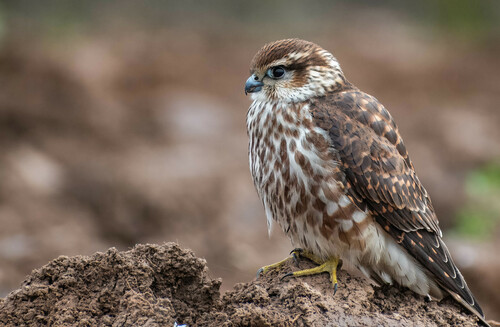 Merlin
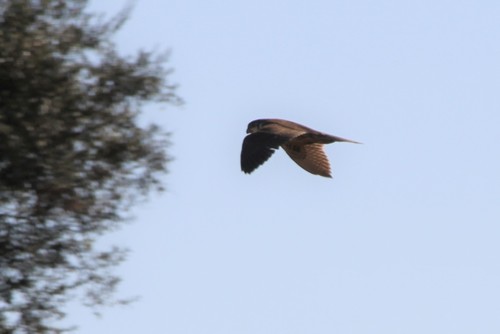 Prairie Falcon
In short
The most reliable field mark to separate Merlin from Prairie Falcon is the underwing pattern in flight: Prairie Falcon of all ages shows strikingly dark brown 'armpits' (axillars and underwing coverts), forming a bold contrast with the rest of the pale underwing, while Merlin's underwing is evenly colored without this dark patch. Juvenile Prairie Falcons can be confused with Merlins at a distance, but the Prairie Falcon's larger size, longer wings, and distinctive underwing 'struts' are diagnostic. Merlins are compact, heavily built small falcons with relatively short tails and wings, while Prairie Falcons are much larger, with a rangy, long-winged, long-tailed look. Plumage differences are subtle at rest, but structural and flight marks are decisive.
Identification tips
- Underwing pattern in flight (all ages): Prairie Falcon shows bold, dark brown axillars and underwing coverts ('armpits'), forming a strong dark bar from the body along the underwing. Merlin never shows this; its underwing is evenly patterned. This is the single most reliable field mark, especially at a distance or in poor light.
- Size and structure: Prairie Falcon is much larger, with a long tail and long, pointed wings, giving a rangy, almost lanky look. Merlin is compact, with shorter wings and tail, and appears more muscular and barrel-chested.
- Flight style: Merlin flies with rapid, powerful wingbeats and direct, purposeful movements, often low to the ground. Prairie Falcon tends to soar or glide more, with slower, deeper wingbeats and a more buoyant, open-country flight.
- Upperparts color (adult males): Merlin males are blue-gray above, never seen in Prairie Falcon, which is always gray-brown ('sandy').
- Upperparts color (females/immatures): Both can be brownish, but Merlin is darker and more uniform, while Prairie Falcon is paler and warmer brown, especially in adults with more barring on the back and shoulders.
- Tail pattern: Merlin has 3–4 bold, blackish tail bands and a black tip with a narrow white terminal band, visible in flight and at rest. Prairie Falcon's tail is less distinctly marked and lacks the crisp white tip.
- Head pattern: Prairie Falcon has a thin, dark malar stripe and a white eyebrow (supercilium), both more distinct than Merlin's faint, often barely visible, facial markings.
- Underparts: Merlin shows buff to orange-tinted underparts with heavy streaking or spotting; Prairie Falcon is paler below, with dark mottling and, in adults, more vertical streaking on the upper breast.
- Leg and cere color (age-related): Prairie Falcon adults have yellow skin on the legs and cere, sometimes tinged orange or green; juveniles have gray skin, but this is variable and not always reliable. Merlin always has yellow feet and cere in adults.
- Habitat context: Prairie Falcon is found in dry, open western landscapes; Merlin is more widespread and can be found in urban, forest edge, and open country, especially outside the arid west.
- Perched jizz: Merlin perches upright, often on exposed branches or wires, looking compact and alert. Prairie Falcon appears larger, longer-tailed, and more elongated when perched.
- Feeding behavior: Merlin often hunts small birds in fast, direct pursuit; Prairie Falcon may take larger prey and is more likely to be seen soaring or hunting over open terrain.
- Juvenile confusion: Juvenile Prairie Falcons are more uniformly brown above and may lack strong barring, but still show the underwing 'strut' in flight; Merlin juveniles are darker above and lack any underwing contrast.
- Sexual dimorphism: Both species show females much larger than males, but even a female Merlin is much smaller than a male Prairie Falcon.
- When marks fail: At great distance or in poor light, size and structure plus the underwing pattern are the most reliable; plumage details are secondary and can be misleading, especially in juveniles or worn birds.
Size
Merlin is a small falcon (body mass ~187g), noticeably smaller and more compact than Prairie Falcon. Prairie Falcon males are about twice as long (37–38 cm vs. 24–33 cm for Merlin) and much heavier (500–635g for males, 762–970g for females), with a wingspan up to 1.1 meters (3.5 feet), compared to Merlin's 50–73 cm. Even a female Merlin is dwarfed by a male Prairie Falcon. In the field, Prairie Falcon appears long-winged and rangy, while Merlin is stocky and short-tailed by comparison.
Plumage
- Juvenile/immature birds in flight: Prairie Falcon of all ages (including juveniles) shows very dark brown axillars and underwing coverts, forming a 'strut' or bar along the underwing from the body outward. Merlin never shows this; its underwing is evenly patterned, lacking any dark 'armpit' patch.
- Upperparts: Merlin adult males are blue-gray above; females and immatures are brownish-gray to dark brown. Prairie Falcon is always warm gray-brown ('sandy') above, never blue-gray. Juvenile Prairie Falcons are more uniformly brown above, while adults have more barred backs and shoulders.
- Underparts: Merlin is buff to orange-tinted below with heavy streaking (males) or brown spotting (females/immatures). Prairie Falcon is pale with dark mottling below; adults show more vertical streaking on the upper breast, while juveniles are more uniform.
- Head pattern: Prairie Falcon has a thin dark malar stripe and a white supercilium (eyebrow), both more distinct than Merlin's weak, often barely visible, facial markings.
- Tail: Merlin's tail has 3–4 wide, blackish bands and a black tip with a narrow white terminal band. Prairie Falcon's tail pattern is less distinct and lacks the strong banding and white tip of Merlin.
Behaviour
Merlin is a robust, aggressive small falcon, often seen making rapid, direct flights low over the ground or in fast pursuits of small birds. It is more heavily built for its size and can appear muscular and purposeful in flight. Prairie Falcon is adapted to open, arid landscapes, often soaring or gliding with long, pointed wings and a more buoyant, rangy flight. It may hunt larger prey and is less likely to be seen in urban or forested settings compared to Merlin.
Habitat
Merlin breeds across the northern Holarctic and winters in a wide range of open habitats, including urban areas, grasslands, and forest edges. Prairie Falcon is restricted to arid, open country of western North America—grasslands, deserts, and canyons. If you are in a dry, open landscape in the western US, Prairie Falcon is much more likely; Merlins are more widespread and can occur in a broader range of habitats, especially outside the arid west.