

Motmot

Matsudaira's Storm-Petrel vs Kermadec Petrel

Hydrobates matsudairae versus Pterodroma neglecta

Play a quiz with Matsudaira's Storm-Petrel and Kermadec Petrel

Matsudaira's Storm-Petrel (Hydrobates matsudairae) Matsudaira's Storm-Petrel
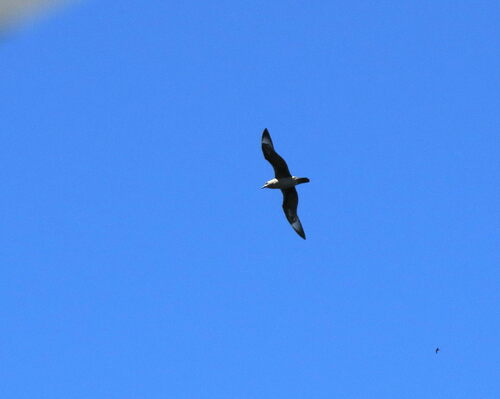
Kermadec Petrel (Pterodroma neglecta) Kermadec Petrel

Media

Loading…

In short

The most reliable field mark to separate Matsudaira's Storm-Petrel from Kermadec Petrel is overall structure and tail shape: Matsudaira's Storm-Petrel is a much smaller, more delicate bird with a long, deeply forked tail and a slim, hooked bill, while Kermadec Petrel is a large, robust petrel with a broad wingspan and a less dramatic tail fork. In flight, Matsudaira's Storm-Petrel shows blackish alula feathers contrasting with white bases to the primaries, a pattern not seen in Kermadec Petrel. Kermadec Petrel is highly variable in plumage (light, dark, and intermediate morphs), but all morphs are much larger and bulkier than Matsudaira's. If you see a small, swift, fork-tailed seabird with a sharp bill and contrasting wing pattern, it's Matsudaira's; a large, polymorphic, heavy petrel is Kermadec.

Identification tips

  1. Size is the first check: Kermadec Petrel is huge compared to Matsudaira's Storm-Petrel. If the bird looks gull- or albatross-sized, it's Kermadec; if it's much smaller, it's Matsudaira's.
  2. Tail shape: Matsudaira's Storm-Petrel has a long, deeply forked tail visible in flight and often even at rest. Kermadec Petrel's tail is shorter and less forked.
  3. Wing pattern: Look for the blackish alula contrasting with white bases to the dark primaries on Matsudaira's Storm-Petrel. This contrast is unique and visible in good flight views. Kermadec Petrel's wing is more uniform, regardless of morph.
  4. Bill shape: Matsudaira's has a long, slender bill with a pronounced hook at the tip; Kermadec Petrel's bill is shorter and stouter (though this is subtle at range).
  5. Plumage polymorphism: Kermadec Petrel comes in light, dark, and intermediate morphs. Matsudaira's Storm-Petrel is always dark overall, with no pale morphs.
  6. Flight style: Matsudaira's is fluttery, erratic, and buoyant, often pattering on the water. Kermadec Petrel is powerful, with deep wingbeats and long glides.
  7. Resting behavior: Matsudaira's Storm-Petrel is rarely seen sitting on the water; Kermadec Petrel may rest on the surface.
  8. Geographic context: Matsudaira's is only expected in the NW Pacific and Indian Ocean; Kermadec Petrel breeds in the South Pacific. Out-of-range records are exceptional.
  9. Habitat: Both are pelagic, but if seen near breeding islands, check which species is expected locally.
  10. Jizz: Matsudaira's looks slim, long-tailed, and swift-like; Kermadec is bulky, broad-winged, and powerful.
  11. No age-specific confusion: There are no described juvenile/immature upperwing patterns for Kermadec Petrel that mimic the storm-petrel's alula/primary contrast. All ages of Matsudaira's show this mark.
  12. No voice cues: Vocalizations are not described as diagnostic in the available sources.
  13. No overlap in mass: If you have a sense of weight (e.g., from a bird in the hand), Kermadec Petrel is over 500 g; Matsudaira's is far lighter.
  14. Polymorphic confusion: Dark-morph Kermadec Petrel might look superficially similar to Matsudaira's at a distance, but will always be much larger and lack the storm-petrel's tail and wing pattern.
  15. Bill detail at close range: If you can see the bill tip, Matsudaira's pronounced hook is a clincher.

Size

Kermadec Petrel is dramatically larger, with an adult body mass around 501 g and a wingspan of 100 cm [wikidata]. Matsudaira's Storm-Petrel is much smaller and lighter (no mass given, but all storm-petrels are dwarfed by gadfly petrels), with a more delicate build and proportionally longer tail. There is no overlap in size: if you see a bird the size of a large gull or small albatross, it's Kermadec Petrel; if it's closer to a swift or swallow in size, it's Matsudaira's Storm-Petrel.

Plumage

For all ages, Matsudaira's Storm-Petrel shows blackish alula feathers offset by white bases to the otherwise dark primaries, creating a subtle but diagnostic contrast on the upperwing in flight [wikipedia]. The tail is long and deeply forked, and the bird is overall dark. Kermadec Petrel is polymorphic: adults and immatures can be dark, pale, or intermediate, but none show the storm-petrel's sharp alula/primary contrast or deeply forked tail. Instead, Kermadec Petrel's wing pattern is more uniform, and the tail is shorter and less forked. The storm-petrel's bill is also longer and more hooked at the tip, visible at close range. No age-specific juvenile/immature upperwing patterns are described for either species, but the storm-petrel's unique alula/primary contrast is present in all plumages.

Behaviour

Matsudaira's Storm-Petrel behaves like other storm-petrels: it is agile, buoyant, and often flutters or patters over the water, sometimes appearing bat-like. Kermadec Petrel is a strong, direct flier, with deep wingbeats and long glides, typical of large gadfly petrels. Matsudaira's is rarely seen sitting on the water, while Kermadec Petrel may rest on the surface. In mixed flocks, the storm-petrel will look much smaller and more erratic in flight.

Habitat

Matsudaira's Storm-Petrel breeds only in the Volcano Islands (NW Pacific) and winters in the Indian Ocean, typically far offshore [wikipedia]. Kermadec Petrel breeds on islands from Lord Howe to the Juan Fernández Islands, especially the Kermadec Islands, and is a rare vagrant elsewhere [wikipedia]. Both are pelagic, but Kermadec Petrel is not expected in the NW Pacific or Indian Ocean, and Matsudaira's is not expected in the South Pacific. If context is known, location can be a strong clue.

Submit a better description

Use the same sections as the comparison. Your text is published immediately.

The most reliable field mark to separate Matsudaira's Storm-Petrel from Kermadec Petrel is overall structure and tail shape: Matsudaira's Storm-Petrel is a much smaller, more delicate bird with a long, deeply forked tail and a slim, hooked bill, while Kermadec Petrel is a large, robust petrel with a broad wingspan and a less dramatic tail fork. In flight, Matsudaira's Storm-Petrel shows blackish alula feathers contrasting with white bases to the primaries, a pattern not seen in Kermadec Petrel. Kermadec Petrel is highly variable in plumage (light, dark, and intermediate morphs), but all morphs are much larger and bulkier than Matsudaira's. If you see a small, swift, fork-tailed seabird with a sharp bill and contrasting wing pattern, it's Matsudaira's; a large, polymorphic, heavy petrel is Kermadec.

  1. Size is the first check: Kermadec Petrel is huge compared to Matsudaira's Storm-Petrel. If the bird looks gull- or albatross-sized, it's Kermadec; if it's much smaller, it's Matsudaira's.
  2. Tail shape: Matsudaira's Storm-Petrel has a long, deeply forked tail visible in flight and often even at rest. Kermadec Petrel's tail is shorter and less forked.
  3. Wing pattern: Look for the blackish alula contrasting with white bases to the dark primaries on Matsudaira's Storm-Petrel. This contrast is unique and visible in good flight views. Kermadec Petrel's wing is more uniform, regardless of morph.
  4. Bill shape: Matsudaira's has a long, slender bill with a pronounced hook at the tip; Kermadec Petrel's bill is shorter and stouter (though this is subtle at range).
  5. Plumage polymorphism: Kermadec Petrel comes in light, dark, and intermediate morphs. Matsudaira's Storm-Petrel is always dark overall, with no pale morphs.
  6. Flight style: Matsudaira's is fluttery, erratic, and buoyant, often pattering on the water. Kermadec Petrel is powerful, with deep wingbeats and long glides.
  7. Resting behavior: Matsudaira's Storm-Petrel is rarely seen sitting on the water; Kermadec Petrel may rest on the surface.
  8. Geographic context: Matsudaira's is only expected in the NW Pacific and Indian Ocean; Kermadec Petrel breeds in the South Pacific. Out-of-range records are exceptional.
  9. Habitat: Both are pelagic, but if seen near breeding islands, check which species is expected locally.
  10. Jizz: Matsudaira's looks slim, long-tailed, and swift-like; Kermadec is bulky, broad-winged, and powerful.
  11. No age-specific confusion: There are no described juvenile/immature upperwing patterns for Kermadec Petrel that mimic the storm-petrel's alula/primary contrast. All ages of Matsudaira's show this mark.
  12. No voice cues: Vocalizations are not described as diagnostic in the available sources.
  13. No overlap in mass: If you have a sense of weight (e.g., from a bird in the hand), Kermadec Petrel is over 500 g; Matsudaira's is far lighter.
  14. Polymorphic confusion: Dark-morph Kermadec Petrel might look superficially similar to Matsudaira's at a distance, but will always be much larger and lack the storm-petrel's tail and wing pattern.
  15. Bill detail at close range: If you can see the bill tip, Matsudaira's pronounced hook is a clincher.

Kermadec Petrel is dramatically larger, with an adult body mass around 501 g and a wingspan of 100 cm [wikidata]. Matsudaira's Storm-Petrel is much smaller and lighter (no mass given, but all storm-petrels are dwarfed by gadfly petrels), with a more delicate build and proportionally longer tail. There is no overlap in size: if you see a bird the size of a large gull or small albatross, it's Kermadec Petrel; if it's closer to a swift or swallow in size, it's Matsudaira's Storm-Petrel.

For all ages, Matsudaira's Storm-Petrel shows blackish alula feathers offset by white bases to the otherwise dark primaries, creating a subtle but diagnostic contrast on the upperwing in flight [wikipedia]. The tail is long and deeply forked, and the bird is overall dark. Kermadec Petrel is polymorphic: adults and immatures can be dark, pale, or intermediate, but none show the storm-petrel's sharp alula/primary contrast or deeply forked tail. Instead, Kermadec Petrel's wing pattern is more uniform, and the tail is shorter and less forked. The storm-petrel's bill is also longer and more hooked at the tip, visible at close range. No age-specific juvenile/immature upperwing patterns are described for either species, but the storm-petrel's unique alula/primary contrast is present in all plumages.

Matsudaira's Storm-Petrel behaves like other storm-petrels: it is agile, buoyant, and often flutters or patters over the water, sometimes appearing bat-like. Kermadec Petrel is a strong, direct flier, with deep wingbeats and long glides, typical of large gadfly petrels. Matsudaira's is rarely seen sitting on the water, while Kermadec Petrel may rest on the surface. In mixed flocks, the storm-petrel will look much smaller and more erratic in flight.

Matsudaira's Storm-Petrel breeds only in the Volcano Islands (NW Pacific) and winters in the Indian Ocean, typically far offshore [wikipedia]. Kermadec Petrel breeds on islands from Lord Howe to the Juan Fernández Islands, especially the Kermadec Islands, and is a rare vagrant elsewhere [wikipedia]. Both are pelagic, but Kermadec Petrel is not expected in the NW Pacific or Indian Ocean, and Matsudaira's is not expected in the South Pacific. If context is known, location can be a strong clue.

Discard your changes?

You have unsaved edits. If you leave now, those changes will be lost.

Matsudaira's Storm-Petrel · Kermadec Petrel · My Tricky Birds