

Mascarene Swiftlet vs Wedge-tailed Shearwater
Aerodramus francicus versus Ardenna pacifica
Play a quiz with Mascarene Swiftlet and Wedge-tailed Shearwater
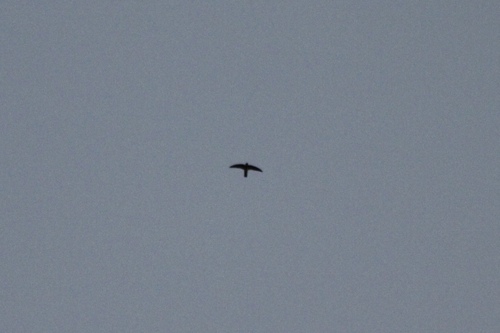 Mascarene Swiftlet
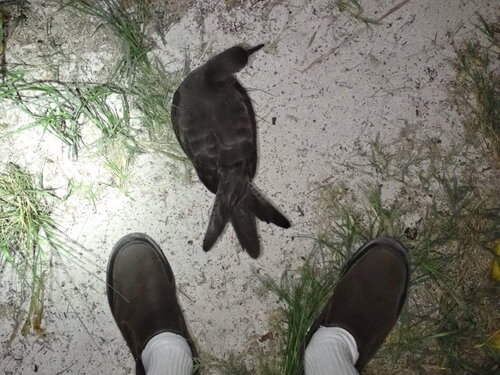 Wedge-tailed Shearwater
In short
The most reliable field mark to separate Mascarene Swiftlet from Wedge-tailed Shearwater is overall size and structure: the swiftlet is a tiny, fast-flying aerial insectivore, while the shearwater is a large, heavy-bodied seabird with a distinctive wedge-shaped tail. In flight, the swiftlet shows compact, scythe-shaped wings and rapid, fluttery flight, whereas the shearwater has long, broad wings and a languid, gliding flight style. Plumage differences are also stark: the swiftlet is uniformly dark above and pale below, while the shearwater varies from all-dark to pale below, but always has a bulkier look and a proportionally massive bill. Habitat is a strong clue—swiftlets are seen over land on Mauritius and Réunion, while shearwaters are strictly pelagic, rarely seen inland.
Identification tips
- Size is the fastest check: Wedge-tailed Shearwater is enormous compared to Mascarene Swiftlet; if you see a bird the size of a pigeon or larger, it cannot be a swiftlet.
- Tail shape: Shearwater has a long, pointed, wedge-shaped tail visible in flight and at rest; swiftlet’s tail is short and square or slightly forked, never wedge-shaped.
- Flight style: Swiftlet flies with rapid, fluttery wingbeats and quick changes of direction; shearwater glides and shears over the water with long, stiff wings and deep, steady wingbeats.
- Wing shape: Swiftlet’s wings are narrow, sickle-shaped, and proportionally much shorter; shearwater’s wings are long, broad, and suited for dynamic soaring.
- Bill: Shearwater has a thick, long, dark bill easily seen at a distance; swiftlet’s bill is tiny and almost invisible in the field.
- Plumage: Swiftlet is dark above and pale below, with no strong pattern; shearwater is either all dark or pale below, but always bulkier and never as sharply two-toned as the swiftlet.
- Color morphs: Only shearwater shows dark and pale morphs; swiftlet does not vary.
- Leg color: Shearwater has salmon-pink legs, but these are rarely visible unless the bird is at rest; not a practical field mark.
- Habitat: Swiftlet is only seen over land on Mauritius and Réunion; shearwater is marine, seen at sea or at coastal breeding sites.
- Behavior at rest: Shearwater may be seen on the ground at colonies; swiftlet almost never perches in the open.
- Vocalizations: Shearwater’s moaning calls are distinctive at colonies; swiftlet’s calls are high-pitched and twittering, mostly heard in flight.
- Context: If you are birding inland or over forest, expect swiftlet; if you are at sea or on a remote island, expect shearwater.
- Association: Swiftlets often occur in flocks with other swifts or swallows; shearwaters are usually alone or in loose groups at sea.
- Confusion risk: The only real risk of confusion is a distant, fast-flying bird over the ocean, but size and flight style will quickly separate them.
- Juvenile/immature marks: No distinctive juvenile wing patterns are described for either species, so rely on structure and context for all ages.
Size
Wedge-tailed Shearwater is vastly larger, with an adult mass of about 465 grams [wikidata], compared to the much smaller Mascarene Swiftlet (no mass given, but all swiftlets are tiny by comparison). The shearwater is a medium-large seabird, easily dwarfing the swiftlet, which is among the smallest birds in its range. In the field, size alone is often enough to rule out confusion if both species are seen together or with known reference birds.
Plumage
No age-specific upperwing patterns are described for either species, but overall plumage is highly distinctive. Mascarene Swiftlet (all ages) is dark above with paler underparts, lacking any strong pattern or color morphs. Wedge-tailed Shearwater comes in two morphs: pale (grey-brown above, white below) and dark (uniformly dark grey-brown). Both morphs have a wedge-shaped tail and, in all plumages, a much bulkier look than the swiftlet. The swiftlet lacks any wedge in the tail and has a much shorter, squared or slightly forked tail. The shearwater’s bill is always dark and thick, while the swiftlet’s bill is tiny and barely visible at a distance. Leg color is not a useful field mark unless the bird is handled or seen at rest, which is rare for both.
Behaviour
Mascarene Swiftlet is almost always seen in rapid, agile flight, catching insects high over land or forest. It rarely lands in the open. Wedge-tailed Shearwater is a strong, gliding flier, spending most of its life over the ocean, often seen shearing low over waves or gliding with stiff wings. On land, shearwaters are clumsy and rarely seen except at breeding colonies or at sea. The swiftlet’s flight is fluttery and erratic, while the shearwater’s is powerful, with deep wingbeats and long glides.
Habitat
Mascarene Swiftlet is restricted to Mauritius and Réunion, foraging over land, forest, and sometimes near cliffs. It is never seen far out to sea. Wedge-tailed Shearwater is strictly marine, found throughout the tropical Pacific and Indian Oceans, and only comes to land to breed, typically on remote islands or coastal colonies. Seeing a swiftlet over the open ocean or a shearwater inland is extremely unlikely.
Voice
Wedge-tailed Shearwater is highly vocal at colonies, giving long, moaning calls with inhaling and exhaling notes (described as 'OOO...err'), especially at night. Mascarene Swiftlet’s calls are not described in the notes, but swiftlets in general give high-pitched, twittering calls, mostly in flight. Vocalizations are unlikely to be confused if heard well, but are rarely diagnostic at sea or in flight.
Mascarene Swiftlet · Wedge-tailed Shearwater · My Tricky Birds