
Motmot

Marsh Warbler vs Savi's Warbler

Acrocephalus palustris versus Locustella luscinioides

Play a quiz with Marsh Warbler and Savi's Warbler
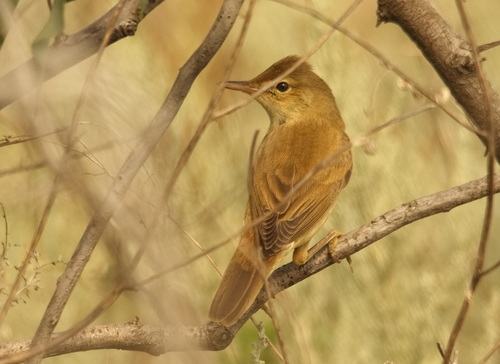
Marsh Warbler (Acrocephalus palustris) Marsh Warbler
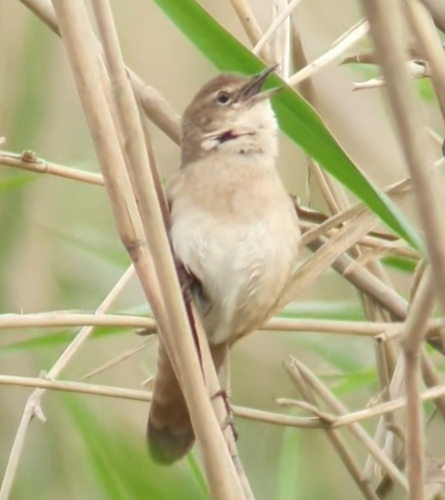
Savi's Warbler (Locustella luscinioides) Savi's Warbler

Media

Loading…

In short

The most reliable field mark for separating Marsh Warbler from Savi's Warbler is overall plumage tone and structure: Marsh Warbler is a medium-sized, rather plain acrocephaline with a greenish-brown back and no strong pattern, while Savi's Warbler is a Locustella with a distinctly uniform, dark reddish-brown upperpart coloration and a subtle buff eye-stripe. Savi's Warbler also has a more rounded, blunt-tipped tail and a subtly streaked appearance on the underparts, while Marsh Warbler is cleaner below and structurally more like Reed Warbler. In flight or perched, Savi's Warbler often appears bulkier and more compact, with a shorter, rounder tail. Marsh Warbler's song is a remarkable, varied mimicry of other birds, while Savi's Warbler produces a mechanical, insect-like trill. Habitat can help: Marsh Warbler prefers tall, dense herbaceous vegetation away from pure reedbeds, whereas Savi's Warbler is a classic reedbed specialist.

Identification tips

  1. Overall plumage tone: Savi's Warbler is uniformly dark reddish-brown above with a slight greenish tinge, while Marsh Warbler is plainer, greenish-brown above and off-white below. This contrast is visible in all ages and seasons.
  2. Facial pattern: Savi's Warbler shows a subtle but noticeable buff eye-stripe and dark lores, while Marsh Warbler lacks a strong eye-stripe and appears more plain-faced.
  3. Tail shape: Savi's Warbler has a shorter, rounder, and more blunt-tipped tail, often held low or slightly fanned when perched. Marsh Warbler's tail is longer, more square-tipped, and not as rounded.
  4. Underparts: Savi's Warbler has sandy brown underparts with a whitish-buff chin, throat, and belly, often appearing slightly streaked or shaded. Marsh Warbler is cleaner and whiter below, with little or no streaking.
  5. Structure/jizz: Savi's Warbler is bulkier, more compact, and often appears heavier-bodied, especially when climbing reeds. Marsh Warbler is slimmer, more elongated, and upright, with a longer wing and tail.
  6. Perched behavior: Savi's Warbler often climbs reed stems to sing in full view, but otherwise moves low and mouse-like through dense reeds. Marsh Warbler tends to stay in tall, dense herbaceous vegetation and is less likely to be seen climbing reeds.
  7. Habitat: If the bird is in a pure reedbed or singing from a reed stem, Savi's Warbler is more likely. If in tall nettles, meadowsweet, or mixed herbaceous vegetation away from reeds, Marsh Warbler is favored.
  8. Song: Marsh Warbler's song is a complex, varied mimicry of many other birds, often switching between phrases and imitating both European and African species. Savi's Warbler gives a mechanical, insect-like trill, lower-pitched and less prolonged than Grasshopper Warbler, sometimes with introductory ticking notes.
  9. Season: Both are migrants, but Savi's Warbler arrives earlier in southern Europe (mid-April) and later in the north (late May). Marsh Warbler's migration timing is more variable and overlaps but is less likely in pure reedbeds.
  10. Sex differences: Both species are sexually monomorphic in plumage; do not rely on sex for identification.
  11. Flight views: No distinctive upperwing or flight pattern marks are described for either species—use overall color and structure instead.
  12. Juvenile/immature birds: No age-specific wing or tail patterns are noted for either species; separation is as for adults.
  13. Pitfalls: Reed Warbler is a much more common confusion species for Marsh Warbler, but Savi's Warbler's Locustella structure and uniform dark upperparts are distinctive. Beware of light conditions making Marsh Warbler appear darker or Savi's paler.
  14. Calls: Calls are less distinctive, but Savi's Warbler's ticking notes before the trill can be a clue.
  15. Hybridization: Marsh Warbler can hybridize with Reed and Blyth's Reed Warbler, but not with Savi's; hybrids are rare and unlikely to cause confusion here.

Size

Savi's Warbler is slightly larger, averaging about 14 cm in length [wikipedia], while Marsh Warbler is a medium-sized acrocephaline, typically a bit smaller and slimmer. Savi's Warbler often appears bulkier and more compact, with a shorter, rounder tail, while Marsh Warbler is more slender and elongated, with a proportionally longer tail and wing. Both species are similar in size to other small warblers, but Savi's Warbler may look heavier-bodied when seen well.

Plumage

No distinctive juvenile or first-winter upperwing patterns are described for either species, so separation relies on overall coloration and subtle facial details. Savi's Warbler (all ages, all seasons) has uniform dark reddish-brown upperparts with a slight greenish tinge, indistinct buff eye-stripes, dark lores, and pale brown ear-coverts. Its underparts are sandy brown with a whitish-buff chin, throat, and belly. In breeding season, both upper- and underparts become slightly paler. Marsh Warbler, by contrast, is generally plain brownish-green above and off-white below, lacking any strong eye-stripe or facial pattern, and does not show the reddish or uniform dark tones of Savi's. Both sexes are similar in both species. Savi's Warbler's tail is also slightly rounder and more blunt-tipped, while Marsh Warbler's is more square. In summary: Savi's Warbler is richer, darker, and more uniform above with a subtle eye-stripe; Marsh Warbler is plainer, greener-brown, and cleaner below.

Behaviour

Marsh Warbler tends to skulk in tall, dense herbaceous vegetation (nettles, meadowsweet, willowherb, young osiers), often away from pure reedbeds, and is less likely to be seen climbing reeds. It is more likely to be detected by its song than by sight. Savi's Warbler is a classic reedbed bird, often climbing reed stems to sing in full view, but otherwise moves low and quickly through dense reed and sedge beds, seldom venturing onto open ground. Savi's Warbler may appear more secretive except when singing, and its movements are more mouse-like and creeping compared to the more upright Marsh Warbler.

Habitat

Marsh Warbler breeds in tall, rank, herbaceous vegetation on damp or seasonally flooded soils, often with nettles, meadowsweet, willowherbs, or young willows, and avoids pure reedbeds. It can also be found in urban brownfields or arable crops with suitable vegetation. Savi's Warbler, in contrast, is tightly associated with reedbeds, marshes, and lagoons dominated by reeds, sedges, and other marsh plants, sometimes with scattered bushes. In winter, both use well-vegetated habitats, but Savi's is more likely to be found in classic reedbed or fen environments, while Marsh Warbler uses a broader range of dense, moist vegetation.

Voice

Marsh Warbler's song is a rich, varied, and highly imitative sequence, incorporating mimicry of up to 75 other bird species, often including both European and African birds. This song is unique among acrocephaline warblers and is the best single field clue if heard. Savi's Warbler, by contrast, produces a mechanical, insect-like trill, lower-pitched and less prolonged than Grasshopper Warbler, often preceded by low ticking notes. Both sexes sing in Savi's Warbler, while in Marsh Warbler, only males produce the complex, imitative song. Calls are less distinctive, but the song is a strong separator.

Submit a better description

Use the same sections as the comparison. Your text is published immediately.

The most reliable field mark for separating Marsh Warbler from Savi's Warbler is overall plumage tone and structure: Marsh Warbler is a medium-sized, rather plain acrocephaline with a greenish-brown back and no strong pattern, while Savi's Warbler is a Locustella with a distinctly uniform, dark reddish-brown upperpart coloration and a subtle buff eye-stripe. Savi's Warbler also has a more rounded, blunt-tipped tail and a subtly streaked appearance on the underparts, while Marsh Warbler is cleaner below and structurally more like Reed Warbler. In flight or perched, Savi's Warbler often appears bulkier and more compact, with a shorter, rounder tail. Marsh Warbler's song is a remarkable, varied mimicry of other birds, while Savi's Warbler produces a mechanical, insect-like trill. Habitat can help: Marsh Warbler prefers tall, dense herbaceous vegetation away from pure reedbeds, whereas Savi's Warbler is a classic reedbed specialist.

  1. Overall plumage tone: Savi's Warbler is uniformly dark reddish-brown above with a slight greenish tinge, while Marsh Warbler is plainer, greenish-brown above and off-white below. This contrast is visible in all ages and seasons.
  2. Facial pattern: Savi's Warbler shows a subtle but noticeable buff eye-stripe and dark lores, while Marsh Warbler lacks a strong eye-stripe and appears more plain-faced.
  3. Tail shape: Savi's Warbler has a shorter, rounder, and more blunt-tipped tail, often held low or slightly fanned when perched. Marsh Warbler's tail is longer, more square-tipped, and not as rounded.
  4. Underparts: Savi's Warbler has sandy brown underparts with a whitish-buff chin, throat, and belly, often appearing slightly streaked or shaded. Marsh Warbler is cleaner and whiter below, with little or no streaking.
  5. Structure/jizz: Savi's Warbler is bulkier, more compact, and often appears heavier-bodied, especially when climbing reeds. Marsh Warbler is slimmer, more elongated, and upright, with a longer wing and tail.
  6. Perched behavior: Savi's Warbler often climbs reed stems to sing in full view, but otherwise moves low and mouse-like through dense reeds. Marsh Warbler tends to stay in tall, dense herbaceous vegetation and is less likely to be seen climbing reeds.
  7. Habitat: If the bird is in a pure reedbed or singing from a reed stem, Savi's Warbler is more likely. If in tall nettles, meadowsweet, or mixed herbaceous vegetation away from reeds, Marsh Warbler is favored.
  8. Song: Marsh Warbler's song is a complex, varied mimicry of many other birds, often switching between phrases and imitating both European and African species. Savi's Warbler gives a mechanical, insect-like trill, lower-pitched and less prolonged than Grasshopper Warbler, sometimes with introductory ticking notes.
  9. Season: Both are migrants, but Savi's Warbler arrives earlier in southern Europe (mid-April) and later in the north (late May). Marsh Warbler's migration timing is more variable and overlaps but is less likely in pure reedbeds.
  10. Sex differences: Both species are sexually monomorphic in plumage; do not rely on sex for identification.
  11. Flight views: No distinctive upperwing or flight pattern marks are described for either species—use overall color and structure instead.
  12. Juvenile/immature birds: No age-specific wing or tail patterns are noted for either species; separation is as for adults.
  13. Pitfalls: Reed Warbler is a much more common confusion species for Marsh Warbler, but Savi's Warbler's Locustella structure and uniform dark upperparts are distinctive. Beware of light conditions making Marsh Warbler appear darker or Savi's paler.
  14. Calls: Calls are less distinctive, but Savi's Warbler's ticking notes before the trill can be a clue.
  15. Hybridization: Marsh Warbler can hybridize with Reed and Blyth's Reed Warbler, but not with Savi's; hybrids are rare and unlikely to cause confusion here.

Savi's Warbler is slightly larger, averaging about 14 cm in length [wikipedia], while Marsh Warbler is a medium-sized acrocephaline, typically a bit smaller and slimmer. Savi's Warbler often appears bulkier and more compact, with a shorter, rounder tail, while Marsh Warbler is more slender and elongated, with a proportionally longer tail and wing. Both species are similar in size to other small warblers, but Savi's Warbler may look heavier-bodied when seen well.

No distinctive juvenile or first-winter upperwing patterns are described for either species, so separation relies on overall coloration and subtle facial details. Savi's Warbler (all ages, all seasons) has uniform dark reddish-brown upperparts with a slight greenish tinge, indistinct buff eye-stripes, dark lores, and pale brown ear-coverts. Its underparts are sandy brown with a whitish-buff chin, throat, and belly. In breeding season, both upper- and underparts become slightly paler. Marsh Warbler, by contrast, is generally plain brownish-green above and off-white below, lacking any strong eye-stripe or facial pattern, and does not show the reddish or uniform dark tones of Savi's. Both sexes are similar in both species. Savi's Warbler's tail is also slightly rounder and more blunt-tipped, while Marsh Warbler's is more square. In summary: Savi's Warbler is richer, darker, and more uniform above with a subtle eye-stripe; Marsh Warbler is plainer, greener-brown, and cleaner below.

Marsh Warbler tends to skulk in tall, dense herbaceous vegetation (nettles, meadowsweet, willowherb, young osiers), often away from pure reedbeds, and is less likely to be seen climbing reeds. It is more likely to be detected by its song than by sight. Savi's Warbler is a classic reedbed bird, often climbing reed stems to sing in full view, but otherwise moves low and quickly through dense reed and sedge beds, seldom venturing onto open ground. Savi's Warbler may appear more secretive except when singing, and its movements are more mouse-like and creeping compared to the more upright Marsh Warbler.

Marsh Warbler breeds in tall, rank, herbaceous vegetation on damp or seasonally flooded soils, often with nettles, meadowsweet, willowherbs, or young willows, and avoids pure reedbeds. It can also be found in urban brownfields or arable crops with suitable vegetation. Savi's Warbler, in contrast, is tightly associated with reedbeds, marshes, and lagoons dominated by reeds, sedges, and other marsh plants, sometimes with scattered bushes. In winter, both use well-vegetated habitats, but Savi's is more likely to be found in classic reedbed or fen environments, while Marsh Warbler uses a broader range of dense, moist vegetation.

Marsh Warbler's song is a rich, varied, and highly imitative sequence, incorporating mimicry of up to 75 other bird species, often including both European and African birds. This song is unique among acrocephaline warblers and is the best single field clue if heard. Savi's Warbler, by contrast, produces a mechanical, insect-like trill, lower-pitched and less prolonged than Grasshopper Warbler, often preceded by low ticking notes. Both sexes sing in Savi's Warbler, while in Marsh Warbler, only males produce the complex, imitative song. Calls are less distinctive, but the song is a strong separator.

Discard your changes?

You have unsaved edits. If you leave now, those changes will be lost.

Marsh Warbler · Savi's Warbler · My Tricky Birds