
Motmot

Marbled Godwit vs Short-billed Dowitcher

Limosa fedoa versus Limnodromus griseus

Play a quiz with Marbled Godwit and Short-billed Dowitcher

Marbled Godwit (Limosa fedoa) Marbled Godwit
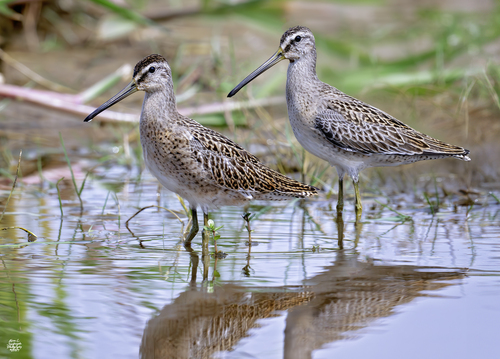
Short-billed Dowitcher (Limnodromus griseus) Short-billed Dowitcher

Media

Loading…

In short

Marbled Godwit and Short-billed Dowitcher are both long-billed shorebirds, but they differ markedly in size, structure, and flight appearance. The godwit is much larger and shows rich cinnamon wing linings in flight, while the dowitcher is smaller, stockier, and lacks this feature. Bill color and shape are also key: godwits have a long, slightly upturned, pink-based bill, whereas dowitchers have a straight, dark bill. Leg color and underpart patterning further help separate them, especially at close range or with good light. Immature and non-breeding birds can be tricky, but overall structure and flight marks remain reliable.

Identification tips

  1. Size is the most immediate clue: Marbled Godwit is much larger and taller than any Short-billed Dowitcher. If you see both together, the godwit will stand out as a giant.
  2. Flight view: cinnamon wing linings: In any age or season, Marbled Godwit shows rich cinnamon-orange underwings in flight, a feature never present in dowitchers.
  3. Bill structure and color: Godwits have a very long, pink-based bill with a slight upward curve and a dark tip. Dowitchers have a shorter, straight, dark bill. Bill length alone is not reliable for dowitcher species, but it is for separating godwit from dowitcher.
  4. Leg color: Marbled Godwit has blue-gray legs; Short-billed Dowitcher has yellowish legs. This is best seen at close range or in good light.
  5. Body shape and posture: Godwits are lanky, long-necked, and stand upright. Dowitchers are stockier, with shorter necks and a more horizontal stance.
  6. Underpart pattern: Godwits have pale brown to buffy underparts with dark barring on the breast and flanks. Dowitchers vary by subspecies: some have reddish bellies and spotted or barred flanks in breeding plumage, but none combine reddish bellies with barred flanks as in Long-billed Dowitcher. In non-breeding and juvenile plumage, dowitchers are mostly gray below.
  7. Tail pattern: Dowitchers have a black-and-white barred tail, visible when preening or in flight. Godwit tails are less contrasting and not as distinctly barred.
  8. Back pattern: Godwits have a mottled, dark back; dowitchers' backs are dark brown, sometimes with pale spots in juveniles.
  9. Foraging behavior: Godwits often walk upright and may pick prey by sight. Dowitchers feed with rapid, repeated probing ('sewing machine' motion) and often feed in tight groups.
  10. Roosting posture: Godwits may sleep standing on one leg with their bill tucked under the body, a less typical posture for dowitchers.
  11. Habitat context: If the bird is in a very open, expansive mudflat or short grass, godwit is more likely. Dense marshes, bogs, or coastal edges may favor dowitcher.
  12. Seasonal variation: Dowitchers in winter or juvenile plumage are mostly gray below, lacking the godwit's warm tones and barring. Godwits retain their pale, barred look year-round.
  13. Subspecies confusion: Dowitcher subspecies differ in belly and flank pattern, but none match the godwit's combination of warm buffy tones and barring.
  14. Bill length overlap: Do not rely on bill length alone to separate these two; use color and shape instead.
  15. Mixed flocks: If you see a group of similar shorebirds and one is much larger, with a pink-based bill and cinnamon underwings, it's a Marbled Godwit among dowitchers.

Size

Marbled Godwit is substantially larger than Short-billed Dowitcher. Godwits reach 40–50 cm in length with a wingspan of 70–88 cm, and females average nearly 400 g in mass. In contrast, Short-billed Dowitchers are medium-sized shorebirds, just 23–32 cm long, with a wingspan of 46–56 cm and an average mass of about 113 g. In the field, godwits look lanky and tall, towering over any dowitcher nearby.

Plumage

In flight, adult and immature Marbled Godwits show distinctive rich cinnamon-orange wing linings, visible from below, which are never present in Short-billed Dowitchers of any age. Godwits have a pale brown to buffy body with dark barring on the breast and flanks, and a mottled, dark back. Short-billed Dowitchers, depending on subspecies and season, show dark brown upperparts and reddish or grayish underparts. Juvenile and winter dowitchers are mostly gray below and lack the godwit's barring and cinnamon tones. Dowitchers have a black-and-white barred tail, while godwit tails are less contrasting. Leg color is also a clue: godwits have blue-gray legs, dowitchers yellowish. Bill color is diagnostic: godwits' bills are pink at the base, dowitchers' are dark throughout. Subtle differences in belly and flank patterning exist among dowitcher subspecies, but none match the godwit's overall warm, barred look.

Behaviour

Both species forage by probing, but Marbled Godwits often stride through open mudflats or short grass with a more upright, stately gait, sometimes picking insects by sight. Dowitchers feed with a rapid 'sewing machine' motion, often in denser flocks and lower to the ground. Godwits may roost standing on one leg with their bill tucked, a behavior less typical of dowitchers.

Habitat

Both use mudflats and marshes, but Marbled Godwits tend to favor more open, expansive mudflats and beaches, while Short-billed Dowitchers are more often found in a variety of wetland habitats, including tidal marshes, bogs, and even forest clearings during breeding. During migration and winter, dowitchers are more likely to be seen near ocean coasts, while godwits can be found from inland prairies to coastal flats.

Voice

No diagnostic vocalization differences are described between Marbled Godwit and Short-billed Dowitcher in the provided notes. Dowitcher identification by voice is mainly relevant for separating it from Long-billed Dowitcher, not from godwit.

Submit a better description

Use the same sections as the comparison. Your text is published immediately.

Marbled Godwit and Short-billed Dowitcher are both long-billed shorebirds, but they differ markedly in size, structure, and flight appearance. The godwit is much larger and shows rich cinnamon wing linings in flight, while the dowitcher is smaller, stockier, and lacks this feature. Bill color and shape are also key: godwits have a long, slightly upturned, pink-based bill, whereas dowitchers have a straight, dark bill. Leg color and underpart patterning further help separate them, especially at close range or with good light. Immature and non-breeding birds can be tricky, but overall structure and flight marks remain reliable.

  1. Size is the most immediate clue: Marbled Godwit is much larger and taller than any Short-billed Dowitcher. If you see both together, the godwit will stand out as a giant.
  2. Flight view: cinnamon wing linings: In any age or season, Marbled Godwit shows rich cinnamon-orange underwings in flight, a feature never present in dowitchers.
  3. Bill structure and color: Godwits have a very long, pink-based bill with a slight upward curve and a dark tip. Dowitchers have a shorter, straight, dark bill. Bill length alone is not reliable for dowitcher species, but it is for separating godwit from dowitcher.
  4. Leg color: Marbled Godwit has blue-gray legs; Short-billed Dowitcher has yellowish legs. This is best seen at close range or in good light.
  5. Body shape and posture: Godwits are lanky, long-necked, and stand upright. Dowitchers are stockier, with shorter necks and a more horizontal stance.
  6. Underpart pattern: Godwits have pale brown to buffy underparts with dark barring on the breast and flanks. Dowitchers vary by subspecies: some have reddish bellies and spotted or barred flanks in breeding plumage, but none combine reddish bellies with barred flanks as in Long-billed Dowitcher. In non-breeding and juvenile plumage, dowitchers are mostly gray below.
  7. Tail pattern: Dowitchers have a black-and-white barred tail, visible when preening or in flight. Godwit tails are less contrasting and not as distinctly barred.
  8. Back pattern: Godwits have a mottled, dark back; dowitchers' backs are dark brown, sometimes with pale spots in juveniles.
  9. Foraging behavior: Godwits often walk upright and may pick prey by sight. Dowitchers feed with rapid, repeated probing ('sewing machine' motion) and often feed in tight groups.
  10. Roosting posture: Godwits may sleep standing on one leg with their bill tucked under the body, a less typical posture for dowitchers.
  11. Habitat context: If the bird is in a very open, expansive mudflat or short grass, godwit is more likely. Dense marshes, bogs, or coastal edges may favor dowitcher.
  12. Seasonal variation: Dowitchers in winter or juvenile plumage are mostly gray below, lacking the godwit's warm tones and barring. Godwits retain their pale, barred look year-round.
  13. Subspecies confusion: Dowitcher subspecies differ in belly and flank pattern, but none match the godwit's combination of warm buffy tones and barring.
  14. Bill length overlap: Do not rely on bill length alone to separate these two; use color and shape instead.
  15. Mixed flocks: If you see a group of similar shorebirds and one is much larger, with a pink-based bill and cinnamon underwings, it's a Marbled Godwit among dowitchers.

Marbled Godwit is substantially larger than Short-billed Dowitcher. Godwits reach 40–50 cm in length with a wingspan of 70–88 cm, and females average nearly 400 g in mass. In contrast, Short-billed Dowitchers are medium-sized shorebirds, just 23–32 cm long, with a wingspan of 46–56 cm and an average mass of about 113 g. In the field, godwits look lanky and tall, towering over any dowitcher nearby.

In flight, adult and immature Marbled Godwits show distinctive rich cinnamon-orange wing linings, visible from below, which are never present in Short-billed Dowitchers of any age. Godwits have a pale brown to buffy body with dark barring on the breast and flanks, and a mottled, dark back. Short-billed Dowitchers, depending on subspecies and season, show dark brown upperparts and reddish or grayish underparts. Juvenile and winter dowitchers are mostly gray below and lack the godwit's barring and cinnamon tones. Dowitchers have a black-and-white barred tail, while godwit tails are less contrasting. Leg color is also a clue: godwits have blue-gray legs, dowitchers yellowish. Bill color is diagnostic: godwits' bills are pink at the base, dowitchers' are dark throughout. Subtle differences in belly and flank patterning exist among dowitcher subspecies, but none match the godwit's overall warm, barred look.

Both species forage by probing, but Marbled Godwits often stride through open mudflats or short grass with a more upright, stately gait, sometimes picking insects by sight. Dowitchers feed with a rapid 'sewing machine' motion, often in denser flocks and lower to the ground. Godwits may roost standing on one leg with their bill tucked, a behavior less typical of dowitchers.

Both use mudflats and marshes, but Marbled Godwits tend to favor more open, expansive mudflats and beaches, while Short-billed Dowitchers are more often found in a variety of wetland habitats, including tidal marshes, bogs, and even forest clearings during breeding. During migration and winter, dowitchers are more likely to be seen near ocean coasts, while godwits can be found from inland prairies to coastal flats.

No diagnostic vocalization differences are described between Marbled Godwit and Short-billed Dowitcher in the provided notes. Dowitcher identification by voice is mainly relevant for separating it from Long-billed Dowitcher, not from godwit.

Discard your changes?

You have unsaved edits. If you leave now, those changes will be lost.

Marbled Godwit · Short-billed Dowitcher · My Tricky Birds