
Motmot

Marbled Godwit vs Long-billed Dowitcher

Limosa fedoa versus Limnodromus scolopaceus

Play a quiz with Marbled Godwit and Long-billed Dowitcher

Marbled Godwit (Limosa fedoa) Marbled Godwit
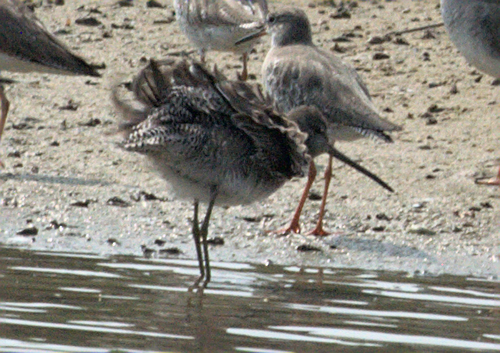
Long-billed Dowitcher (Limnodromus scolopaceus) Long-billed Dowitcher

Media

Loading…

In short

The most reliable field mark between Marbled Godwit and Long-billed Dowitcher is size: Marbled Godwit is a much larger, bulkier bird with a longer, slightly upturned pink-based bill, while Long-billed Dowitcher is medium-sized and stocky with a straight, dark bill. In flight, Marbled Godwit shows distinctive cinnamon wing linings, whereas Long-billed Dowitcher flashes a bright white rump extending up the back and a strongly barred black-and-white tail. Juvenile and non-breeding birds can be especially confusing, but bill shape, overall bulk, and flight pattern remain strong clues. Both species have mottled brown upperparts, but their underparts and structural proportions differ markedly.

Identification tips

  1. Size is the first check: If the bird is nearly curlew-sized, it's a Marbled Godwit; if it's only a bit larger than a typical sandpiper, it's a Long-billed Dowitcher. This holds true at any distance or in mixed flocks.
  2. Bill shape and color: Marbled Godwit has a very long, slightly upturned bill with a pinkish base and dark tip; Long-billed Dowitcher has a straight, black bill (sometimes olive at the base) about twice the length of its head but never as massive or upturned as the godwit's.
  3. Flight pattern (all ages): Marbled Godwit flashes rich cinnamon underwing coverts in flight; Long-billed Dowitcher shows a bright white rump extending up the back and a strongly barred black-and-white tail—these are best seen when the bird flushes or lands.
  4. Neck and body shape: Godwit is long-necked, long-legged, and stands upright; dowitcher is compact, short-necked, and appears more crouched.
  5. Leg color: Godwit has blue-grey legs; dowitcher has yellowish legs (though this can be hard to see in muddy water or poor light).
  6. Breeding plumage: Dowitcher is rufous below with a dark crown and mottled back; godwit is paler brown with dark barring on breast/flanks and a more uniform, less contrasting head.
  7. Juvenile plumage: Dowitcher juveniles have chestnut-fringed upperparts and a gray breast contrasting with a paler rufous belly; godwit juveniles are pale brown below with dark barring, lacking the sharp breast-belly contrast.
  8. Non-breeding plumage: Both become duller, but godwit remains paler and more evenly colored below; dowitcher is drab gray with a white belly and faint supercilium.
  9. Supercilium: Dowitcher always shows a whitish supercilium and dark loral stripe through the eye; godwit lacks this strong facial pattern.
  10. Tail pattern: Dowitcher tail is strongly barred black and white, with black bars wider than white; godwit tail is less distinctly marked.
  11. Feeding behavior: Godwit probes slowly or picks; dowitcher feeds with rapid 'sewing machine' motion.
  12. Roosting posture: Godwits often stand on one leg, bill tucked; dowitchers less so.
  13. Habitat context: Godwits favor open mudflats and beaches; dowitchers are more often in freshwater marshes and flooded fields.
  14. Voice (if heard): Not diagnostic from these notes, but dowitchers are known for sharp 'keek' calls in flight, while godwits have a mellow, yelping call.
  15. Pitfall: In poor light or at a distance, focus on size, bill shape, and flight pattern—plumage alone can be misleading, especially in non-breeding or juvenile birds.

Size

Marbled Godwit is dramatically larger than Long-billed Dowitcher. The godwit averages 326–391 g (males/females), with a total length of 40–50 cm and a wingspan of 70–88 cm [wikipedia]. In contrast, Long-billed Dowitcher averages only 104 g [wikidata], and is much shorter and more compact overall. Even at a distance or in mixed flocks, the godwit stands out as a giant among shorebirds, while the dowitcher is closer to a large sandpiper in size.

Plumage

Juvenile and non-breeding plumages can be confusing, but key differences persist. In flight (all ages), Marbled Godwit reveals rich cinnamon underwing coverts, while Long-billed Dowitcher shows a bright white rump extending up the back and a strongly barred black-and-white tail. Dowitcher juveniles have upperparts fringed chestnut and a gray breast demarcated from a paler rufous belly, while godwit juveniles are generally paler brown below with dark barring on the breast and flanks. In breeding plumage, dowitchers are rufous below with a dark crown and mottled back, while godwits are paler brown with dark barring and a more uniform appearance. In non-breeding (winter) plumage, both species become grayer, but the godwit retains a longer neck and paler, more even underparts, while the dowitcher is drab gray with a contrasting white belly and a faint supercilium.

Behaviour

Marbled Godwits often forage by slow probing or picking in open mudflats or short grass, sometimes standing tall and upright. They may be seen roosting on one leg with the bill tucked. Long-billed Dowitchers feed with a rapid 'sewing machine' motion, probing repeatedly and quickly in shallow water. In flight, godwits have a more languid, steady wingbeat and appear elongated, while dowitchers are more compact and direct.

Habitat

Marbled Godwits are most often found on open mudflats, beaches, and sometimes short grass near water, especially during migration and winter. Long-billed Dowitchers prefer freshwater habitats—marshes, ponds, and flooded fields—especially during migration and winter. While both may overlap on coastal mudflats, dowitchers are more likely in inland or freshwater settings.

Submit a better description

Use the same sections as the comparison. Your text is published immediately.

The most reliable field mark between Marbled Godwit and Long-billed Dowitcher is size: Marbled Godwit is a much larger, bulkier bird with a longer, slightly upturned pink-based bill, while Long-billed Dowitcher is medium-sized and stocky with a straight, dark bill. In flight, Marbled Godwit shows distinctive cinnamon wing linings, whereas Long-billed Dowitcher flashes a bright white rump extending up the back and a strongly barred black-and-white tail. Juvenile and non-breeding birds can be especially confusing, but bill shape, overall bulk, and flight pattern remain strong clues. Both species have mottled brown upperparts, but their underparts and structural proportions differ markedly.

  1. Size is the first check: If the bird is nearly curlew-sized, it's a Marbled Godwit; if it's only a bit larger than a typical sandpiper, it's a Long-billed Dowitcher. This holds true at any distance or in mixed flocks.
  2. Bill shape and color: Marbled Godwit has a very long, slightly upturned bill with a pinkish base and dark tip; Long-billed Dowitcher has a straight, black bill (sometimes olive at the base) about twice the length of its head but never as massive or upturned as the godwit's.
  3. Flight pattern (all ages): Marbled Godwit flashes rich cinnamon underwing coverts in flight; Long-billed Dowitcher shows a bright white rump extending up the back and a strongly barred black-and-white tail—these are best seen when the bird flushes or lands.
  4. Neck and body shape: Godwit is long-necked, long-legged, and stands upright; dowitcher is compact, short-necked, and appears more crouched.
  5. Leg color: Godwit has blue-grey legs; dowitcher has yellowish legs (though this can be hard to see in muddy water or poor light).
  6. Breeding plumage: Dowitcher is rufous below with a dark crown and mottled back; godwit is paler brown with dark barring on breast/flanks and a more uniform, less contrasting head.
  7. Juvenile plumage: Dowitcher juveniles have chestnut-fringed upperparts and a gray breast contrasting with a paler rufous belly; godwit juveniles are pale brown below with dark barring, lacking the sharp breast-belly contrast.
  8. Non-breeding plumage: Both become duller, but godwit remains paler and more evenly colored below; dowitcher is drab gray with a white belly and faint supercilium.
  9. Supercilium: Dowitcher always shows a whitish supercilium and dark loral stripe through the eye; godwit lacks this strong facial pattern.
  10. Tail pattern: Dowitcher tail is strongly barred black and white, with black bars wider than white; godwit tail is less distinctly marked.
  11. Feeding behavior: Godwit probes slowly or picks; dowitcher feeds with rapid 'sewing machine' motion.
  12. Roosting posture: Godwits often stand on one leg, bill tucked; dowitchers less so.
  13. Habitat context: Godwits favor open mudflats and beaches; dowitchers are more often in freshwater marshes and flooded fields.
  14. Voice (if heard): Not diagnostic from these notes, but dowitchers are known for sharp 'keek' calls in flight, while godwits have a mellow, yelping call.
  15. Pitfall: In poor light or at a distance, focus on size, bill shape, and flight pattern—plumage alone can be misleading, especially in non-breeding or juvenile birds.

Marbled Godwit is dramatically larger than Long-billed Dowitcher. The godwit averages 326–391 g (males/females), with a total length of 40–50 cm and a wingspan of 70–88 cm [wikipedia]. In contrast, Long-billed Dowitcher averages only 104 g [wikidata], and is much shorter and more compact overall. Even at a distance or in mixed flocks, the godwit stands out as a giant among shorebirds, while the dowitcher is closer to a large sandpiper in size.

Juvenile and non-breeding plumages can be confusing, but key differences persist. In flight (all ages), Marbled Godwit reveals rich cinnamon underwing coverts, while Long-billed Dowitcher shows a bright white rump extending up the back and a strongly barred black-and-white tail. Dowitcher juveniles have upperparts fringed chestnut and a gray breast demarcated from a paler rufous belly, while godwit juveniles are generally paler brown below with dark barring on the breast and flanks. In breeding plumage, dowitchers are rufous below with a dark crown and mottled back, while godwits are paler brown with dark barring and a more uniform appearance. In non-breeding (winter) plumage, both species become grayer, but the godwit retains a longer neck and paler, more even underparts, while the dowitcher is drab gray with a contrasting white belly and a faint supercilium.

Marbled Godwits often forage by slow probing or picking in open mudflats or short grass, sometimes standing tall and upright. They may be seen roosting on one leg with the bill tucked. Long-billed Dowitchers feed with a rapid 'sewing machine' motion, probing repeatedly and quickly in shallow water. In flight, godwits have a more languid, steady wingbeat and appear elongated, while dowitchers are more compact and direct.

Marbled Godwits are most often found on open mudflats, beaches, and sometimes short grass near water, especially during migration and winter. Long-billed Dowitchers prefer freshwater habitats—marshes, ponds, and flooded fields—especially during migration and winter. While both may overlap on coastal mudflats, dowitchers are more likely in inland or freshwater settings.

Discard your changes?

You have unsaved edits. If you leave now, those changes will be lost.

Marbled Godwit · Long-billed Dowitcher · My Tricky Birds