
Mallard vs Eurasian/Green-winged Teal
Anas platyrhynchos versus Anas crecca
Play a quiz with Mallard and Eurasian/Green-winged Teal
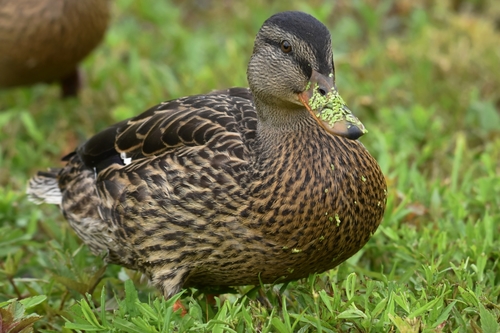 Mallard
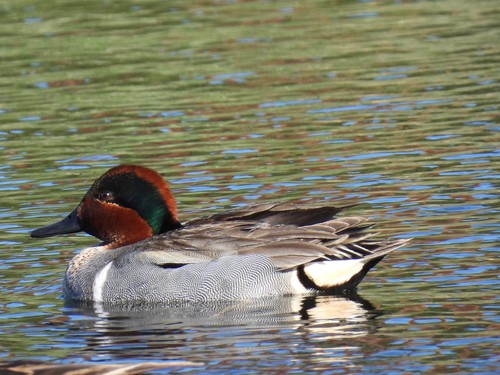 Eurasian/Green-winged Teal
In short
The most reliable field mark to separate Mallard from Eurasian/Green-winged Teal is size: even at a distance or in flight, Mallard is much larger and heavier-bodied, while Teal is notably small and compact. In flight, both species show an iridescent green speculum, but Teal's is bordered by white and often flashes a yellowish triangle at the tail, while Mallard's speculum is bordered with white only on the trailing edge. Females and juveniles of both species are mottled brown, but Teal is much more finely patterned and daintier overall. Structure, especially bill size and body shape, is a strong backup: Mallard has a broad, flat bill and a long, heavy body; Teal is short-necked, short-billed, and quick. Misidentifications often happen with female or juvenile birds, especially in mixed flocks or poor light.
Identification tips
- Size is the first check: Mallard is much larger and heavier than Teal. If you see a duck that looks dainty and small, especially in a mixed flock, it's likely Teal.
- Speculum pattern in flight: Both show a green speculum, but Mallard's is bordered white only on the trailing edge, while Teal's is bordered by white both in front and behind, and often flashes a yellowish triangle at the tail sides (all ages/sexes).
- Bill structure: Mallard has a broad, flat bill; Teal's bill is short and neat, never appearing broad from a distance.
- Body shape and posture: Mallard is long-bodied, sits low in the water, and has a long neck. Teal is compact, short-necked, and sits higher, often looking buoyant.
- Female/juvenile plumage: Female Mallard is coarsely mottled with strong contrast and a pale face; female Teal is finely streaked and scaly, with a more uniform, delicate look.
- Male breeding plumage: Mallard drake has a green head, white collar, and chestnut breast; Teal drake has a chestnut head with a bold green crescent and a white vertical stripe on the side.
- Eclipse plumage: Male Teal in eclipse resembles the female but is darker above; Mallard males in eclipse are still larger and bulkier, with a duller version of their usual plumage.
- Tail pattern in flight: Teal shows a bright yellowish triangle at the tail sides; Mallard does not.
- Wing length and shape: Teal's wings are short and pointed, giving a rapid, flickering flight; Mallard's are broader and flight is steadier.
- Flock structure: Teal often fly in tight, twisting flocks; Mallard flocks are looser and less coordinated.
- Behavior when flushed: Teal flushes quickly and erratically; Mallard rises more slowly and steadily.
- Voice: Listen for high-pitched whistles (Teal) versus deeper quacks (Mallard).
- Habitat context: In urban parks or large open water, Mallard dominates; in shallow, muddy, or vegetated wetlands, especially with tight flocks, look for Teal.
- Bare part color: Mallard males have yellow bills, females orange and black; Teal bills are dark grey (males) or pinkish/yellowish at base (females/immatures), but this is subtle at a distance.
- Duckling size: Downy young are similar in color, but Teal ducklings are much smaller and lighter.
Size
Mallard is a medium-large duck: 50–65 cm long, 0.7–1.6 kg, with a wingspan of 81–98 cm [wikipedia][avonet]. Eurasian/Green-winged Teal is much smaller: 34–43 cm long, 340–360 g, with a wingspan of 53–59 cm [wikipedia][avonet]. Even without direct comparison, Teal looks noticeably petite and light, while Mallard is robust and heavy. The difference is obvious in flight, on water, or on land. Bill and tarsus are also proportionally much shorter in Teal.
Plumage
Juvenile and female Mallards are coarsely mottled brown with a strong contrast between buff and dark brown on each feather, a pale face with a dark crown and eye-stripe, and a blue or violet speculum bordered white only on the trailing edge. Juvenile and female Teal are much smaller, with finer, denser streaking on the head and neck, a scaly pattern on the body, and a green speculum bordered by white both in front and behind, plus a yellowish triangle at the tail sides in flight. In adult breeding plumage, male Mallard is unmistakable with a glossy green head, white collar, and chestnut breast; male Teal has a chestnut head with a bold green crescent from eye to nape, a white vertical stripe on the side, and a yellowish patch at the tail. In eclipse (non-breeding) plumage, male Teal resembles the female but is darker above and keeps a greyish bill. Mallard males in eclipse are duller but still larger and bulkier than any Teal. Downy young of both are yellow below and dark above, but Teal ducklings are much tinier.
Behaviour
Mallards are often seen in large, loose flocks, feeding in open water or dabbling at the edge, and are generally less wary. Teal are more compact, often in tight groups, and flush quickly with rapid, twisting flight. On water, Teal sit higher and look more buoyant, while Mallard is heavier and sits lower. Teal are more agile and quick in flight, with rapid wingbeats, while Mallard has a steadier, slower wingbeat.
Habitat
Both species use wetlands, but Mallard is more generalist, found in a wide range of open water, urban ponds, and marshes. Teal prefers shallow, vegetated wetlands, muddy edges, and is less likely in urban or heavily disturbed sites. In migration and winter, Teal often gather in large flocks on shallow lakes or flooded fields, sometimes with Mallards but usually in denser, more cohesive groups.
Voice
Mallard males give a soft rasping or 'quack', while females have the familiar loud 'quack'. Teal males whistle with a clear, high 'cryc' or 'creelycc', and females give a softer 'keh' or 'neeh' quack. Teal are generally more vocal and higher-pitched, especially in flight or when flushed. Mallard's calls are deeper and more resonant.