

Malagasy Kestrel vs Seychelles Kestrel
Falco newtoni versus Falco araeus
Play a quiz with Malagasy Kestrel and Seychelles Kestrel
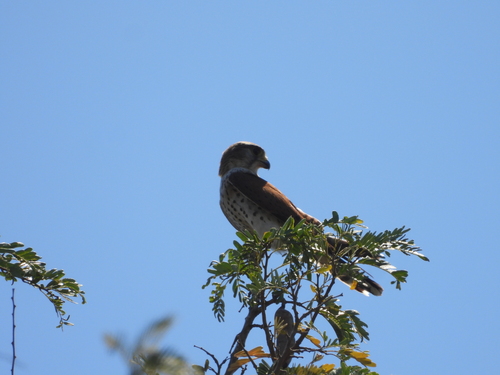 Malagasy Kestrel
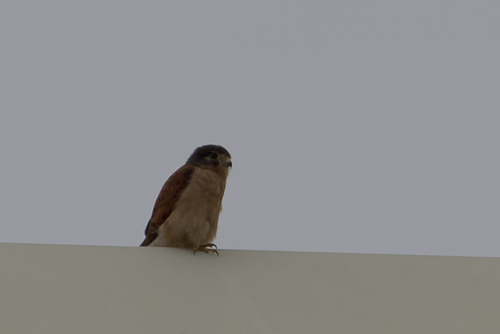 Seychelles Kestrel
In short
The most reliable field mark to separate Malagasy Kestrel and Seychelles Kestrel is the underpart spotting: Malagasy Kestrel of all ages shows distinct black spots on the whitish underparts, while adult Seychelles Kestrel has plain, unspotted buff underparts. Juvenile Seychelles Kestrel can show some breast spotting, but the head is brown and streaked, not rufous-grey or chestnut as in Malagasy Kestrel. In flight, both are small kestrels with barred tails, but the Seychelles Kestrel is noticeably smaller and more compact, with shorter, rounder wings. Head and rump color also help: Seychelles Kestrel adults have a dark blue-grey head and rump, while Malagasy Kestrel males have a rufous-grey head with dark streaks. Habitat is a strong clue: Malagasy Kestrel is found on Madagascar and Aldabra, while Seychelles Kestrel is endemic to the Seychelles.
Identification tips
- Underpart spotting: Malagasy Kestrel of all ages shows black spots on the whitish underparts; Seychelles Kestrel adults are plain buff below. This is the most reliable field mark in perched or flying birds.
- Juvenile head and breast: Juvenile Seychelles Kestrel has a brown, streaked head and some breast spotting, but not the rufous/grey or chestnut head and heavy spotting of juvenile Malagasy Kestrel.
- Adult head color: Seychelles Kestrel adults have a dark blue-grey head and rump; Malagasy Kestrel males have a rufous-grey, streaked head, and females a stronger chestnut head.
- Tail pattern: Both have barred tails, but Malagasy Kestrel's tail is grey with 6–7 narrow black bars and a broad subterminal bar, all feathers tipped white; Seychelles Kestrel's tail is blue-grey with black bars, and immatures have a buff tip.
- Upperparts: Malagasy Kestrel upperparts are chestnut with black spots; Seychelles Kestrel upperparts are reddish brown with black spots, but the difference is subtle and not always reliable in the field.
- Size and structure: Seychelles Kestrel is noticeably smaller and more compact, with shorter, rounder wings and a shorter tail. Malagasy Kestrel appears longer and slimmer, especially in flight.
- Rufous morph: Only Malagasy Kestrel shows a rufous morph, with a nearly black head and dark chestnut body, still with black streaks and spots below. If you see this morph, it is not Seychelles Kestrel.
- Bill, cere, and legs: Both have a dark bill with yellow cere and legs, but Malagasy Kestrel (rufous morph) may show bright orange legs. This is not a primary field mark.
- Sex differences: Female Malagasy Kestrel is more heavily spotted below and has a stronger chestnut head than the male; Seychelles Kestrel female is paler than the male but still unspotted below.
- Flight jizz: In flight, Seychelles Kestrel is compact and short-winged; Malagasy Kestrel is longer-winged and more buoyant.
- Habitat and range: Malagasy Kestrel is found on Madagascar and Aldabra; Seychelles Kestrel is endemic to the Seychelles. Location is a strong clue.
- Perching behavior: Both perch low, but Malagasy Kestrel may be seen hawking insects at dawn/dusk, while Seychelles Kestrel is more likely to be seen in forested or rocky areas.
- Immature tail tip: Juvenile Seychelles Kestrel has a buff tip to the tail, which is absent in Malagasy Kestrel.
- Voice: Both are called 'katiti' for their shrill calls, but no reliable separation by voice is documented.
- When in doubt: Focus on underpart spotting (present in Malagasy, absent in adult Seychelles), head color (blue-grey in Seychelles, rufous/chestnut in Malagasy), and overall size/structure.
Size
Malagasy Kestrel is larger and heavier, with males weighing 112–118 g and females up to 128 g [wikidata]. Its body length reaches about 30 cm, and wings measure 180–203 mm. Seychelles Kestrel is the smallest kestrel, only 18–23 cm long with a 40–45 cm wingspan [wikipedia]. In the field, Seychelles Kestrel looks distinctly smaller, with a more compact, short-winged, and short-tailed appearance compared to the longer, slimmer Malagasy Kestrel.
Plumage
- Juvenile/immature birds: Malagasy Kestrel juveniles resemble females, with strong chestnut tones on the head and heavy black spotting below. Seychelles Kestrel immatures have a brown, streaked head, spots on the breast (not belly), and a buff tip to the tail. The underparts of young Seychelles Kestrel are less heavily marked than Malagasy Kestrel, and the head is never rufous or chestnut.
- Adult males: Malagasy Kestrel males have a rufous-grey, streaked head, chestnut upperparts with black spots, and whitish underparts with black spots. Seychelles Kestrel males have a dark blue-grey head and rump, reddish brown upperparts with black spots, and plain buff underparts.
- Adult females: Malagasy Kestrel females have a stronger chestnut head, more spotting below, and a brown tail with black bars. Seychelles Kestrel females are similar to males but paler and slightly larger; underparts remain unspotted and buff.
- Tail: Both species have barred tails, but Malagasy Kestrel's tail is grey with 6–7 narrow black bars and a broad subterminal bar, all feathers tipped white. Seychelles Kestrel's tail is blue-grey with black bars, and immatures have a buff tip.
- Rufous morph: Only Malagasy Kestrel shows a rufous morph, with almost black head and dark chestnut body, still with black streaks and spots below.
Behaviour
Both species hunt from low perches and may hover, but Malagasy Kestrel is more likely to be seen hawking insects at dawn or dusk, often from open or semi-open habitats. Seychelles Kestrel, being island-restricted and the only raptor in its range, may be more confiding and is often seen in forested or rocky habitats. Both may take small vertebrates, but Malagasy Kestrel is more insectivorous overall.
Habitat
Habitat is a strong separator: Malagasy Kestrel is found throughout Madagascar and Aldabra, often in open country, forest edges, and even near human habitation. Seychelles Kestrel is strictly endemic to the Seychelles Islands, where it is the only breeding raptor, and is found in forest, woodland, and rocky areas. If seen outside the Seychelles, the bird is Malagasy Kestrel by default.
Voice
Both species are called 'katiti' in local Creole after their loud, shrill calls, but no diagnostic differences in voice are described in the available notes.