

Magpie Mannikin vs Black-and-white Mannikin
Spermestes fringilloides versus Spermestes bicolor
Play a quiz with Magpie Mannikin and Black-and-white Mannikin
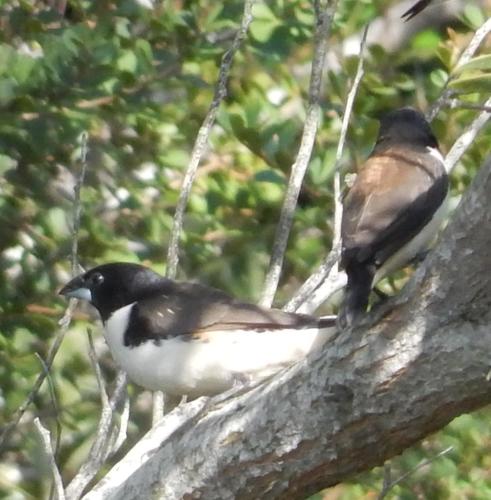 Magpie Mannikin
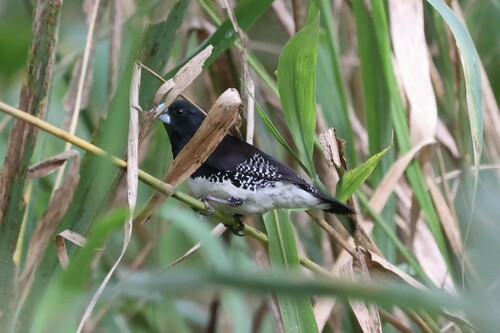 Black-and-white Mannikin
In short
Magpie Mannikin and Black-and-white Mannikin are both small, black-and-white estrildid finches of sub-Saharan Africa, but they differ in abundance, subtle plumage details, and preferred habitats. The Magpie Mannikin is much less widespread and favors drier grassland and shrubland, while the Black-and-white Mannikin is common in moist savanna and forest. In the field, separation is challenging due to their similar size and overall pattern, but habitat and local abundance can be strong clues. No age-specific wing or flight pattern differences are documented in the available sources, so focus on context and subtle plumage distinctions.
Identification tips
- Habitat is often the most useful clue: Magpie Mannikin prefers drier grasslands and shrubland, while Black-and-white Mannikin is abundant in moist savanna and forest. Always note the local habitat before making an ID.
- Abundance and range: Black-and-white Mannikin is much more widespread and likely to be encountered across sub-Saharan Africa. If you see a flock of mannikins in a typical area, odds favor Black-and-white Mannikin unless you are in a known Magpie Mannikin locality.
- Plumage contrast: Magpie Mannikin tends to show a crisper, more sharply defined black-and-white pattern, while Black-and-white Mannikin may appear slightly duller or browner, especially on the back (sometimes called 'red-backed'). This is subtle and may be affected by light and wear.
- Back color: If you notice a brownish or reddish wash on the back, this favors Black-and-white Mannikin, but beware of individual variation and feather wear.
- Juvenile birds: No clear field marks are described for separating juveniles, so be cautious with young or molting birds.
- Bill shape and structure: No reliable differences are documented; both have the typical thick, conical mannikin bill.
- Flight and wing pattern: No distinctive age-specific wing or flight marks are described for either species, so do not rely on in-flight pattern for separation.
- Flock composition: Both species may mix with other mannikins, but mixed flocks are more likely to be dominated by the common Black-and-white Mannikin.
- Perched posture and jizz: Both species perch upright and have similar proportions; posture is not a reliable separator.
- Voice: No diagnostic vocal differences are described in the available sources; do not rely on calls for separation.
- Season and sex: No seasonal or sexual plumage differences are described that would help in separating these two species.
- Geographic context: If birding in an area where Magpie Mannikin is known to be rare or absent, default to Black-and-white Mannikin unless you have strong evidence otherwise.
- Documentation: If you suspect Magpie Mannikin in an area dominated by Black-and-white Mannikin, take careful notes and photos, focusing on any sharpness of contrast and habitat context.
- Pitfalls: Overlap in range and habitat can occur, especially at edges of distribution; always use multiple features and context for a confident ID.
- Summary: In practice, most field separations rely on habitat and abundance, with subtle plumage differences as supporting evidence. When in doubt, document thoroughly and consult local experts.
Size
Both species are small estrildid finches, and no reliable size or mass differences are documented in the available sources. Expect similar proportions and jizz in the field, so do not rely on size for separation.
Plumage
No detailed age-specific wing or flight pattern differences are described in the available sources for either species. Both show a black-and-white pattern typical of Spermestes mannikins. Adult plumage is similar, but the Magpie Mannikin is said to have a more sharply contrasting black-and-white pattern, while the Black-and-white Mannikin may show a duller or browner wash, especially on the back (sometimes called 'red-backed'). Juvenile and immature plumages are not described in detail, so caution is needed with young birds.
Behaviour
Both species are typical mannikins, often seen in small flocks and feeding on grass seeds. No behavioral differences are described in the available sources that would reliably separate them in the field.
Habitat
Habitat is a key separator: Magpie Mannikin is sparsely present and favors subtropical or tropical moist shrubland, forest, and especially dry grassland. In contrast, Black-and-white Mannikin is much more widespread and common, preferring moist savanna and lowland forest. If you find a mannikin in a dry grassland or shrubland, consider Magpie Mannikin; in moist savanna or forest, Black-and-white Mannikin is far more likely.
Magpie Mannikin · Black-and-white Mannikin · My Tricky Birds