

Madagascar Forest Rail vs Tsingy Forest Rail
Mentocrex kioloides versus Mentocrex beankaensis
Play a quiz with Madagascar Forest Rail and Tsingy Forest Rail
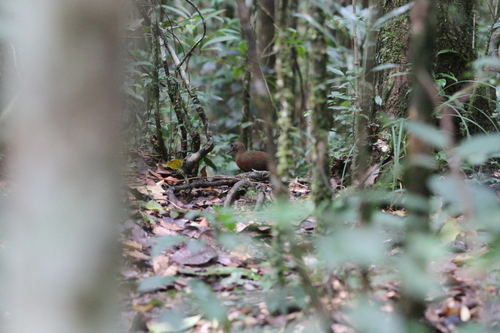 Madagascar Forest Rail
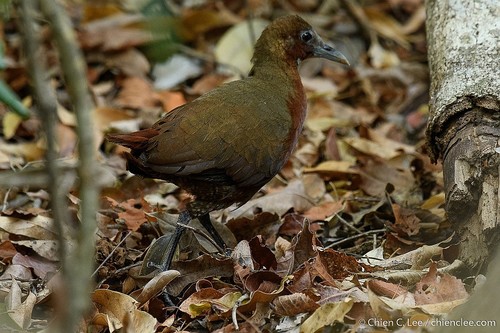 Tsingy Forest Rail
In short
The most reliable field mark to separate Madagascar Forest Rail from Tsingy Forest Rail is overall size: Tsingy is distinctly larger. In addition, the two differ in throat, facial, and eye-region coloration, with Tsingy showing unique patterns in these areas. Habitat is also a strong clue: Madagascar Forest Rail is found in wet forests of northern and eastern Madagascar, while Tsingy Forest Rail is restricted to dry deciduous forests and limestone karst in west-central Madagascar. Juvenile and immature plumages are not described in detail for Tsingy, but Madagascar Forest Rail immatures have less grey on the head and yellow spotting on the undertail-coverts. Structural and plumage differences are subtle, so context and size are often key.
Identification tips
- Size is the most reliable field mark: Tsingy Forest Rail is noticeably larger than Madagascar Forest Rail. Use this when you have a good sense of scale or can compare to known objects or other birds.
- Throat and facial pattern: Tsingy Forest Rail has a distinctive throat color, moustachial stripe, and eye-region pattern. Madagascar Forest Rail lacks these specific facial contrasts, instead showing a more uniform reddish-brown with a greyer head.
- Undertail-coverts: Madagascar Forest Rail adults have darker undertail-coverts, while immatures show yellow spotting here. There is no description of undertail pattern for Tsingy Forest Rail, so this mark is only useful for Madagascar Forest Rail.
- Head and upperparts: Madagascar Forest Rail adults have a greyer head, especially in the paler subspecies (M.k. berliozi), which also shows a larger white throat patch and pale greenish-olive upper back. These features are not described for Tsingy Forest Rail.
- Juvenile/immature plumage: Only Madagascar Forest Rail immatures are described—duller overall, less grey on the head, and yellow-spotted undertail. If you see these features, you are likely looking at Madagascar Forest Rail.
- Sexes similar: Both species have similar plumage in males and females, so sex is not a useful separator.
- No known flight/wing pattern differences: There are no documented differences in upperwing or flight pattern between the two, so do not rely on this in the field.
- Habitat is critical: Madagascar Forest Rail is found in wet, often eastern forests; Tsingy Forest Rail is restricted to dry deciduous and limestone karst forests of west-central Madagascar. Use habitat as a primary clue if plumage is ambiguous.
- Bill and structure: Both species are rail-like, with no specific differences in bill length or shape described between them. Do not rely on bill structure for separation.
- Behavior: Both are secretive and shy, often difficult to observe. Behavior is not a reliable separator.
- Subspecies variation: If you encounter a paler Madagascar Forest Rail with more grey on the forehead and a larger white throat patch, you may be seeing the M.k. berliozi subspecies. This should not be confused with Tsingy Forest Rail, which is larger and has distinctive facial patterning.
- Geographic context: If you are outside the known range of one species, it is highly unlikely to occur. Always consider your location on the island.
- No vocalization differences described: Calls and songs are not documented as distinguishing marks between these two species.
- When in doubt: If you cannot assess size or habitat, and the bird lacks distinctive facial or throat patterning, identification may not be possible to species level.
Size
Madagascar Forest Rail is a medium-sized rail, about 28 cm in length and weighing 250–280 g. Tsingy Forest Rail is larger than Madagascar Forest Rail, though exact measurements are not provided. In the field, Tsingy will appear bulkier and longer, which is especially noticeable if both species are seen in similar postures or at close range. Both species are similar in overall rail proportions, but size is a consistent separator when seen well.
Plumage
Adults of both species are reddish-brown overall, but differ in facial and throat pattern: Tsingy Forest Rail shows distinct coloration on the throat, moustachial stripe, and around the eyes, which are not matched by Madagascar Forest Rail. Madagascar Forest Rail adults are reddish-brown with a greyer head and darker undertail-coverts; immatures are duller, with less grey on the head and yellow spotting on the undertail. The subspecies M.k. berliozi of Madagascar Forest Rail is paler, with more grey on the forehead, a larger white throat patch, and a pale greenish-olive upper back. Juvenile and immature plumages for Tsingy Forest Rail are not described, so caution is needed with young birds. No specific wing or flight pattern differences are documented for either species.
Behaviour
Both species are secretive, ground-dwelling rails, typically shy and difficult to observe. There is no mention of behavioral differences in foraging, movement, or flight between the two. Both are likely to be seen briefly as they move through dense undergrowth, and both are more often heard than seen.
Habitat
Habitat is a strong separator: Madagascar Forest Rail is found in wet forests (often near water) in northern and eastern Madagascar. In contrast, Tsingy Forest Rail is restricted to dry deciduous forests and limestone karst in the lowlands of west-central Madagascar. If you are birding in wet, eastern forests, Tsingy is extremely unlikely; in dry, limestone-rich forests of the west, Madagascar Forest Rail is not expected.
Madagascar Forest Rail · Tsingy Forest Rail · My Tricky Birds