

Madagascar Blue-Pigeon vs Comoro Blue-Pigeon
Alectroenas madagascariensis versus Alectroenas sganzini
Play a quiz with Madagascar Blue-Pigeon and Comoro Blue-Pigeon
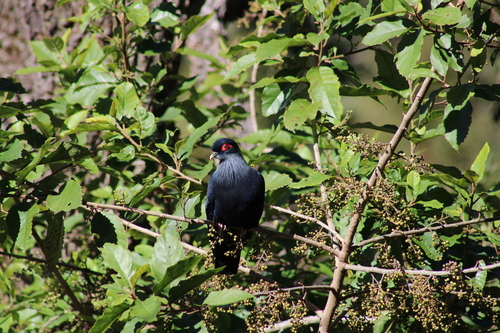 Madagascar Blue-Pigeon
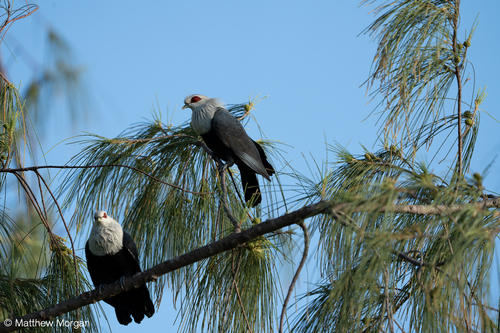 Comoro Blue-Pigeon
In short
The most reliable field mark to separate Madagascar Blue-Pigeon from Comoro Blue-Pigeon is the tail color: Madagascar Blue-Pigeon has a deep red tail, while the Comoro Blue-Pigeon’s tail color is not described in the sources, but the red tail is unique to Madagascar Blue-Pigeon among the group. Both species show overall blue and silvery-grey plumage with filamentous neck feathers, but Madagascar Blue-Pigeon also has a striking red bare patch around the eye and red feet, which are not described for Comoro Blue-Pigeon. Range is a strong separator: Madagascar Blue-Pigeon is only found in northern and eastern Madagascar, while Comoro Blue-Pigeon is restricted to the Comoros and coralline Seychelles. In the field, focus on tail color, facial skin, and location for the most reliable separation.
Identification tips
- Tail color is key: Madagascar Blue-Pigeon has a deep red tail, which is not described for Comoro Blue-Pigeon. If you see a red tail, you are looking at Madagascar Blue-Pigeon.
- Facial skin: Madagascar Blue-Pigeon has a large red patch of bare skin around the yellow eye. This feature is not mentioned for Comoro Blue-Pigeon and is likely absent or much less prominent.
- Feet color: Madagascar Blue-Pigeon has red feet, a feature not described for Comoro Blue-Pigeon. If you see red feet, this supports Madagascar Blue-Pigeon.
- Bill color: Madagascar Blue-Pigeon has a small greenish bill with a yellow tip. Bill color for Comoro Blue-Pigeon is not described, so use with caution.
- Overall plumage: Both species are dominated by blue and silvery-grey tones with filamentous neck plumes. This is not a reliable separator.
- Range: If you are in Madagascar (especially the north or east), it is Madagascar Blue-Pigeon. If you are in the Comoros or coralline Seychelles, it is Comoro Blue-Pigeon. There is no overlap.
- Group behavior: Comoro Blue-Pigeon is often seen in groups, flying between islands, and perching high to sun themselves. Madagascar Blue-Pigeon’s social behavior is not described, but this is not a reliable separator on its own.
- Flight style: Comoro Blue-Pigeon has a fast flight with wing claps, but this is not described for Madagascar Blue-Pigeon and may not be diagnostic.
- Habitat: Both are arboreal and fruit-eating, but Comoro Blue-Pigeon is specifically noted for avoiding the ground and flying over water between islands. Madagascar Blue-Pigeon’s habitat use is not detailed, so use with caution.
- Juvenile/immature plumage: No information is available for age-specific marks, so do not rely on immature wing pattern for separation.
- Sexual dimorphism: No information is given for either species, so assume sexes are similar in the field.
- Vocalization: No vocal differences are described in the sources; do not rely on voice for separation.
- Seasonal variation: No seasonal plumage differences are described for either species.
- Pitfalls: Do not rely on general blue coloration or size, as both species are similar in these respects. Focus on tail color, facial skin, and location for the most reliable separation.
Size
Madagascar Blue-Pigeon is 25–27 cm in length [wikipedia]. No direct size data is given for Comoro Blue-Pigeon, but as close relatives in the same genus, they are likely similar in size and structure. No reliable size-based separation is possible with the available information.
Plumage
- Adults: Madagascar Blue-Pigeon is dominated by blue and silvery-grey tones, with a silvery blue-grey neck and throat, filamentous neck plumes, silvery-grey upperparts, blue-grey breast, deep blue belly, and a deep red tail. The head is blue with a large red bare patch around the yellow eye, and the bill is greenish with a yellow tip. The feet are red.
- Comoro Blue-Pigeon: No detailed color description is provided, but as a close relative, it likely shares the general blue and grey coloration. However, the sources do not mention a red tail, red facial skin, or red feet for Comoro Blue-Pigeon, suggesting these are absent or much less pronounced.
- Juvenile/immature plumage: No specific information is given for either species regarding age-specific wing or upperwing patterns, so no separation is possible on this basis.
Behaviour
Comoro Blue-Pigeon is sometimes solitary but often seen in groups (up to 15), flying between islands, sometimes as low as 10 m above water, and often perching high in trees to sun themselves. Their flight is described as fast with wing claps. They are highly arboreal and rarely land on the ground. Madagascar Blue-Pigeon’s behavior is not detailed, but as a close relative, it is likely similar in arboreal habits. No diagnostic behavioral differences are described.
Habitat
Madagascar Blue-Pigeon is endemic to northern and eastern Madagascar, while Comoro Blue-Pigeon is found only in the Comoros and coralline Seychelles. This non-overlapping range is a strong separator. Both are arboreal and fruit-eating, but only Comoro Blue-Pigeon is specifically noted for flying between islands and avoiding the ground.
Madagascar Blue-Pigeon · Comoro Blue-Pigeon · My Tricky Birds