

Long-tailed Skua vs Pomarine Skua
Stercorarius longicaudus versus Stercorarius pomarinus
Play a quiz with Long-tailed Skua and Pomarine Skua
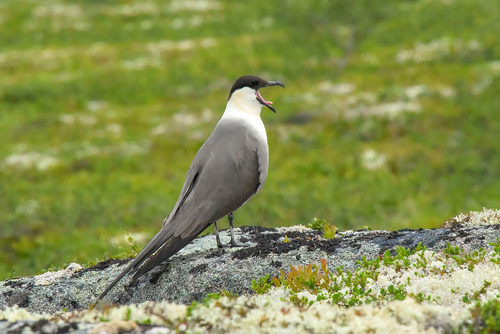 Long-tailed Skua
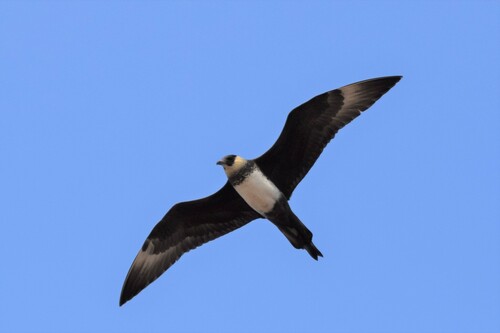 Pomarine Skua
In short
The most reliable field mark between Long-tailed Skua and Pomarine Skua is the presence or absence of a bold white 'flash' on the wing: Pomarine Skua adults (all morphs) show a prominent white double flash on the underwing, while Long-tailed Skua adults lack this feature and have plain dark primaries. In flight, Pomarine is bulkier and broader-winged, while Long-tailed is slimmer and more tern-like. Adult Long-tailed Skuas have extremely long, slender tail streamers, whereas Pomarine's tail streamers are shorter, spoon-shaped, and twisted. Juvenile separation is difficult, but Long-tailed is generally colder-toned and greyer, while Pomarine is bulkier and browner. Size is also a clue, with Pomarine being much heavier and larger overall.
Identification tips
- White wing flash (all ages): Pomarine Skua always shows a bold white double flash on the underwing (all morphs and ages), visible in flight. Long-tailed Skua lacks this, with plain dark primaries. This is the single most reliable field mark.
- Tail shape and length (adults, breeding): Adult Long-tailed Skua has extremely long, slender, pointed tail streamers (up to 29 cm), while Pomarine's are shorter (about 10 cm), spoon-shaped, and twisted. Outside breeding, both species lose tail streamers, so this is less useful.
- Overall structure: Pomarine is much bulkier, with broader wings and a heavier, more gull-like build. Long-tailed is slimmer, more tern-like, with narrower wings and a more delicate jizz.
- Flight style: Long-tailed Skua is agile, often hovers, and appears light and buoyant. Pomarine is heavier, with a more deliberate, powerful flight.
- Juvenile plumage: Juvenile Long-tailed Skua is colder, greyer, and more uniform, while Pomarine juvenile is browner and bulkier. Both are variable, but Pomarine's white underwing flash is a key mark.
- Head pattern (adults, light morph): Adult Pomarine (light morph) has a yellowish-white head and neck with a black cap, while Long-tailed has a black cap but a greyer back and lacks the yellowish tones.
- Bill and head: Pomarine's bill is stouter and heavier, matching its overall robust appearance. Long-tailed's bill is finer and more delicate.
- Size in context: If seen with gulls, Pomarine is as large or larger than most common gulls, while Long-tailed is noticeably smaller.
- Habitat context: Inland sightings of skuas in migration are more likely to be Long-tailed, especially if the bird is hunting insects or small prey on fields. Pomarine is rarely seen away from the sea outside breeding.
- Behavior near humans: Long-tailed juveniles are often fearless and may approach closely on migration; Pomarine is less likely to do so.
- Plumage morphs: Pomarine comes in three morphs (light, dark, intermediate), but all retain the white underwing flash. Long-tailed is less variable and never shows a white wing flash.
- Underparts (adults): Pomarine (light morph) has mainly white underparts, while Long-tailed is more evenly grey and white, with less contrast.
- Vocalizations: If heard, Long-tailed's calls are higher-pitched and rattling; Pomarine's are deeper and chattering, but this is rarely diagnostic in the field.
- Tail in non-breeding/juvenile: Both species lose tail streamers outside breeding, so tail shape is less useful then; rely on wing flash and structure.
- Mixed flocks: If multiple skuas are present, compare size and structure directly—Pomarine will stand out as the largest and bulkiest, Long-tailed as the most slender and tern-like.
Size
Pomarine Skua is substantially larger and heavier than Long-tailed Skua. Adult Pomarine averages around 694 g, while Long-tailed averages about 289 g. Pomarine's wingspan (110–138 cm) and body length (46–67 cm, including tail streamers) exceed Long-tailed's (wingspan 102–117 cm; length 38–58 cm, with up to 29 cm from the tail). In the field, Pomarine appears bulkier and more gull-like, while Long-tailed is noticeably slimmer and more delicate.
Plumage
Juvenile and immature birds are the toughest to separate. Pomarine juveniles are variable but generally browner and bulkier, with a white double flash on the underwing (visible in all morphs and ages), while Long-tailed juveniles are colder, greyer, and lack the white wing flash, appearing more uniform and plain in the primaries. Adult Long-tailed Skuas in breeding plumage are unmistakable with their very long, slender tail streamers, grey back, black cap, and clean, dark primaries without a white flash. Pomarine adults (light morph) have a brown back, white underparts, yellowish-white head and neck with a black cap, and the diagnostic white double flash on the underwing. Their tail streamers are shorter, spoon-shaped, and twisted. Dark and intermediate morph Pomarines are overall dark brown but retain the white underwing flash. Non-breeding and juvenile birds of both species can be confusing, but structure and wing pattern are key.
Behaviour
Long-tailed Skua is more agile and tern-like in flight, often hovering over breeding territories. Pomarine Skua has a heavier, more measured flight, appearing less agile and more gull-like. Both species are kleptoparasitic, chasing other seabirds for food, but Pomarine's bulkier build and broader wings give it a more powerful presence. Long-tailed is more likely to be seen hunting small prey on land during migration, sometimes fearlessly close to humans.
Habitat
Both species breed in Arctic regions but Pomarine Skua tends to be associated with wetter tundra and coastal areas, while Long-tailed Skua prefers drier tundra and higher ground. On migration and in winter, both are pelagic, but Long-tailed may be seen inland more often during passage, especially juveniles on fields or golf courses. Pomarine is more strictly marine outside the breeding season.
Voice
Long-tailed Skua on breeding grounds gives yelping and rattling calls, and a harsh 'kreeah' outside the breeding season. Pomarine Skua has harsh chattering calls and a 'which-yew' sound. In most field situations, vocalizations are not the primary means of separation, but Long-tailed's calls are higher-pitched and more rattling, while Pomarine's are deeper and harsher.