

Long-tailed Shrike vs Great Grey Shrike
Lanius schach versus Lanius excubitor
Play a quiz with Long-tailed Shrike and Great Grey Shrike
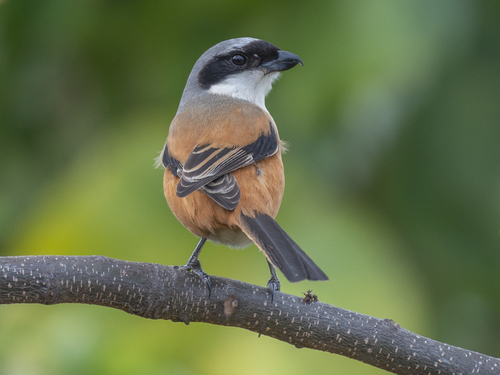 Long-tailed Shrike
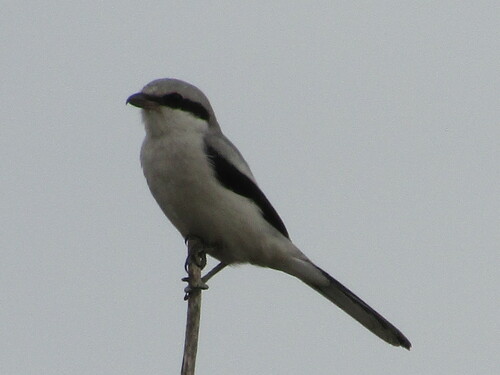 Great Grey Shrike
In short
The most reliable field mark between Long-tailed Shrike and Great Grey Shrike is the tail: Long-tailed Shrike has a distinctly long, narrow, and graduated tail with rufous tones, while Great Grey Shrike’s tail is shorter, wedge-shaped, and lacks rufous. Both have a black facial mask, but Long-tailed Shrike’s is broader and often covers the forehead, especially in some subspecies. Great Grey Shrike is much bulkier and paler overall, with a pearly grey back and white underparts, whereas Long-tailed Shrike shows rufous on the flanks and rump. In flight or perched, look for the Long-tailed Shrike’s smaller size and more colorful, contrasting plumage versus the Great Grey Shrike’s larger, greyer, and heavier appearance.
Identification tips
- Tail shape and color: Long-tailed Shrike has a long, narrow, and graduated tail with pale rufous outer feathers; Great Grey Shrike’s tail is shorter, wedge-shaped, and lacks rufous. This is the most reliable field mark at any age.
- Overall size and build: Great Grey Shrike is much larger and heavier-bodied (almost double the mass), with a bulkier head and thicker neck. Long-tailed Shrike is more slender and elongated.
- Facial mask: Long-tailed Shrike’s black mask is broader, often covering the forehead (especially in tricolor and nasutus subspecies), while Great Grey Shrike’s mask is narrower and does not extend over the crown.
- Back and flanks color: Long-tailed Shrike shows rufous on the rump and flanks, and some subspecies have rufous on the mantle and upper back. Great Grey Shrike is pearly grey above, with no rufous tones.
- Wing pattern: Both have white at the base of the primaries, but Great Grey Shrike’s white wing patch is more prominent and contrasts with the black wing. Long-tailed Shrike’s white is smaller and less striking.
- Underparts: Great Grey Shrike has clean white underparts, while Long-tailed Shrike has white underparts with rufous flanks.
- Perched posture: Both sit upright, but Long-tailed Shrike often appears more elongated due to its tail, while Great Grey Shrike is chunkier and more upright.
- Flight style: Great Grey Shrike’s flight is undulating and heavy, with display spirals and hovering in social contexts. Long-tailed Shrike glides down at an angle from its perch.
- Bill structure: Great Grey Shrike has a heavier, more powerful bill, but this may be hard to judge without close views.
- Habitat context: Long-tailed Shrike is more likely in warm, dry, open country with bushes and wires; Great Grey Shrike favors open country in cooler climates, often with scattered trees.
- Vocalizations: If you hear extensive mimicry or harsh, grating calls, suspect Long-tailed Shrike. Great Grey Shrike’s calls are less mimetic.
- Sex and age: Both species are sexually monomorphic in plumage. No distinctive juvenile wing patterns are described for field use, so focus on adult marks.
- Subspecies variation: Some Long-tailed Shrike subspecies (e.g., tricolor, nasutus) have an all-black head, which can be confusing, but the rufous tail and flanks remain diagnostic.
- Pitfalls: In poor light, Long-tailed Shrike’s rufous tones may be subdued, but the tail length and shape still separate it from Great Grey Shrike. Great Grey Shrike never shows rufous.
- Group behavior: Great Grey Shrike may be seen in small groups in winter, while Long-tailed Shrike is usually solitary or in pairs.
Size
Great Grey Shrike is substantially heavier (about 63 g vs 36 g) and appears much bulkier and more robust than Long-tailed Shrike. In the field, Great Grey Shrike looks larger-headed and thicker-necked, with a heavier bill and a generally more imposing presence. Long-tailed Shrike is noticeably slimmer, with a more elongated silhouette due to its long, narrow tail. If both birds are seen together, the size difference is striking, but beware that a lone Great Grey Shrike can sometimes appear smaller at a distance if not well seen.
Plumage
Juvenile and immature plumages are not described in detail for either species in the sources, so focus on adult and general field marks. Long-tailed Shrike always shows a long, narrow, and graduated black tail with pale rufous on the outer feathers, a rufous rump and flanks, and a black mask that is broad and often extends over the forehead (especially in some subspecies). There is a small white patch at the base of the primaries, but this is less prominent than the white wing patch of Great Grey Shrike. Great Grey Shrike is pearly grey above, with a black eye-mask (not as broad as Long-tailed Shrike’s), white underparts, and a wedge-shaped tail with white edges. Its wings are black with a prominent white spot. The overall impression is of a much paler, less rufous bird with a cleaner, more monochrome look. Sexes are alike in both species.
Behaviour
Both species perch conspicuously and hunt from elevated positions, but Great Grey Shrike often appears more deliberate and heavy in its movements, with a characteristic undulating and powerful flight. It may perform display flights, spiraling high and hovering briefly before gliding down, especially in social contexts. Long-tailed Shrike typically sits upright in a classic shrike pose and glides down at an angle to catch prey. Both impale prey, but Long-tailed Shrike is more likely to be seen alone or in well-spaced pairs, while Great Grey Shrike may gather in small groups outside the breeding season.
Habitat
Long-tailed Shrike favors dry open habitats, often in scrub, bushy areas, or perched on wires and exposed branches. It is widespread across Asia, including the eastern archipelagos. Great Grey Shrike is more associated with open country, sometimes with scattered trees or shrubs, and is found across Eurasia, often in colder or more northern regions. Both can overlap in some open habitats, but Long-tailed Shrike is more likely in warmer, subtropical, or tropical settings, while Great Grey Shrike prefers temperate to subarctic zones.
Voice
Long-tailed Shrike gives harsh, grating, and scolding calls, sometimes likened to a squealing frog, and is capable of extensive vocal mimicry, including imitating other birds and even mammals. Great Grey Shrike’s calls are not described in detail here, but are generally less varied and less mimetic than Long-tailed Shrike’s. If you hear a shrike mimicking a wide range of sounds, it is more likely to be Long-tailed Shrike.