
Lizard Buzzard vs Gabar Goshawk
Kaupifalco monogrammicus versus Micronisus gabar
Play a quiz with Lizard Buzzard and Gabar Goshawk
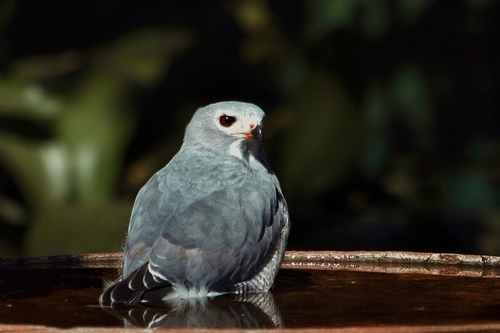 Lizard Buzzard
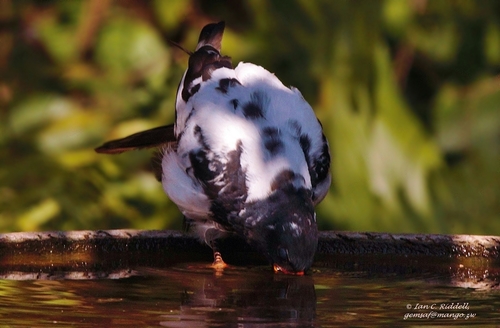 Gabar Goshawk
In short
The most reliable field mark to separate Lizard Buzzard from Gabar Goshawk is the Lizard Buzzard’s bold, vertical black throat stripe, which is unique among African raptors and visible in both perched and flying birds of all ages. Juvenile and adult Gabar Goshawks never show this mark. In flight, Lizard Buzzard’s underwings are white with dark tips, while Gabar Goshawk (pale morph) shows barred underwings and a distinctive white rump. Gabar Goshawk is also noticeably slimmer and lighter, with a longer tail and more agile, accipiter-like flight compared to the stockier, more compact Lizard Buzzard. Both species can show grey upperparts and reddish legs/cere as adults, but careful attention to throat, underwing, and structure will resolve most field encounters.
Identification tips
- Look for the vertical black throat stripe: Only Lizard Buzzard shows a bold, vertical black line on the white throat. This is present in all ages and is diagnostic at any distance if visible.
- Check for a white rump in flight: Gabar Goshawk (pale morph) always shows a conspicuous white rump, visible both perched and especially in flight. Lizard Buzzard lacks this feature.
- Assess underwing pattern: Lizard Buzzard has white underwings with dark tips (adults and juveniles), while Gabar Goshawk (pale morph) shows barred underwings. In dark morph Gabar Goshawk, the entire underwing is dark.
- Tail pattern: Lizard Buzzard’s tail is black with a single white band and white tip. Gabar Goshawk’s tail is dark grey with multiple narrow bars and no single broad band.
- Overall structure: Lizard Buzzard is stocky, compact, and short-tailed, with relatively short, pointed wings. Gabar Goshawk is slimmer, longer-tailed, and more accipiter-like in both flight and perched posture.
- Leg and cere color in immatures: Both species show yellow cere and legs as immatures, but only Gabar Goshawk immatures are browner overall with untidy barring and a white rump. Lizard Buzzard immatures are greyer and always show the throat stripe.
- Dark morph confusion: If you see an almost entirely black small raptor, it is a dark morph Gabar Goshawk; Lizard Buzzard never appears all-black.
- Flight style: Lizard Buzzard’s flight is undulating and thrush-like, with little soaring except during courtship. Gabar Goshawk is more agile, with rapid, accipiter-style flight and frequent active pursuit of prey.
- Perching behavior: Lizard Buzzard tends to perch quietly and low (6–10 m), scanning for prey before swooping down. Gabar Goshawk may perch higher, is more restless, and can be seen chasing prey through trees.
- Habitat context: Lizard Buzzard is more likely in dense woodland or forest edge; Gabar Goshawk is common in open woodland, thornveld, and sometimes gardens.
- Voice: If you hear a clear, melodious whistle in early breeding season, suspect Lizard Buzzard. Gabar Goshawk is more vocal overall but details are less distinctive.
- Relative size: If both species are seen together, Lizard Buzzard is noticeably bulkier and heavier, with a broader wingspan and thicker build.
- Sex and age pitfalls: Female Gabar Goshawks can approach male Lizard Buzzard in size, but never match the latter’s bulk or compactness. Juvenile Gabar Goshawk may look browner, but always lacks the throat stripe and shows a white rump.
- Bare part color in adults: Both species have red cere and legs as adults, so this is not a reliable separation.
- Pitfall – grey upperparts: Both can appear grey above, especially adults, but only Lizard Buzzard combines this with a throat stripe and unbarred white underparts.
Size
Lizard Buzzard is significantly heavier and bulkier (average 275.5g vs 165g for Gabar Goshawk [wikidata]), with a slightly longer body length (35–37 cm vs 28–36 cm) and broader wings (wingspan 79 cm vs 63 cm). In the field, Lizard Buzzard appears compact and thickset, with a short tail and relatively short, pointed wings. Gabar Goshawk is noticeably smaller, slimmer, and longer-tailed, with a more accipiter-like silhouette. Females of both species are larger than males, but even a female Gabar Goshawk rarely matches the mass or bulk of a male Lizard Buzzard.
Plumage
- Juveniles/immatures: Juvenile Lizard Buzzard closely resembles the adult, but has a slight brown tinge to the wings and orange-yellow cere and legs. The throat stripe is always present. Juvenile Gabar Goshawk (pale morph) is browner overall with untidier barring on the chest, yellow cere and legs, and never shows a throat stripe. Both species’ immatures have paler bare parts than adults, but the Gabar Goshawk’s barring is less crisp and the white rump is already visible.
- Adults: Lizard Buzzard is grey above, white below with fine dark barring on the belly, and always shows a vertical black throat stripe on a white throat. Underwings are white with dark tips; tail is black with a single white band and white tip. Gabar Goshawk (pale morph) is also grey above, but with a conspicuous white rump, white and grey barring on the chest, thighs, and underwings, and a dark grey, barred tail. The dark morph Gabar Goshawk is almost entirely black, which never overlaps with Lizard Buzzard. Both species have dark eyes and red cere/legs as adults, but only Lizard Buzzard has the diagnostic throat stripe.
Behaviour
Lizard Buzzard is typically solitary, silent, and hunts from low perches, rarely soaring except during courtship. Its flight is undulating, reminiscent of a thrush, and it rarely pursues prey in flight, instead swooping or gliding down onto prey on the ground. Gabar Goshawk is more active and agile, often seen alone or in pairs, especially during breeding season. It hunts both from perches and by actively flushing prey from trees, frequently pursuing small birds with energetic, accipiter-like flight. Gabar Goshawk may also raid weaver nests by tearing into them, a behavior not seen in Lizard Buzzard.
Habitat
Both species are found in Sub-Saharan Africa and can overlap in range. Lizard Buzzard prefers woodland and forest edges, often perching 6–10 m up in trees and is adapted for rapid flight in dense vegetation. Gabar Goshawk is more flexible, found in a range of wooded habitats including savanna, thornveld, and sometimes gardens. It is more likely to be seen in open woodland, acacia, or even semi-arid areas, and is less strictly tied to dense forest than Lizard Buzzard.
Voice
Lizard Buzzard is generally silent except early in the breeding season (September–October), when it gives a clear, melodious whistle: "klu-klu-klu." Gabar Goshawk is more vocal, especially during breeding, with calls given during display flights and when perched, but specific call details are not provided in the notes. Vocalizations are not usually the most reliable separation in the field, but Lizard Buzzard’s silence outside breeding season can be a supporting clue.