

Little Egret vs Ornate Sunbird
Egretta garzetta versus Cinnyris ornatus
Play a quiz with Little Egret and Ornate Sunbird
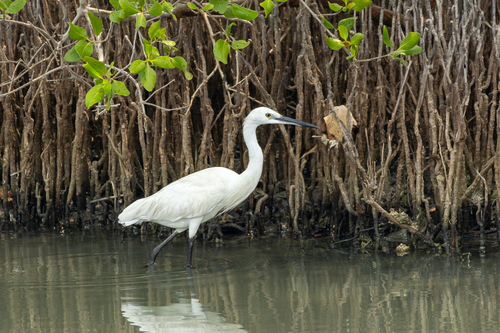 Little Egret
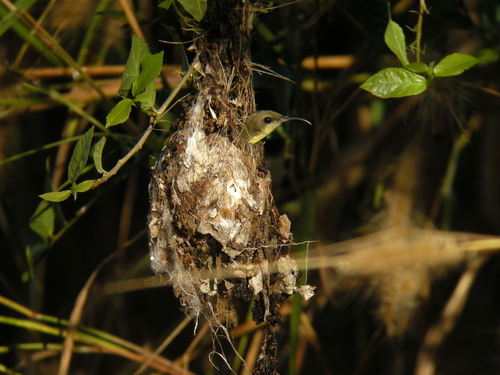 Ornate Sunbird
In short
Little Egret and Ornate Sunbird are extremely unlikely to be confused in the field due to their vast differences in size, structure, and coloration, but quiz mix-ups can happen with unfamiliar juveniles or misleading photos. The most reliable field mark is overall size: Little Egret is a large, entirely white heron with long black legs and yellow feet, while Ornate Sunbird is a tiny, active songbird with bright yellow underparts and, in males, iridescent blue-black on the throat and breast. Juvenile Little Egrets may show duller legs and some greyish or brownish feathers, but never approach the sunbird's coloration or structure. If seen in flight or perched, the egret's long neck, legs, and bill are unmistakable compared to the compact, short-billed sunbird.
Identification tips
- Size is the quickest check: If the bird is anywhere near heron-sized, it is a Little Egret; if it is tiny and sparrow-sized or smaller, it is an Ornate Sunbird. This holds for all ages and sexes.
- Plumage color: Any bird that is entirely or mostly white (apart from some greyish juvenile feathers) is a Little Egret. Ornate Sunbird is never white; males are iridescent blue-black and yellow, females greenish-olive and yellow.
- Legs and feet: Little Egret has long black legs and yellow (or blackish) feet, visible when walking or wading. Sunbirds have short black legs, never long or adapted for wading.
- Bill shape and length: Little Egret has a long, slender, straight black bill; Ornate Sunbird has a short, decurved bill suited for nectar feeding. Bill shape is diagnostic even in poor light.
- Neck length: Egrets have long, S-shaped necks, often extended or retracted in flight. Sunbirds have short necks, never appearing elongated.
- Flight silhouette: Little Egret in flight shows broad, rounded wings, trailing legs, and a long neck. Ornate Sunbird is fast, with rapid wingbeats, short tail, and compact body.
- Ornamental plumes: In breeding season, Little Egret adults show long, wispy plumes on the nape and scapulars. Sunbirds never show such plumes.
- Juvenile confusion: Juvenile Little Egrets may have duller legs and some grey or brown feathers, but are still mostly white and large. Juvenile sunbirds are never white and always small.
- Habitat context: Any bird seen wading in water or foraging in open wetlands is a Little Egret. Any bird feeding in flowers, gardens, or forest edge is an Ornate Sunbird.
- Behavior: Little Egret stalks or runs after prey in water or on land; Ornate Sunbird hovers or flits among flowers.
- Sexual dimorphism: Only Ornate Sunbird is sexually dimorphic; males are iridescent, females duller. Little Egret sexes are similar.
- Iris color: Little Egret has a yellow iris; Ornate Sunbird's iris is dark brown. Useful at close range.
- Feet color in courtship: Little Egret's feet may turn red during courtship; sunbirds never show this.
- Supercilium: Female Ornate Sunbird has a yellow supercilium; Little Egret never shows a supercilium.
- Range overlap: Little Egret is widespread in Old World wetlands, Ornate Sunbird is restricted to Southeast Asia and nearby islands. Only rarely would a vagrant egret appear in sunbird range.
Size
Little Egret is a large bird (body mass ~532 g, length 55–65 cm, wingspan 88–106 cm) [wikidata][wikipedia], dwarfing the Ornate Sunbird, which is only 10–11.4 cm long and weighs 6–12 g [wikipedia]. Even at a distance, the egret is heron-sized, while the sunbird is smaller than a sparrow. There is no overlap in size; even a juvenile egret is vastly larger than any sunbird.
Plumage
Juvenile Little Egrets are mostly white, sometimes with a few greyish or brownish feathers, and have greenish-black legs with dull yellow feet. Adults are pure white with long ornamental plumes in breeding season, black bill, black legs, and yellow feet (except some races with blackish feet). In contrast, Ornate Sunbird males have iridescent blue-black on the throat and breast, olive upperparts, black wings with green edges, and bright yellow underparts; females are greenish-olive above, yellow below, and have a yellow supercilium. No age or sex of sunbird is ever all-white or even mostly white. In flight, the egret's wings are broad and entirely white, while the sunbird's wings are short, dark, and edged green. There are no similar wing patterns between the two at any age.
Behaviour
Little Egret forages in shallow water or on land, often wading, stalking, or running after prey, sometimes associating with cormorants or livestock. Its movements are deliberate, with long strides and neck extended. Ornate Sunbird is highly active, flitting among flowers, hovering or perching briefly, and feeding on nectar and insects. The egret is never seen feeding in flowers or hovering, and the sunbird is never seen wading or stalking prey in water.
Habitat
Little Egret is found in wetlands, marshes, shallow lakes, and estuaries, often in open water or muddy edges. Ornate Sunbird inhabits gardens, forest edges, and areas with flowering plants, never in open wetlands or wading habitats. Their preferred environments do not overlap.