
Little Bee-eater vs Black-backed Puffback
Merops pusillus versus Dryoscopus cubla
Play a quiz with Little Bee-eater and Black-backed Puffback
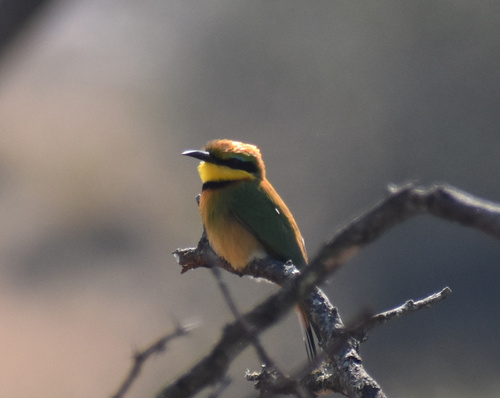 Little Bee-eater
 Black-backed Puffback
In short
The most reliable field mark to separate Little Bee-eater from Black-backed Puffback is overall color and pattern: Little Bee-eater is a slender, vividly green-and-yellow bird with a black throat band, while Black-backed Puffback is a chunkier, mostly black-and-white bushshrike with a striking red or orange eye and a dark cap. Juvenile and female puffbacks can show greyer or buffy tones, but never the bright green upperparts or yellow throat of the bee-eater. In flight or perched, the bee-eater’s slim, delicate structure and square tail contrast with the puffback’s heavier body, shorter bill, and more robust, bushshrike profile. Both species can be found in Sub-Saharan Africa, but the bee-eater favors open, grassy, or marshy areas, while the puffback sticks to wooded habitats and tree canopies.
Identification tips
- Upperparts color: Little Bee-eater is bright green above (all ages), while Black-backed Puffback is black or greyish above (male/female/immature), never green.
- Throat and breast: Bee-eater has a yellow throat with a sharp black gorget (band) below; puffback has white or buffy underparts with no black throat band.
- Bill shape: Bee-eater has a long, slender, slightly decurved bill; puffback’s bill is shorter, stouter, and more hooked, typical of bushshrikes.
- Tail shape: Bee-eater’s tail is square or slightly forked; puffback’s tail is more rounded and less prominent.
- Eye color: Adult puffbacks have red or orange eyes (varies by subspecies); bee-eater’s eyes are dark. Immature puffbacks have brown eyes.
- Cap and face: Puffback males have a solid black cap; females and immatures have a black loral stripe and white supercilium. Bee-eater has a plain green crown and face with no dark mask or cap.
- Underpart color: Bee-eater’s underparts are ochre to buff; puffback’s are pure white (male) or greyish/buffy (female/immature).
- Wing pattern: Puffbacks can show white scapular bars or white edging on wing feathers (especially in some subspecies), but never green or brown wings like bee-eater.
- Structure and posture: Bee-eater is slim, delicate, and often perches upright on exposed branches; puffback is chunkier, with a more horizontal stance and bushshrike jizz.
- Behavior: Bee-eater often sallies out to catch insects in open air; puffback moves restlessly through tree canopies and rarely hawks insects in flight.
- Habitat: Open, grassy, or marshy areas favor bee-eater; wooded, forested, or tree-rich habitats favor puffback.
- Vocalization: A soft 'seep' call is typical of bee-eater; more varied or louder calls suggest puffback.
- Sex and age confusion: Female and immature puffbacks are greyer and buffier but never green or yellow; bee-eater sexes and ages are similar and always show green/yellow/black gorget.
- Size and bulk: Puffback is heavier and bulkier (26g) than the much lighter, more delicate bee-eater (14.6g).
- Context: If seen in a group sallying from low perches, likely bee-eater; if moving singly or in pairs through tree canopy, likely puffback.
Size
Little Bee-eater is notably smaller and lighter, with an average mass of 14.6g and a length of 15–17 cm, making it the smallest African bee-eater. In contrast, Black-backed Puffback is heavier at 26g and about 17 cm long, but appears much bulkier and more robust due to its stocky build and bushshrike proportions. The bee-eater’s slender, elongated shape and fine bill are very different from the puffback’s more compact, thickset body and shorter, stouter bill.
Plumage
Juvenile and immature Black-backed Puffbacks resemble females, with greyer upperparts, buffy underparts, and brownish bills and eyes, but always lack the Little Bee-eater’s bright green upperparts and yellow throat. Little Bee-eater of all ages shows green upperparts, yellow throat bordered below by a neat black gorget, and a brownish upper breast fading to buff ochre on the belly. Its wings are green and brown, and the tail is square or slightly forked. Black-backed Puffback adult males are deep blue-black above with a glossy sheen, a black cap, red or orange eyes, and pure white underparts; females and immatures are greyer above, with a black loral stripe, white supercilium, and more buffy or greyish white below. Puffbacks show black-and-white wing and back patterns, sometimes with white scapular bars or edging depending on subspecies, but never the bee-eater’s green and yellow. No age of puffback shows the bee-eater’s black throat band or green upperparts.
Behaviour
Little Bee-eaters are often seen perched openly on low branches or wires, sallying out to catch insects in the air, and can be hard to spot when perched due to their green camouflage. They are usually solitary or in small groups. Black-backed Puffbacks are restless, moving singly, in pairs, or family groups, and typically stay high in the tree canopy, often flitting through branches and making short flights. Their bushshrike behavior is more secretive and arboreal compared to the open, aerial habits of bee-eaters.
Habitat
Little Bee-eater prefers open habitats such as savanna, bushveld, and marshy areas across Sub-Saharan Africa, often away from dense woodland. Black-backed Puffback is tied to wooded habitats, including forests, thickets, and tree-rich areas south of the equator, and is rarely seen in open country. If you’re in dense woodland or forest, puffback is more likely; in open grassland or marsh, expect bee-eater.
Voice
Little Bee-eater is often silent but gives a soft, high-pitched 'seep' call. Black-backed Puffback’s vocalizations are not described in the provided notes, but they are generally more vocal and may give a variety of whistles and chattering calls typical of bushshrikes. If you hear only a faint 'seep,' suspect bee-eater; more complex or louder calls may point to puffback.