

Light-mantled Albatross vs Grey-headed Albatross
Phoebetria palpebrata versus Thalassarche chrysostoma
Play a quiz with Light-mantled Albatross and Grey-headed Albatross
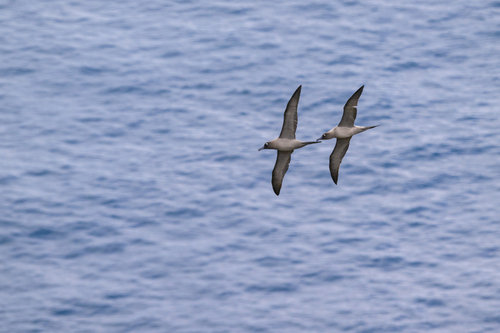 Light-mantled Albatross
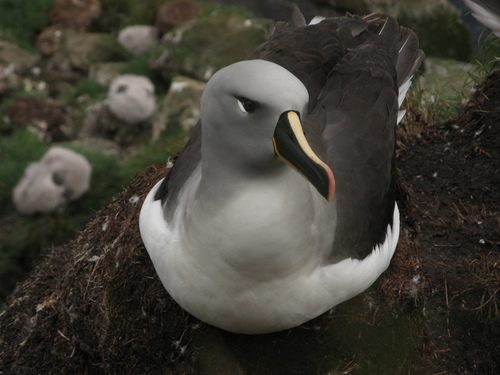 Grey-headed Albatross
In short
The most reliable field mark between Light-mantled Albatross and Grey-headed Albatross is the contrast in mantle and head coloration: Light-mantled shows a pale grey mantle and back with a darker, almost blackish head, while Grey-headed has a uniform ashy-grey head and neck with a much darker, almost black mantle and upperwings. Juvenile Grey-headed Albatrosses can be especially confusing, as their head and bill are both dark, but their underwing is almost entirely dark, unlike the more contrasting pattern of Light-mantled. Bill color is also key: Light-mantled has a mostly black bill with blue and greyish-yellow lines, while Grey-headed adults have a striking black bill with bright yellow ridges and a pinkish tip. In flight, the white rump and underparts of Grey-headed stand out against its dark upperwings, while Light-mantled appears more evenly pale-mantled and lacks the white rump. Both are large, long-winged seabirds, but subtle differences in structure and plumage are critical for confident separation.
Identification tips
- Juvenile underwing pattern: Juvenile Grey-headed Albatross shows an almost entirely dark underwing, while Light-mantled does not have such extensive dark underwing—useful for immatures in flight.
- Mantle and back color: Light-mantled has a pale grey mantle and back, creating a 'light-mantled' look; Grey-headed has a much darker, almost black mantle and upperwings, contrasting with its grey head.
- Head and neck: Light-mantled's head is darker than its mantle, but still sooty-brown/blackish; Grey-headed has a uniform ashy-grey head, throat, and upper neck, sharply set off from the black mantle.
- White rump: Grey-headed has a conspicuous white rump and white underparts, especially obvious in flight; Light-mantled lacks this, appearing more evenly pale above.
- Bill color and pattern: Adult Light-mantled has a mostly black bill with a blue sulcus and greyish-yellow line along the lower mandible; Grey-headed adult has a black bill with bright yellow ridges and a pinkish or orange tip. Juvenile Grey-headed has a black bill, which can be confusing.
- Eye crescent: Both species can show a pale crescent behind the eye, but it is more prominent in adult Grey-headed. In juveniles, this mark is indistinct in Grey-headed.
- Underwing pattern (adult): Grey-headed adult has white underwings with heavy black on the leading edge and less on the trailing edge; Light-mantled's underwing pattern is not highlighted as strongly contrasting, so look for the more uniform pale impression.
- Overall contrast: Grey-headed Albatross is a bird of strong contrasts: dark upperparts, white rump and underparts, and a grey head. Light-mantled is more subtle, with a smooth gradient from pale grey mantle to darker head and less contrast overall.
- Structure and jizz: Both are similar in size and shape, but Light-mantled may appear slightly more slender and long-winged. This is subtle and not a primary field mark.
- Courtship behavior: If observed, Light-mantled uses more tail displays and formation flying in courtship than Grey-headed.
- Habitat context: If seen near breeding colonies, Grey-headed is more likely further south, but both can overlap widely at sea.
- Vocalizations: Only Light-mantled's voice is described—shrill, trumpet-like, and bill-snapping when threatened. This is rarely diagnostic at sea.
- Pitfall—juvenile confusion: Juvenile Grey-headed can look very dark-headed and dark-billed, similar to Light-mantled, but the almost entirely dark underwing is a giveaway for Grey-headed.
- Pitfall—distance and light: At long range or in poor light, the subtle mantle and head contrasts can be lost; focus on the white rump (Grey-headed) or the smooth pale mantle (Light-mantled) when possible.
- Bill detail requires close view: Bill color differences are reliable but require good light and close views—do not rely on bill color alone at distance.
Size
Both species are similar in size, with Light-mantled Albatross averaging 3150 g in mass and Grey-headed Albatross ranging from 2.8 to 4.4 kg (mean 3.65 kg). Length and wingspan overlap: Light-mantled is 79–89 cm long with a 183–232 cm wingspan, while Grey-headed averages 81 cm in length and 2.2 m wingspan. In the field, size alone is not a reliable separator, as both are medium-sized albatrosses and can appear very similar at a distance.
Plumage
Juvenile and immature birds are the main pitfall: juvenile Grey-headed Albatrosses have a black bill and head, a darker nape, and an almost entirely dark underwing, lacking the crisp white underwing seen in adults. Light-mantled Albatross, by contrast, shows a pale grey mantle and back with a darker head, and the underwing is not described as being as extensively dark as in juvenile Grey-headed. In adults, Light-mantled has a striking pale grey mantle and back (the 'light-mantled' look), with a darker head and a thin grey eye crescent. Grey-headed adults have a uniform ashy-grey head, throat, and upper neck, with a nearly black mantle, upperwings, and tail, plus a white rump and underparts. The bill is a strong separator: Light-mantled's is black with blue and greyish-yellow lines, while Grey-headed's is black with bright yellow ridges and a pinkish tip. The white crescent behind the eye is more prominent in Grey-headed adults, but less so or indistinct in juveniles. In flight, Grey-headed shows a white rump and underparts contrasting with dark upperparts, while Light-mantled is more evenly pale above, lacking the white rump.
Behaviour
Both species share typical albatross behaviors: soaring flight, long glides, and oceanic habits. Light-mantled is noted for aerial displays and formation flying in courtship, and uses its tail in displays more than other albatrosses. Both species produce stomach oil for defense and chick feeding, and have similar bill-snapping threat displays. Behavior is not a strong field separator except possibly during courtship displays.
Habitat
Both species nest on remote Southern Ocean islands and forage widely at sea. Grey-headed Albatross breeds further south than other mollymawks and is more likely to be seen at higher latitudes, especially near the Antarctic Polar Frontal Zone, but both can occur in overlapping oceanic zones during non-breeding periods. Habitat is not a reliable separator at sea, but breeding context may help if known.
Voice
Light-mantled Albatross has a loud, shrill, trumpet-like call, and will snap its bill or make a throaty "gaaaa" when threatened. Grey-headed's vocalizations are not described in the provided notes. Voice is not a primary field mark for separation.
Light-mantled Albatross · Grey-headed Albatross · My Tricky Birds