

Lesson's Motmot vs Keel-billed Motmot
Momotus lessonii versus Electron carinatum
Play a quiz with Lesson's Motmot and Keel-billed Motmot
 Lesson's Motmot
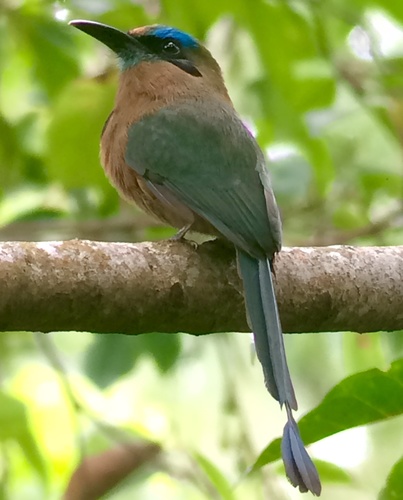 Keel-billed Motmot
In short
The most reliable field mark to separate Lesson's Motmot from Keel-billed Motmot is the bill: Keel-billed Motmot has a long, very broad, laterally flattened bill with a prominent keel (ridge) and serrated edges, while Lesson's Motmot has a more typical, less exaggerated motmot bill. In plumage, Keel-billed Motmot shows a rufous forehead, a turquoise-blue arc over a black mask, and a mostly rufous (north) to greenish-cinnamon (south) belly, whereas Lesson's Motmot has a blue crown and lacks the strong rufous underparts. Both species have racquet-tipped tails, but Keel-billed Motmot is slightly smaller and more slender. Habitat can help: Keel-billed Motmot is rare, local, and favors humid evergreen forests with steep gullies, while Lesson's Motmot is more widespread in forests and woodlands. If you see a motmot with a strikingly broad, ridged bill and rufous underparts, it's almost certainly Keel-billed.
Identification tips
- Bill shape is diagnostic: Keel-billed Motmot has a long, very broad, laterally flattened bill with a prominent ridge (keel) on the culmen and serrated edges. Lesson's Motmot has a more typical, less exaggerated motmot bill. This is visible even at a distance if the bird is facing sideways or preening.
- Head pattern: Keel-billed Motmot shows a rufous forehead and a black mask with a turquoise-blue arc above it. Lesson's Motmot has a blue crown (sometimes called a 'diadem') and lacks the rufous forehead and turquoise arc.
- Underparts color: Keel-billed Motmot has mostly rufous underparts in the north of its range, shifting to greenish or greenish-cinnamon further south. Lesson's Motmot does not show extensive rufous or cinnamon below; its underparts are more uniform and lack the strong color contrast.
- Chest spot: Keel-billed Motmot has a black spot on the chest, which may be visible in good views. This is less prominent or absent in Lesson's Motmot.
- Tail: Both species have racquet-tipped central tail feathers, so tail shape alone is not diagnostic.
- Upperparts: Both are green above, but Keel-billed's green may look brighter or more uniform, while Lesson's may show a blue crown contrasting with the green back.
- Face pattern: The turquoise-blue arc above the black mask is unique to Keel-billed Motmot; Lesson's Motmot lacks this feature.
- Size and structure: Keel-billed Motmot is slightly smaller and more slender, but size overlap means this is not reliable unless both species are seen together.
- Habitat: Keel-billed Motmot is found in humid evergreen forest, especially in steep-sided gullies with streams, and is rare and local. Lesson's Motmot is more widespread and can be found in a broader range of forests and woodlands.
- Range: If you are in western Panama, you are only likely to encounter Lesson's Motmot. In northern Central America, both are possible, but Keel-billed is much rarer and more habitat-restricted.
- Behavior: Both perch quietly and sally for prey, but Keel-billed may be more tied to the mid-story and specific microhabitats.
- Voice: If you hear a loud, low-pitched, nasal call similar to broad-billed motmot, consider Keel-billed, but voice is not a strong separator unless you know the species well.
- Sexes: Both species are sexually monomorphic; plumage differences do not help separate males from females.
- Juvenile/immature plumage: No distinctive age-specific upperwing or flight pattern marks are described for either species, so rely on head and underpart coloration for all ages visible in the field.
- Pitfalls: In poor light, the rufous underparts and rufous forehead of Keel-billed may be hard to see, but the bill shape and face pattern are still useful. Lesson's Motmot may appear more colorful overall, especially with the blue crown.
Size
Keel-billed Motmot is a smallish motmot, measuring 30.5–38 cm in length and weighing around 65 g (based on one male) [wikipedia]. Lesson's Motmot is similar in overall length but is generally a bit bulkier and more robust in structure. In the field, Keel-billed may appear slightly more slender and less heavy-bodied, but size alone is not reliable for separation.
Plumage
No age-specific upperwing or flight pattern differences are described for either species, so focus on head and underpart coloration. Adult Keel-billed Motmot has a rufous forehead, a black mask bordered above by a turquoise-blue arc, green upperparts, a pale turquoise chin, and underparts that are mostly rufous in the north of its range, becoming greenish to greenish-cinnamon further south. It has a black chest spot and a green tail with racquet-tipped central feathers. Lesson's Motmot, by contrast, has a blue crown (sometimes called a 'diadem'), lacks the rufous forehead, and its underparts are not predominantly rufous or cinnamon. Both species have green upperparts and racquet-tipped tails, but the combination of head pattern and underpart color is distinctive. Juvenile or immature plumages are not described in detail for either species, so these contrasts apply to adults and likely to older immatures as well.
Behaviour
Both species perch quietly in the midstory and sally for prey, but Keel-billed Motmot is noted for foraging in the forest's mid-story and favoring steep-sided gullies with streams. Its feeding behavior is presumed similar to the broad-billed motmot, including hawking insects from perches and occasional ground sallies. Lesson's Motmot shows typical motmot behavior: perching still for long periods and making short flights to catch prey. Neither species is particularly conspicuous in behavior, but Keel-billed may be more tied to specific microhabitats within humid forest.
Habitat
Lesson's Motmot is found in a broad range of forests and woodlands from southern Mexico to western Panama and is generally more widespread and locally common. Keel-billed Motmot, in contrast, is rare and local, with a fragmented range from southern Mexico to northern Costa Rica, and is strongly associated with humid evergreen forests, especially steep-sided gullies with streams. It is much less likely to be encountered outside dense, humid, low- to mid-elevation forest, and is absent from many apparently suitable areas. If you are in drier or more open woodland, Keel-billed is very unlikely.
Voice
Keel-billed Motmot's voice is described as a loud, far-carrying, low-pitched, nasal 'cuaet cuaet cadack' or 'ohhng', and is very similar to that of the broad-billed motmot. No specific vocal description is given for Lesson's Motmot in the sources, but motmots in general have low, owl-like hoots or calls. Voice alone is not a strong separator unless you are familiar with the subtle differences between motmot species.