

Lesser Yellowlegs vs Common Greenshank
Tringa flavipes versus Tringa nebularia
Play a quiz with Lesser Yellowlegs and Common Greenshank
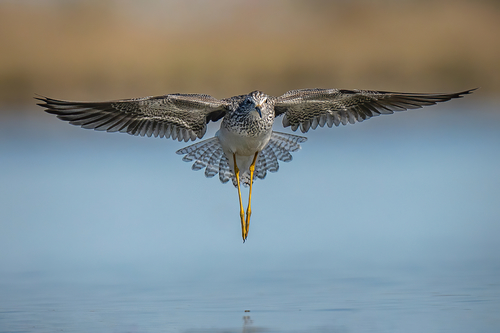 Lesser Yellowlegs
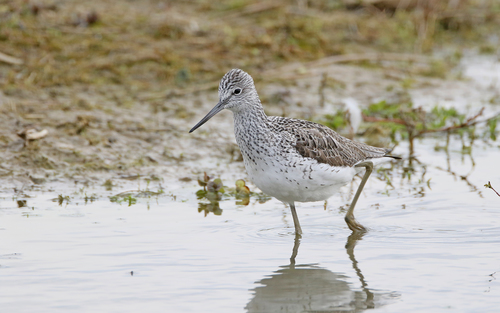 Common Greenshank
In short
The most reliable way to separate Lesser Yellowlegs from Common Greenshank is by leg color and bill shape: Lesser Yellowlegs has bright yellow legs and a slim, straight, dark bill about as long as its head, while Common Greenshank shows greenish legs and a longer, slightly upturned bill with a pale base. In flight, Greenshank displays a distinctive white wedge up the back, which Lesser Yellowlegs lacks. Lesser Yellowlegs is also much lighter and more delicate overall. If you see a medium-sized wader with yellow legs and a fine, straight bill, it's a Lesser Yellowlegs; a larger, heavier bird with greenish legs and a longer, upturned bill is a Greenshank.
Identification tips
- Leg color: Lesser Yellowlegs always shows bright yellow legs; Greenshank's legs are greenish. This is the quickest check in good light.
- Bill shape and length: Lesser Yellowlegs has a slim, straight, uniformly dark bill about as long as its head. Greenshank's bill is longer, slightly upturned, and has a pale base—especially obvious at close range or in good light.
- Flight pattern: Greenshank in all ages shows a white wedge up the back in flight, a key mark absent in Lesser Yellowlegs. Look for this when birds flush or fly past.
- Size and structure: Lesser Yellowlegs is much smaller and lighter (81 g vs 173 g), with a dainty, high-stepping appearance. Greenshank is bulkier, taller, and heavier-billed.
- Breast and neck pattern: In breeding plumage, Lesser Yellowlegs has fine, dense streaking on the neck and breast; Greenshank shows a coarser, darker, and crisper breast pattern.
- Non-breeding plumage: Both species become greyer above, but Lesser Yellowlegs remains more uniform and clean below, while Greenshank may retain a crisper breast.
- Bill color: Lesser Yellowlegs' bill is entirely dark; Greenshank's bill has a pale base, especially obvious in fresh plumage or good light.
- Foraging behavior: Lesser Yellowlegs moves quickly with a high-stepping gait, looking more delicate and agile than the heavier Greenshank.
- Voice: Greenshank's call is a distinctive three-note 'teu-teu-teu'; Lesser Yellowlegs is softer and less forceful. Use this if birds are vocal.
- Habitat and range: Lesser Yellowlegs breeds only in North America; Greenshank is Eurasian. Overlap is possible only on migration or in wintering areas.
- Sex and age: Both species are similar between sexes; no strong sexual dimorphism. Age-related marks are not strongly diagnostic except for Greenshank's flight wedge.
- Pitfalls: In poor light, leg color can look dull or misleading. Bill shape is best judged in profile. Size is hard to judge without direct comparison.
- When marks fail: If only distant or silhouetted views are available, rely on flight pattern (white wedge for Greenshank) and overall structure (Greenshank bulkier, longer-legged). If the bird is silent, leg color and bill shape are most reliable.
- Juvenile/immature birds: No specific juvenile upperwing or flight marks are described for Lesser Yellowlegs; Greenshank's white wedge is present at all ages.
- Summary tip: If you see a medium-sized wader with yellow legs and a fine, straight bill, it's a Lesser Yellowlegs. If it's larger, with greenish legs and a longer, upturned bill, and especially if it shows a white wedge up the back in flight, it's a Greenshank.
Size
Lesser Yellowlegs is significantly smaller and lighter, averaging 81 g, compared to the Common Greenshank's 173 g. This difference is obvious in the field: Lesser Yellowlegs appears slim, dainty, and high-stepping, while Greenshank looks bulkier and more robust. The Greenshank also has a longer bill and legs, and generally stands taller. If both species are present, the size gap is striking, but beware of lone birds or poor views where size can be deceptive.
Plumage
No age-specific upperwing or flight marks are described for Lesser Yellowlegs, but Common Greenshank in all plumages shows a clear white wedge up the back in flight—a key mark. In breeding plumage, Lesser Yellowlegs has finely streaked brown and white underparts and densely patterned neck, while Greenshank is browner above with a coarser, darker breast pattern. In non-breeding plumage, both are grey-brown above, but Lesser Yellowlegs remains more uniform and clean below, while Greenshank is bulkier and often shows a crisper breast. Leg color is always yellow in Lesser Yellowlegs and greenish in Greenshank. Bill color also differs: Lesser Yellowlegs has a uniformly dark, straight bill; Greenshank's bill is longer, slightly upturned, and has a pale base.
Behaviour
Lesser Yellowlegs is very active when foraging, moving quickly with a high-stepping gait and neck outstretched, picking at prey. Greenshank is also an active feeder but tends to look heavier and more deliberate. Both species wade in shallow water and may probe mud or water for invertebrates, but the Lesser Yellowlegs often appears more delicate and agile. Social behavior is similar, with both species sometimes seen singly or in loose groups.
Habitat
Lesser Yellowlegs breeds in North American boreal forests and winters from southern North America to South America, favoring shallow freshwater or brackish wetlands, flooded fields, and muddy margins. Common Greenshank is a widespread Eurasian breeder, found in marshy or wetland habitats, and winters in similar shallow water environments across Africa, southern Asia, and Australasia. Both species overlap on migration in some regions, but Lesser Yellowlegs is strictly a New World breeder, while Greenshank is Old World.
Voice
Lesser Yellowlegs has a softer call compared to the Greenshank. Greenshank's usual call is a rapid series of three short, fluty notes ('teu-teu-teu'), which is distinctive if heard well. Lesser Yellowlegs' call is less forceful and more subdued. Voice can be helpful if the birds call, but is not always diagnostic in silence.