

Lesser White-fronted Goose vs Tundra Bean Goose
Anser erythropus versus Anser serrirostris
Play a quiz with Lesser White-fronted Goose and Tundra Bean Goose
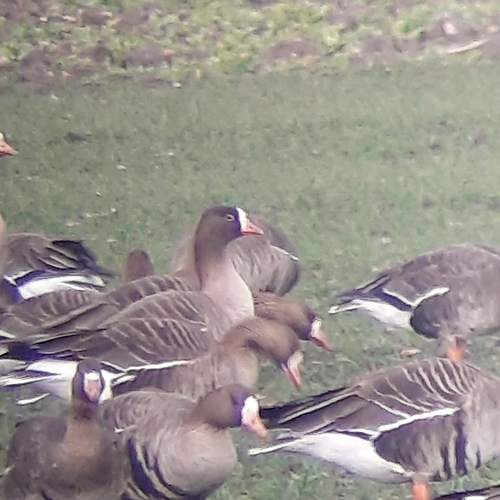 Lesser White-fronted Goose
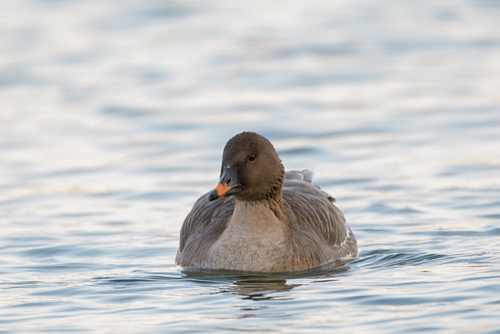 Tundra Bean Goose
In short
The most reliable field mark to separate Lesser White-fronted Goose from Tundra Bean Goose is the combination of the Lesser's small size, prominent yellow eye-ring, and the extent of its white facial blaze reaching up to the crown. Both have orange legs and similar upperwing tones, but the Tundra Bean Goose is much larger, with a heavier build and a distinctive bill pattern: black at the base and tip with an orange band in the middle. In flight or at rest, pay close attention to facial details and bill structure, as overall coloration and leg color can overlap. Juvenile and adult plumages are broadly similar in both, so structural and facial marks are critical.
Identification tips
- Size is a strong clue: Lesser White-fronted Goose is much smaller and more delicate than Tundra Bean Goose. In mixed flocks, look for the smallest goose with a short neck and small bill.
- Yellow eye-ring (Lesser White-fronted): Adults (and often immatures) show a bright yellow orbital ring, unique among geese in the region. This is visible at moderate range in good light.
- White facial blaze: The white on the face of Lesser White-fronted Goose extends up to the crown, forming a high, rounded blaze. Tundra Bean Goose lacks this feature entirely.
- Bill pattern: Tundra Bean Goose has a distinctive bill: black at the base and tip, with an orange band in the middle. Lesser White-fronted's bill is smaller, pinkish, and lacks the orange band.
- Leg color: Both have orange legs, so this is not a reliable separator.
- Upperwing coverts: Both species have mouse-brown upperwing coverts, but Tundra Bean Goose's coverts have narrow white fringes (subtle, best seen at close range or in photos). Not a strong field mark.
- Belly bars: Both species show black bars across the belly, but Lesser White-fronted's are usually broader and more extensive. This is helpful if the belly is visible.
- Structure: Lesser White-fronted Goose is compact, short-necked, and small-billed, giving a daintier impression. Tundra Bean Goose is heavyset, long-necked, and big-billed.
- Head shape: Lesser White-fronted has a steep forehead and rounded crown, accentuated by the white blaze. Tundra Bean Goose's head is more sloping and less distinct.
- Jizz in flight: Lesser White-fronted appears quick and agile, with rapid wingbeats; Tundra Bean Goose is slower and more ponderous.
- Habitat context: If you are in an area with large numbers of Bean Geese, be cautious—Lesser White-fronted is rare and usually only present as singles or small groups.
- Juvenile confusion: Juveniles of both species are similar to adults in structure and facial pattern; the yellow eye-ring may be duller in young Lesser White-fronted but is still usually visible.
- No distinctive upperwing pattern: Neither species shows a diagnostic upperwing pattern in flight, so rely on size, bill, and face.
- Voice: Not diagnostic with available information.
- Season: Both species are migratory and may overlap in wintering areas, so do not use season alone for identification.
Size
Lesser White-fronted Goose is significantly smaller, with a body mass around 1797 g [wikidata], and is only slightly larger than a Mallard. Tundra Bean Goose is much larger and bulkier, with lengths ranging from 68–90 cm and wingspans from 140–174 cm [wikipedia]. In the field, Tundra Bean Goose will stand out as a robust, heavyset goose, while Lesser White-fronted appears compact and light-billed.
Plumage
Both species have orange legs and mouse-colored (brownish) upperwing coverts, which can cause confusion, especially in flight. Neither species shows a distinctive juvenile upperwing pattern that is diagnostic in flight; both lack the black 'W' of the Greater White-fronted Goose. The Lesser White-fronted Goose of all ages shows a very conspicuous white blaze extending up to the crown, and adults have a clear yellow eye-ring—this is unique and visible at close range. Both species have dark brown upperwing coverts, but Tundra Bean Goose has narrow white fringes to these feathers, which are subtle and not always visible at distance. The Tundra Bean Goose's bill is black at base and tip with an orange band, while Lesser White-fronted's bill is smaller and pinkish, lacking the orange band. Both species have black belly bars, but these are broader and more extensive in Lesser White-fronted. Juvenile and immature birds of both species are similar to adults in these respects.
Behaviour
Both species are typically seen in flocks, often grazing in open fields or wetlands. Lesser White-fronted Goose tends to be more active and alert, often appearing nervier and more upright, while Tundra Bean Goose is heavier and slower-moving. In mixed flocks, Lesser White-fronted Geese may be more restless and prone to sudden movements.
Habitat
Lesser White-fronted Goose is a scarce breeder in the northernmost Palearctic and is rare in Europe, with only isolated reintroduction attempts. Tundra Bean Goose breeds in northern Siberia and winters further south in Asia, and is generally more widespread and numerous. In Europe, a flock with many Bean Geese is more likely to contain Tundra Bean than Lesser White-fronted, which is always a notable rarity.
Lesser White-fronted Goose · Tundra Bean Goose · My Tricky Birds