
Motmot

Lesser White-fronted Goose vs Eurasian Wryneck

Anser erythropus versus Jynx torquilla

Play a quiz with Lesser White-fronted Goose and Eurasian Wryneck
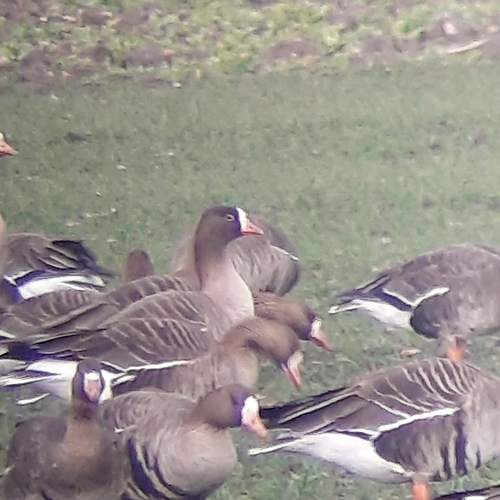
Lesser White-fronted Goose (Anser erythropus) Lesser White-fronted Goose
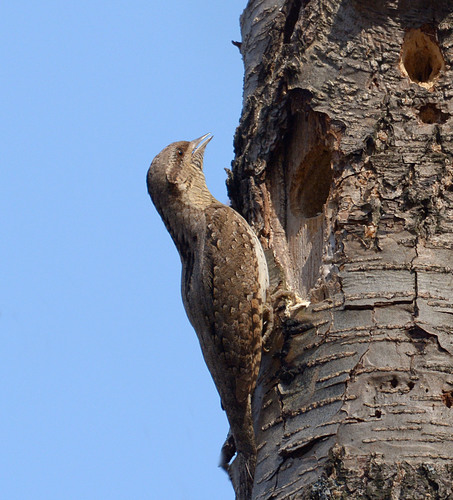
Eurasian Wryneck (Jynx torquilla) Eurasian Wryneck

Media

Loading…

In short

The most reliable field mark is overall structure and size: the Lesser White-fronted Goose is a large, heavy-bodied waterfowl with bright orange legs and a bold white blaze up to the crown, while the Eurasian Wryneck is a slim, thrush-sized woodpecker relative with cryptic, intricately barred brown plumage. If you see a bird with a yellow eye-ring and orange legs in open wetlands or fields, it is the goose; a small, elongated bird with a slender bill, mottled brown plumage, and zygodactyl feet in woodland or orchard settings is the wryneck. Juvenile wrynecks look similar to adults but are duller, while all ages of the goose show the white facial blaze and black belly bars. In flight, the goose is powerful and direct, the wryneck weak and undulating. These species are so different in size, structure, and context that confusion is most likely from a fleeting or distant view, or a quiz photo with little context.

Identification tips

  1. Size and bulk: The goose is nearly 50 times heavier than the wryneck; even at a distance, the difference in bulk, neck length, and overall size is unmistakable.
  2. Bill shape: Goose has a short, stout, orange bill; wryneck has a long, slender, pointed brown bill, well-adapted for probing.
  3. Leg color: Lesser White-fronted Goose always shows bright orange legs; wryneck's legs are pale brown and much finer.
  4. Facial pattern: Goose has a bold white blaze extending up to the crown and a yellow eye-ring (all ages); wryneck has a cryptic, finely barred face with no white blaze or eye-ring.
  5. Belly pattern: Goose shows broad black bars across the belly; wryneck's underparts are creamy with brown arrowhead markings, never barred.
  6. Upperwing coverts: Goose's upperwing coverts are mouse-grey; wryneck's wings are barred and mottled brown, rufous, and black.
  7. Tail: Goose's tail is broad and plain; wryneck's tail is rounded, grey with brown speckles and faint bands.
  8. Feet and posture: Wryneck has zygodactyl feet (two toes forward, two back), often seen clinging to trunks or branches; goose always walks or swims, never perches.
  9. Flight style: Goose flies powerfully and directly, often in flocks; wryneck's flight is weak, undulating, and solitary or in small groups during migration.
  10. Behavior: Wryneck may twist its neck in a snake-like display when alarmed; goose never does this.
  11. Habitat: Goose is found in open wetlands, lakes, and fields; wryneck in woodlands, orchards, and areas with scattered trees.
  12. Vocalization: Wryneck's call is a repeated harsh 'quee-quee-quee-quee' or staccato 'tuck's; goose gives typical honking calls.
  13. Juvenile confusion: Juvenile wrynecks are duller but still cryptic and barred; juvenile geese retain the white blaze and black belly bars.
  14. Context: If seen swimming or grazing in open areas, it is the goose; if perched on a tree or trunk, it is the wryneck.
  15. Pitfalls: Only the most distant, context-free views (e.g., a quiz photo) could lead to confusion; in the field, structure, size, and habitat are instantly diagnostic.

Size

Lesser White-fronted Goose is vastly larger: body mass averages 1797 g, compared to just 37 g for Eurasian Wryneck. The goose is 53–66 cm long with a 120–135 cm wingspan, similar to a mallard, while the wryneck is only 16–18 cm long, about the size of a starling or small thrush. Even at a distance, the goose's bulk and long neck are obvious, while the wryneck is small, slim, and compact.

Plumage

No age or flight plumage overlap: all ages of Lesser White-fronted Goose show a conspicuous white blaze that extends up to the crown, broad black bars crossing the belly, and orange legs. The upperwing coverts are mouse-grey (not bluish as in Greylag), and the yellow eye-ring is diagnostic. Eurasian Wryneck, adult and juvenile, is intricately barred and mottled in pale brown, rufous, and black, with a cryptic pattern that camouflages against bark. The wryneck's underparts are creamy white with brown arrowhead marks, and the tail is rounded and banded. Juvenile wrynecks are similar to adults but duller and less contrasting. The goose's plumage is bold and contrasting; the wryneck's is subtle and cryptic.

Behaviour

Lesser White-fronted Goose is typically seen in flocks on open wetlands, lakes, or fields, walking or grazing, and flies in strong, direct lines. Eurasian Wryneck is usually solitary or in pairs in summer, sometimes in small groups during migration, perching upright on branches or trunks, often holding its head high and beak slightly up. Wrynecks climb and cling to vertical surfaces, sometimes twisting their necks in a snake-like display when alarmed. In flight, the goose is powerful and steady; the wryneck's flight is weak and undulating, more reminiscent of a woodpecker or thrush.

Habitat

Lesser White-fronted Goose favors open wetlands, tundra, lakes, and agricultural fields, rarely venturing into wooded areas. Eurasian Wryneck breeds in temperate woodlands, orchards, and open areas with scattered trees, especially where ant nests are abundant. If you find a bird in open water or on a grassy plain, it is almost certainly the goose; in orchards, woodland edges, or old trees, the wryneck is far more likely.

Voice

Lesser White-fronted Goose gives typical goose honking and cackling calls, not described in detail here. Eurasian Wryneck's song is a repeated harsh, shrill 'quee-quee-quee-quee' lasting several seconds, reminiscent of a small woodpecker or falcon, with alarm calls of short staccato 'tuck's and hissing when disturbed. If you hear a woodpecker-like or falcon-like call, it is the wryneck; the goose is much louder and deeper-voiced.

Submit a better description

Use the same sections as the comparison. Your text is published immediately.

The most reliable field mark is overall structure and size: the Lesser White-fronted Goose is a large, heavy-bodied waterfowl with bright orange legs and a bold white blaze up to the crown, while the Eurasian Wryneck is a slim, thrush-sized woodpecker relative with cryptic, intricately barred brown plumage. If you see a bird with a yellow eye-ring and orange legs in open wetlands or fields, it is the goose; a small, elongated bird with a slender bill, mottled brown plumage, and zygodactyl feet in woodland or orchard settings is the wryneck. Juvenile wrynecks look similar to adults but are duller, while all ages of the goose show the white facial blaze and black belly bars. In flight, the goose is powerful and direct, the wryneck weak and undulating. These species are so different in size, structure, and context that confusion is most likely from a fleeting or distant view, or a quiz photo with little context.

  1. Size and bulk: The goose is nearly 50 times heavier than the wryneck; even at a distance, the difference in bulk, neck length, and overall size is unmistakable.
  2. Bill shape: Goose has a short, stout, orange bill; wryneck has a long, slender, pointed brown bill, well-adapted for probing.
  3. Leg color: Lesser White-fronted Goose always shows bright orange legs; wryneck's legs are pale brown and much finer.
  4. Facial pattern: Goose has a bold white blaze extending up to the crown and a yellow eye-ring (all ages); wryneck has a cryptic, finely barred face with no white blaze or eye-ring.
  5. Belly pattern: Goose shows broad black bars across the belly; wryneck's underparts are creamy with brown arrowhead markings, never barred.
  6. Upperwing coverts: Goose's upperwing coverts are mouse-grey; wryneck's wings are barred and mottled brown, rufous, and black.
  7. Tail: Goose's tail is broad and plain; wryneck's tail is rounded, grey with brown speckles and faint bands.
  8. Feet and posture: Wryneck has zygodactyl feet (two toes forward, two back), often seen clinging to trunks or branches; goose always walks or swims, never perches.
  9. Flight style: Goose flies powerfully and directly, often in flocks; wryneck's flight is weak, undulating, and solitary or in small groups during migration.
  10. Behavior: Wryneck may twist its neck in a snake-like display when alarmed; goose never does this.
  11. Habitat: Goose is found in open wetlands, lakes, and fields; wryneck in woodlands, orchards, and areas with scattered trees.
  12. Vocalization: Wryneck's call is a repeated harsh 'quee-quee-quee-quee' or staccato 'tuck's; goose gives typical honking calls.
  13. Juvenile confusion: Juvenile wrynecks are duller but still cryptic and barred; juvenile geese retain the white blaze and black belly bars.
  14. Context: If seen swimming or grazing in open areas, it is the goose; if perched on a tree or trunk, it is the wryneck.
  15. Pitfalls: Only the most distant, context-free views (e.g., a quiz photo) could lead to confusion; in the field, structure, size, and habitat are instantly diagnostic.

Lesser White-fronted Goose is vastly larger: body mass averages 1797 g, compared to just 37 g for Eurasian Wryneck. The goose is 53–66 cm long with a 120–135 cm wingspan, similar to a mallard, while the wryneck is only 16–18 cm long, about the size of a starling or small thrush. Even at a distance, the goose's bulk and long neck are obvious, while the wryneck is small, slim, and compact.

No age or flight plumage overlap: all ages of Lesser White-fronted Goose show a conspicuous white blaze that extends up to the crown, broad black bars crossing the belly, and orange legs. The upperwing coverts are mouse-grey (not bluish as in Greylag), and the yellow eye-ring is diagnostic. Eurasian Wryneck, adult and juvenile, is intricately barred and mottled in pale brown, rufous, and black, with a cryptic pattern that camouflages against bark. The wryneck's underparts are creamy white with brown arrowhead marks, and the tail is rounded and banded. Juvenile wrynecks are similar to adults but duller and less contrasting. The goose's plumage is bold and contrasting; the wryneck's is subtle and cryptic.

Lesser White-fronted Goose is typically seen in flocks on open wetlands, lakes, or fields, walking or grazing, and flies in strong, direct lines. Eurasian Wryneck is usually solitary or in pairs in summer, sometimes in small groups during migration, perching upright on branches or trunks, often holding its head high and beak slightly up. Wrynecks climb and cling to vertical surfaces, sometimes twisting their necks in a snake-like display when alarmed. In flight, the goose is powerful and steady; the wryneck's flight is weak and undulating, more reminiscent of a woodpecker or thrush.

Lesser White-fronted Goose favors open wetlands, tundra, lakes, and agricultural fields, rarely venturing into wooded areas. Eurasian Wryneck breeds in temperate woodlands, orchards, and open areas with scattered trees, especially where ant nests are abundant. If you find a bird in open water or on a grassy plain, it is almost certainly the goose; in orchards, woodland edges, or old trees, the wryneck is far more likely.

Lesser White-fronted Goose gives typical goose honking and cackling calls, not described in detail here. Eurasian Wryneck's song is a repeated harsh, shrill 'quee-quee-quee-quee' lasting several seconds, reminiscent of a small woodpecker or falcon, with alarm calls of short staccato 'tuck's and hissing when disturbed. If you hear a woodpecker-like or falcon-like call, it is the wryneck; the goose is much louder and deeper-voiced.

Discard your changes?

You have unsaved edits. If you leave now, those changes will be lost.

Lesser White-fronted Goose · Eurasian Wryneck · My Tricky Birds