

Lesser Whistling-Duck vs Gadwall
Dendrocygna javanica versus Mareca strepera
Play a quiz with Lesser Whistling-Duck and Gadwall
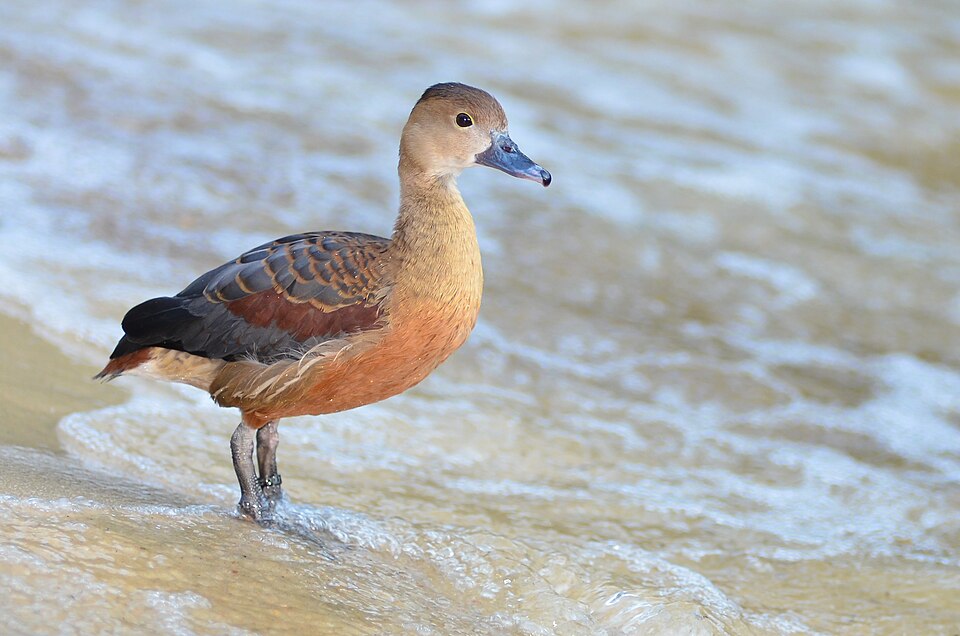 Lesser Whistling-Duck
 Gadwall
In short
The most reliable field mark to separate Lesser Whistling-Duck from Gadwall is the upperwing pattern in flight: Lesser Whistling-Duck (all ages) lacks the Gadwall’s striking white speculum and instead shows uniform chestnut-brown wings, while Gadwall (all ages) displays a bold white speculum, especially obvious in flight. Perched, Lesser Whistling-Duck is a compact, chestnut-toned duck with a dark crown and orange-yellow eye-ring, while Gadwall is larger and more subtly patterned, with males showing gray and black tones and both sexes having a white belly and speculum. Lesser Whistling-Duck is highly gregarious and often perches in trees or rests in tight flocks, whereas Gadwall is less social and rarely perches. Habitat overlap is possible in wetlands, but Lesser Whistling-Duck is more likely in tropical Asia, especially in rice paddies and lakes, while Gadwall favors open marshes and temperate wetlands. Voice is also a clue: Lesser Whistling-Duck gives a prominent, repetitive whistling call, while Gadwall is generally quiet.
Identification tips
- White speculum in flight (all ages): Gadwall always shows a bold white speculum (secondary wing patch) in flight and often at rest, bordered by chestnut and black. Lesser Whistling-Duck never shows white in the wing—look for uniform chestnut-brown wings. This is the single most reliable mark.
- Overall size and structure: Gadwall is much larger and bulkier than Lesser Whistling-Duck; compare neck and body length if both species are present.
- Plumage at rest: Gadwall males (breeding) are finely gray-patterned with a black rear and white belly; females are mottled brown but still show the white speculum and belly. Lesser Whistling-Duck is warm chestnut-brown with a dark crown and orange-yellow eye-ring, sexes alike.
- Tail and upper-tail coverts: Lesser Whistling-Duck has chestnut upper-tail coverts, contrasting with the creamy white in Fulvous Whistling-Duck but not present in Gadwall. Gadwall’s tail area is not contrasting.
- Head pattern: Lesser Whistling-Duck has a dark crown and a clear orange to yellow eye-ring, visible at close range. Gadwall lacks these features; its head is plain gray (male) or brown (female).
- Bill: Not strongly diagnostic between these two; Gadwall females have a dark bill with orange edges, but this is less useful than wing and body color.
- Perching behavior: Lesser Whistling-Duck often perches in trees or on branches, especially when roosting or nesting. Gadwall is almost never seen perching above ground level.
- Flock structure: Lesser Whistling-Duck is highly gregarious, often seen in tight, coordinated flocks. Gadwall tends to form smaller, looser groups.
- Habitat context: In tropical Asia, especially in rice paddies or urban lakes, Lesser Whistling-Duck is far more likely. In temperate marshes or prairie wetlands, Gadwall is expected.
- Voice: A flock making loud, repetitive whistling calls overhead is almost certainly Lesser Whistling-Duck. Gadwall is generally silent except for occasional courtship calls.
- Feeding behavior: Both dabble, but Gadwall is more likely to dive or steal food from other birds; Lesser Whistling-Duck may waddle on land and is often followed by mynas.
- Nesting: Lesser Whistling-Duck may nest in tree hollows or on the ground, sometimes reusing old nests. Gadwall always nests on the ground, often away from water.
- Juvenile plumage: No unique juvenile wing pattern is described for either, but the absence of a white speculum in any age points to Lesser Whistling-Duck.
- Sex differences: Both species have subtle sexual dimorphism, but Lesser Whistling-Duck sexes are nearly identical, while Gadwall males are more distinctly patterned than females.
- Activity timing: Lesser Whistling-Duck is often active and noisy at night, while Gadwall is more diurnal and quiet.
Size
Lesser Whistling-Duck is distinctly smaller and lighter than Gadwall. Lesser Whistling-Duck averages about 525 g in body mass [wikidata], while Gadwall males average 990 g and females 850 g [wikipedia]. Gadwall is also longer (47–58 cm) with a broader wingspan (78–85 cm), making it noticeably bulkier and longer-necked in the field. In mixed flocks, Gadwall will stand out as the larger, more elongated duck, while Lesser Whistling-Duck appears compact and short-necked.
Plumage
The most diagnostic plumage difference is in the wing pattern when the birds are in flight:
- All ages, in flight: Gadwall shows a brilliant white speculum (the secondary wing patch), which is obvious both at rest and in flight, bordered by chestnut and black. Lesser Whistling-Duck lacks any white in the wing; instead, its wings are uniformly chestnut-brown above and below, with chestnut upper-tail coverts.
- At rest: Gadwall males in breeding plumage are finely patterned gray with a black rear and white belly; females are mottled brown but still show the white speculum and belly. Lesser Whistling-Duck is a warm chestnut-brown overall with a dark crown and orange-yellow eye-ring, and both sexes look alike.
- Juveniles: No specific juvenile wing pattern is described for either species, but the white speculum of Gadwall is present from a young age, while Lesser Whistling-Duck juveniles remain chestnut-winged.
- Tail coverts: Lesser Whistling-Duck has chestnut upper-tail coverts; Gadwall’s are not described as contrasting.
- Head: Lesser Whistling-Duck has a dark crown and orange to yellow eye-ring; Gadwall lacks these features.
Behaviour
Lesser Whistling-Duck is notably gregarious, often seen in large flocks and sometimes perching in trees or even nesting in tree hollows. They are highly nocturnal, feeding at night and resting in groups during the day, sometimes even on open water. Gadwall is less social outside the breeding season, typically forming only small flocks, and is rarely seen perching in trees. Both species dabble for food, but Gadwall is also proficient at diving and may steal food from other diving birds. Courtship and social behaviors differ: Lesser Whistling-Duck males perform bill-dipping displays, while Gadwall males display with head-raising and water displacement. Lesser Whistling-Duck is more likely to be seen waddling on land in groups, while Gadwall is more reserved.
Habitat
Lesser Whistling-Duck is most often found in lowland wetlands, lakes, and wet paddy fields across the Indian subcontinent and Southeast Asia, and is comfortable in both rural and urban wetlands, sometimes even on the open sea. Gadwall prefers open wetlands, such as prairie lakes, wet grasslands, and marshes with dense vegetation, and is more typical of temperate regions. While both species can occur in freshwater wetlands, Lesser Whistling-Duck is more likely in tropical Asia, and Gadwall is more widespread in Eurasia and North America. Lesser Whistling-Duck may nest in trees, a behavior not seen in Gadwall.
Voice
Lesser Whistling-Duck is very vocal, especially in flight, producing a prominent, repetitive wheezy whistling call that carries well and is often heard from flocks circling overhead. Gadwall is generally quiet except during courtship; the female gives a high-pitched quack, and the male produces a soft grunt or whistle, but these are rarely heard outside breeding displays. In the field, a flock of whistling ducks is far more likely to be Lesser Whistling-Duck than Gadwall.