

Lesser Spotted Eagle vs Imperial Eagle
Clanga pomarina versus Aquila heliaca
Play a quiz with Lesser Spotted Eagle and Imperial Eagle
 Lesser Spotted Eagle
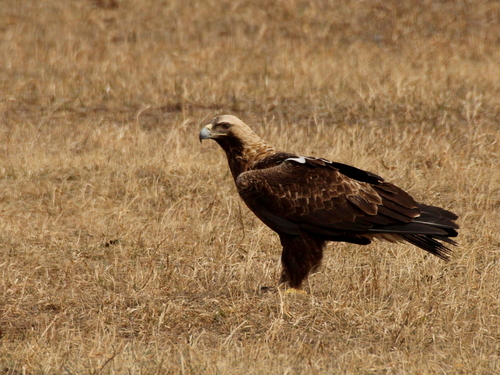 Imperial Eagle
In short
The most reliable field mark between Lesser Spotted Eagle and Imperial Eagle is the upperwing and rump pattern in flight, especially in juveniles and immatures. Lesser Spotted Eagles of all ages show a pale head and coverts contrasting with darker flight feathers, and a distinctive white 'V' on the upper rump, while juveniles have prominent white spots on the remiges but lack covert spotting. Imperial Eagles, by contrast, lack the white rump 'V', and juveniles are a unique tawny-buff with brown streaking, showing a pale rear body and dark remiges, but not the same wing or rump contrast. Imperial Eagles are also much larger and bulkier, with a proportionately bigger head and longer neck. Structure, overall darkness, and the presence or absence of covert and rump markings are key for separation, especially in flight.
Identification tips
- White 'V' on upper rump (all ages): Lesser Spotted Eagle shows a clear white 'V' on the upper rump, visible in flight and often when perched; Imperial Eagle never shows this mark.
- Pale head and wing coverts (all ages): Lesser Spotted Eagle has a noticeably paler head and wing coverts compared to the rest of the body, creating a contrast with darker flight feathers; Imperial Eagle is uniformly darker or tawny-buff in juveniles.
- Juvenile remige spotting: Juvenile Lesser Spotted Eagles have prominent white spots on the remiges (flight feathers), but lack white spots on the wing coverts; Imperial Eagle juveniles do not show this pattern.
- Juvenile covert spotting: If you see white spots on the wing coverts, it is not a Lesser Spotted Eagle juvenile; Imperial Eagle juveniles are tawny-buff with brown streaking and lack covert spotting.
- Neck patch in juveniles: Juvenile Lesser Spotted Eagles show a cream-colored neck patch; Imperial Eagle juveniles have brownish streaking instead.
- Overall color in juveniles: Imperial Eagle juveniles are unique in being tawny-buff with brown streaking, giving a pale rear body and dark remiges; Lesser Spotted Eagle juveniles are more uniformly brown with paler head and rump.
- Adult plumage: Adult Lesser Spotted Eagles retain the pale head/coverts and white rump 'V'; adult Imperial Eagles are much darker, with white spots on the wing mantle and a greyish undertail, but not the same rump or wing contrast.
- Size and bulk: Imperial Eagle is much larger and bulkier, with a heavier build, larger head, and longer neck; Lesser Spotted Eagle is medium-sized and more slender.
- Structure in flight: Imperial Eagle appears more powerful and imposing in flight, with broader wings and a longer neck; Lesser Spotted Eagle is more compact and less bulky.
- Perched posture: Imperial Eagle perches more upright and appears more massive; Lesser Spotted Eagle is less imposing and has a smaller bill and head for an eagle.
- Habitat context: In Eastern Europe, Lesser Spotted Eagle prefers moister, mixed open country; Imperial Eagle is more likely in steppe and drier open woodland, but both can overlap.
- Vocalization: If you hear a dog-like yip, it's Lesser Spotted Eagle; Imperial Eagle's call is not described here.
- Pitfalls with hybrids: Rare hybrids between Lesser and Greater Spotted Eagles are very difficult to separate from Lesser Spotted Eagle; Imperial Eagle is not known to hybridize with either.
- Seasonal variation: Both species are migratory, but Imperial Eagle winters farther east and south; context may help but is not diagnostic.
- When marks fail: At great distance or in poor light, both can appear dark; rely on rump, head, and wing pattern first, then structure and size.
Size
Imperial Eagle is substantially larger and heavier than Lesser Spotted Eagle (adult mass: 3215 g vs 1475.5 g) [wikidata]. In the field, Imperial Eagle appears bulkier and more powerful, with a larger head and longer neck, while Lesser Spotted Eagle is more medium-sized and slender for an eagle. Perched, Imperial Eagle's size and proportions are more imposing, and in flight, its wingspan and body bulk are noticeably greater. However, overlap in size with other large eagles means structure and plumage are more reliable than size alone.
Plumage
Juvenile and immature Lesser Spotted Eagles show a pale brown head and wing coverts contrasting with generally darker plumage, and a clear white 'V' on the upper rump (present in all ages, though less defined in juveniles). Juveniles have prominent white spots on the remiges but lack covert spotting, and show a cream-colored neck patch. Imperial Eagle juveniles are distinctive: overall tawny-buff with brownish streaking, giving a pale rear body and dark remiges, but lack the white rump 'V' and the same degree of wing contrast. Adults: Lesser Spotted Eagle adults retain the pale head/coverts and white rump 'V', while Imperial Eagle adults are much darker overall, lacking the white wing and rump marks, and show white spots on the wing mantle and a greyish undertail. Subadult Imperial Eagles may show some pale shawl but are never as contrastingly patterned as Lesser Spotted Eagle. The presence or absence of covert spotting and the color of the neck patch are key in juveniles. Both can appear dark at distance, but the Lesser Spotted Eagle's contrasting head and rump are unique.
Behaviour
Both species are wary and hunt over open or lightly wooded country, but Imperial Eagle is more dominant and powerful, often displacing other raptors in its winter range. Lesser Spotted Eagle is more likely to be seen hunting small mammals and terrestrial prey in open areas, while Imperial Eagle's larger size allows it to tackle larger prey and dominate at carcasses. Both perch in trees, but Imperial Eagle's bulk and posture are more imposing. Flight style is similar, with broad wings and soaring, but Imperial Eagle appears heavier and more powerful on the wing.
Habitat
Lesser Spotted Eagle breeds in Central and Eastern Europe, southeast to Turkey and Armenia, favoring open or lightly wooded country. Imperial Eagle breeds in southeastern Europe and widely through West and Central Asia, with a broader winter range extending to Africa and Asia. Both can overlap in Eastern Europe, but Imperial Eagle is more likely in steppe, open woodland, and drier habitats, while Lesser Spotted Eagle prefers moister, more mixed landscapes. In winter, context may help, but both can occur in similar open habitats.
Voice
Lesser Spotted Eagle gives a dog-like yip, which is distinctive if heard. No vocalization details are provided for Imperial Eagle in these notes, so voice is not a reliable separator unless Lesser Spotted Eagle's yip is heard.