

Lesser Prairie-Chicken vs Spruce Grouse
Tympanuchus pallidicinctus versus Canachites canadensis
Play a quiz with Lesser Prairie-Chicken and Spruce Grouse
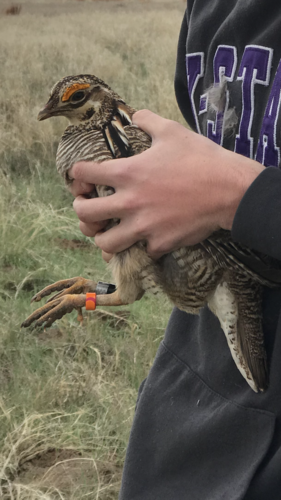 Lesser Prairie-Chicken
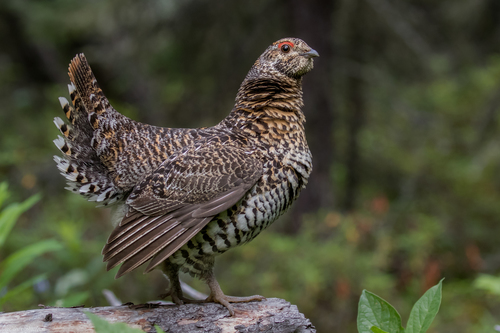 Spruce Grouse
In short
The most reliable way to separate Lesser Prairie-Chicken from Spruce Grouse is by context and overall appearance: Lesser Prairie-Chicken is a heavier, open-country grouse with a pale, barred look, while Spruce Grouse is a smaller, more arboreal species with males showing a striking red eyebrow comb and darker, more contrasting plumage. Juvenile and female Spruce Grouse can be confusing, but their mottled brown or grey pattern and preference for coniferous forests are strong clues. In flight, Lesser Prairie-Chicken appears bulkier and more buffy, whereas Spruce Grouse is more compact and often seen flying short distances between trees. Habitat is a major separator: Lesser Prairie-Chicken is found in open grasslands, while Spruce Grouse is strictly a bird of boreal forests.
Identification tips
- Habitat is often decisive: Open grassland or prairie = Lesser Prairie-Chicken; dense coniferous forest = Spruce Grouse. This works for all ages and sexes.
- Facial features: Male Spruce Grouse have a bright red eyebrow comb, absent in Lesser Prairie-Chicken. Females and juveniles lack this, but males are unmistakable when seen well.
- Plumage contrast: Male Spruce Grouse are sharply marked with black underparts, white spots on the sides, and grey upperparts. Lesser Prairie-Chicken is overall paler, buffier, and more evenly barred, lacking strong black or white contrasts.
- Tail pattern: Spruce Grouse (all ages) shows a dark tail with a pale terminal band; Lesser Prairie-Chicken's tail is more rounded and lacks a sharp pale band.
- Body size and shape: Lesser Prairie-Chicken is heavier and bulkier, with a more chicken-like profile. Spruce Grouse is more compact and suited to perching.
- Behavior: Spruce Grouse is often seen perched in trees or flying short distances through forest. Lesser Prairie-Chicken is almost always on the ground, especially in open areas.
- Display behavior: Lesser Prairie-Chicken males display on the ground with 'booming' calls; Spruce Grouse males perform wing-clap displays in flight.
- Juvenile/female confusion: Spruce Grouse females and juveniles are mottled brown or grey with barred underparts and a dark tail with a pale tip. Lesser Prairie-Chicken juveniles are paler and more uniformly barred, lacking the dark tail and pale tip.
- Vocalizations: If you hear a deep booming call in open country, it's Lesser Prairie-Chicken. Spruce Grouse is mostly silent, with only soft calls and mechanical wing sounds.
- Lek location: If you observe lekking behavior in open grassland, it's Lesser Prairie-Chicken. Spruce Grouse does not lek in open areas.
- Flight style: Spruce Grouse flies short, direct distances between trees; Lesser Prairie-Chicken flushes with a heavier, more labored flight over open ground.
- Perching: Spruce Grouse regularly perches in trees; Lesser Prairie-Chicken does not.
- Facial skin color: Red (Spruce Grouse male) vs. none (Lesser Prairie-Chicken); yellow facial skin is not present in either of these two.
- Seasonal context: Both species can be seen year-round in their respective habitats, but Prairie-Chicken lekking is most obvious in spring.
- Common pitfalls: Female and juvenile Spruce Grouse can be confused with other brownish grouse, but the habitat and tail pattern are reliable; Lesser Prairie-Chicken is rarely confused if seen well in open country.
Size
Lesser Prairie-Chicken is distinctly larger and heavier (body mass ~685.5g [wikidata]) than Spruce Grouse (males 550–650g, females 450–550g [wikipedia]). Prairie-Chicken has a more robust, chicken-like build, while Spruce Grouse is more compact and suited to perching in trees. In the field, Lesser Prairie-Chicken will look bulkier, especially on the ground or in flight, whereas Spruce Grouse appears smaller and neater.
Plumage
Juvenile and female Spruce Grouse are mottled brown (red morph) or grey (grey morph) with dark and white barring below, closely resembling ruffed grouse but with a dark tail tipped pale. Males are mostly grey above and black below, with bold white spots on the sides and a distinctive red eyebrow comb. Lesser Prairie-Chicken, by contrast, is overall paler and more uniformly barred, lacking the strong black/white contrast of male Spruce Grouse and the red eyebrow comb. In all ages, Lesser Prairie-Chicken is more buffy and less sharply marked, with no white spotting or red facial skin. In flight, Spruce Grouse shows a dark tail with a pale terminal band, while Lesser Prairie-Chicken's tail is more rounded and less sharply patterned. No age-specific upperwing patterns are detailed for either species in the notes, but the overall contrast and facial features are key.
Behaviour
Lesser Prairie-Chicken is a classic open-ground lekking species, often seen displaying on short grass hills or ridges, sometimes even using man-made clearings. They are terrestrial, rarely perching in trees. Spruce Grouse, in contrast, is adapted to arboreal life—often perching and moving about in trees, and flying short distances through forest. Males of Spruce Grouse perform wing-clap displays during territorial flights, a behavior not seen in Lesser Prairie-Chicken. Prairie-Chicken males display on the ground with booming calls and visible lekking behavior.
Habitat
Habitat is a strong separator. Lesser Prairie-Chicken is found in open grasslands, prairies, and shrublands, preferring wide, open areas for lekking and nesting. Spruce Grouse is strictly a bird of coniferous boreal forests (taiga), rarely if ever found away from dense spruce or pine stands. If you see a grouse in open grassland, it is almost certainly not a Spruce Grouse; conversely, a grouse in dense conifer forest is not a Lesser Prairie-Chicken.
Voice
Lesser Prairie-Chicken is known for its deep, resonant 'booming' calls during lekking displays, which carry over open ground. Spruce Grouse is among the most silent of grouse, with only soft calls for warning or brood cohesion, and non-vocal sounds like the wing-clap display in males. You are unlikely to hear Spruce Grouse before seeing it, while Prairie-Chicken leks are often located by sound.