
Motmot

Lesser Kestrel vs Common Kestrel

Falco naumanni versus Falco tinnunculus

Play a quiz with Lesser Kestrel and Common Kestrel

Lesser Kestrel (Falco naumanni) Lesser Kestrel
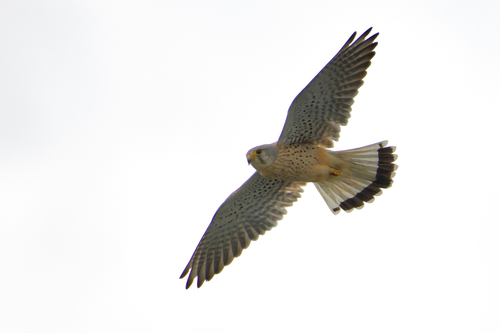
Common Kestrel (Falco tinnunculus) Common Kestrel

Media

Loading…

In short

The most reliable field mark for separating Lesser Kestrel from Common Kestrel is the presence or absence of a bold black malar stripe: Common Kestrel of all ages and sexes shows a prominent black malar stripe, while Lesser Kestrel lacks this feature entirely. Adult male Lesser Kestrels also lack the dark spotting on the back seen in Common Kestrel males, and show distinctive grey patches in the wings. Juveniles and females of both species are extremely similar, but Lesser Kestrel tends to be paler and slightly smaller with proportionally shorter wings and tail. In flight, structure and call can help, but beware: plumage overlap is extensive, especially in young birds. Careful attention to facial pattern, wing coloration, and overall jizz is essential.

Identification tips

  1. Check for a black malar stripe: All Common Kestrels (male, female, juvenile) show a bold black malar stripe on the face; Lesser Kestrel of all ages lacks this feature. This is the single most reliable field mark at all seasons.
  2. Look for back spotting in adult males: Adult male Common Kestrel has prominent black spots on the back, while adult male Lesser Kestrel lacks these spots and appears cleaner rufous above.
  3. Grey wing patches in adult male Lesser Kestrel: Adult male Lesser Kestrel shows grey patches in the wings, which are not present in Common Kestrel males.
  4. Tail and head color in males: Both species' adult males have grey heads and tails, but only Common Kestrel males have a black submoustachial (malar) stripe.
  5. Females and juveniles are tricky: Female and juvenile Lesser and Common Kestrels are very similar; Lesser Kestrel is slightly paler and less heavily marked, but this is subtle and not always reliable.
  6. Structure and jizz: Lesser Kestrel is smaller, more delicate, with shorter wings and tail. In flight, it may appear more compact and less 'rangy' than Common Kestrel, but this is subtle unless both species are seen together.
  7. Talons color: Lesser Kestrel has pale whitish-horn talons, unlike the usual dark talons of Common Kestrel. However, this is only visible at close range and rarely useful in the field.
  8. Vocalizations: Listen for the call: 'chay-chay-chay' (Lesser) vs. 'kee-kee-kee' (Common). Calls are most useful during the breeding season or when birds are agitated.
  9. Colony size and behavior: Lesser Kestrel often nests and roosts in large colonies, especially on migration or wintering grounds. Large groups of small kestrels in southern Europe or Africa are more likely to be Lesser Kestrel.
  10. Season and location: In the UK and much of northern Europe, any kestrel is almost certainly Common Kestrel. In southern Europe, North Africa, or Central Asia, both species may occur together, especially during migration.
  11. Wing and tail proportions: Lesser Kestrel has proportionally shorter wings and tail than Common Kestrel, but this is best judged with direct comparison.
  12. Upperwing pattern in flight: No strong age-specific upperwing pattern separates these species in flight; focus on structure and facial pattern instead.
  13. Bare part color: Both species have yellow cere and feet, but only Lesser Kestrel has pale talons. Bill and iris color are not reliably different in the field.
  14. Plumage overlap: Be aware that female and juvenile plumage is highly overlapping; do not rely on subtle differences in streaking or color unless other marks support the ID.
  15. Fallback on call and context: If plumage is ambiguous, use call, behavior, and context (colony size, season, location) to support your identification.

Size

Common Kestrel is noticeably larger and heavier than Lesser Kestrel, with an average adult mass of 184 g versus 159 g for Lesser Kestrel. In the field, this translates to Common Kestrel appearing more robust, with a longer body (32–39 cm vs. 27–33 cm) and a broader wingspan (65–82 cm vs. 63–72 cm). Lesser Kestrel looks more delicate, with proportionally shorter wings and tail, but size alone is rarely diagnostic unless birds are seen side by side.

Plumage

Juvenile and female Lesser and Common Kestrels are extremely similar, both showing brown backs and barred or streaked underparts. However, all Common Kestrels (regardless of age or sex) have a bold black malar stripe, which is absent in Lesser Kestrel. Adult male Lesser Kestrels lack the dark spotting on the back found in Common Kestrel males and have grey patches in the wings, while Common Kestrel males have more extensive black spotting and a uniform blue-grey cap and tail. Lesser Kestrel females and juveniles are slightly paler than their Common Kestrel counterparts, but this is subtle. Neither species shows strong age-specific upperwing patterns that are diagnostic in flight, so facial pattern and back spotting are more reliable. Lesser Kestrel also has whitish-horn colored talons (not dark), but this is only visible at very close range.

Behaviour

Both species hunt by hovering and dropping onto prey, and both may nest on buildings or cliffs. Lesser Kestrel is more likely to nest colonially, often in large groups, while Common Kestrel is usually more solitary or loosely colonial. Lesser Kestrel is more insectivorous, especially in winter, and may be seen in large communal roosts during migration or on wintering grounds. Common Kestrel tends to be more generalist in diet and less gregarious outside the breeding season.

Habitat

Both species overlap extensively in range and habitat, breeding in open country, farmland, and urban areas. Lesser Kestrel is more migratory, wintering in Africa and South Asia, and may be seen in large flocks during migration or on wintering grounds. Common Kestrel is more resident or only partially migratory in much of its range, and is the default kestrel in the UK and much of Europe. Habitat alone is not a reliable separator where both species occur.

Voice

The calls are distinctive: Lesser Kestrel gives a harsh 'chay-chay-chay', while Common Kestrel produces a 'kee-kee-kee' call. These vocal differences are diagnostic if heard well, but both species are often silent outside the breeding season.

Submit a better description

Use the same sections as the comparison. Your text is published immediately.

The most reliable field mark for separating Lesser Kestrel from Common Kestrel is the presence or absence of a bold black malar stripe: Common Kestrel of all ages and sexes shows a prominent black malar stripe, while Lesser Kestrel lacks this feature entirely. Adult male Lesser Kestrels also lack the dark spotting on the back seen in Common Kestrel males, and show distinctive grey patches in the wings. Juveniles and females of both species are extremely similar, but Lesser Kestrel tends to be paler and slightly smaller with proportionally shorter wings and tail. In flight, structure and call can help, but beware: plumage overlap is extensive, especially in young birds. Careful attention to facial pattern, wing coloration, and overall jizz is essential.

  1. Check for a black malar stripe: All Common Kestrels (male, female, juvenile) show a bold black malar stripe on the face; Lesser Kestrel of all ages lacks this feature. This is the single most reliable field mark at all seasons.
  2. Look for back spotting in adult males: Adult male Common Kestrel has prominent black spots on the back, while adult male Lesser Kestrel lacks these spots and appears cleaner rufous above.
  3. Grey wing patches in adult male Lesser Kestrel: Adult male Lesser Kestrel shows grey patches in the wings, which are not present in Common Kestrel males.
  4. Tail and head color in males: Both species' adult males have grey heads and tails, but only Common Kestrel males have a black submoustachial (malar) stripe.
  5. Females and juveniles are tricky: Female and juvenile Lesser and Common Kestrels are very similar; Lesser Kestrel is slightly paler and less heavily marked, but this is subtle and not always reliable.
  6. Structure and jizz: Lesser Kestrel is smaller, more delicate, with shorter wings and tail. In flight, it may appear more compact and less 'rangy' than Common Kestrel, but this is subtle unless both species are seen together.
  7. Talons color: Lesser Kestrel has pale whitish-horn talons, unlike the usual dark talons of Common Kestrel. However, this is only visible at close range and rarely useful in the field.
  8. Vocalizations: Listen for the call: 'chay-chay-chay' (Lesser) vs. 'kee-kee-kee' (Common). Calls are most useful during the breeding season or when birds are agitated.
  9. Colony size and behavior: Lesser Kestrel often nests and roosts in large colonies, especially on migration or wintering grounds. Large groups of small kestrels in southern Europe or Africa are more likely to be Lesser Kestrel.
  10. Season and location: In the UK and much of northern Europe, any kestrel is almost certainly Common Kestrel. In southern Europe, North Africa, or Central Asia, both species may occur together, especially during migration.
  11. Wing and tail proportions: Lesser Kestrel has proportionally shorter wings and tail than Common Kestrel, but this is best judged with direct comparison.
  12. Upperwing pattern in flight: No strong age-specific upperwing pattern separates these species in flight; focus on structure and facial pattern instead.
  13. Bare part color: Both species have yellow cere and feet, but only Lesser Kestrel has pale talons. Bill and iris color are not reliably different in the field.
  14. Plumage overlap: Be aware that female and juvenile plumage is highly overlapping; do not rely on subtle differences in streaking or color unless other marks support the ID.
  15. Fallback on call and context: If plumage is ambiguous, use call, behavior, and context (colony size, season, location) to support your identification.

Common Kestrel is noticeably larger and heavier than Lesser Kestrel, with an average adult mass of 184 g versus 159 g for Lesser Kestrel. In the field, this translates to Common Kestrel appearing more robust, with a longer body (32–39 cm vs. 27–33 cm) and a broader wingspan (65–82 cm vs. 63–72 cm). Lesser Kestrel looks more delicate, with proportionally shorter wings and tail, but size alone is rarely diagnostic unless birds are seen side by side.

Juvenile and female Lesser and Common Kestrels are extremely similar, both showing brown backs and barred or streaked underparts. However, all Common Kestrels (regardless of age or sex) have a bold black malar stripe, which is absent in Lesser Kestrel. Adult male Lesser Kestrels lack the dark spotting on the back found in Common Kestrel males and have grey patches in the wings, while Common Kestrel males have more extensive black spotting and a uniform blue-grey cap and tail. Lesser Kestrel females and juveniles are slightly paler than their Common Kestrel counterparts, but this is subtle. Neither species shows strong age-specific upperwing patterns that are diagnostic in flight, so facial pattern and back spotting are more reliable. Lesser Kestrel also has whitish-horn colored talons (not dark), but this is only visible at very close range.

Both species hunt by hovering and dropping onto prey, and both may nest on buildings or cliffs. Lesser Kestrel is more likely to nest colonially, often in large groups, while Common Kestrel is usually more solitary or loosely colonial. Lesser Kestrel is more insectivorous, especially in winter, and may be seen in large communal roosts during migration or on wintering grounds. Common Kestrel tends to be more generalist in diet and less gregarious outside the breeding season.

Both species overlap extensively in range and habitat, breeding in open country, farmland, and urban areas. Lesser Kestrel is more migratory, wintering in Africa and South Asia, and may be seen in large flocks during migration or on wintering grounds. Common Kestrel is more resident or only partially migratory in much of its range, and is the default kestrel in the UK and much of Europe. Habitat alone is not a reliable separator where both species occur.

The calls are distinctive: Lesser Kestrel gives a harsh 'chay-chay-chay', while Common Kestrel produces a 'kee-kee-kee' call. These vocal differences are diagnostic if heard well, but both species are often silent outside the breeding season.

Discard your changes?

You have unsaved edits. If you leave now, those changes will be lost.

Lesser Kestrel · Common Kestrel · My Tricky Birds