

Lesser Grass-Finch vs Great Pampa-Finch
Emberizoides ypiranganus versus Embernagra platensis
Play a quiz with Lesser Grass-Finch and Great Pampa-Finch
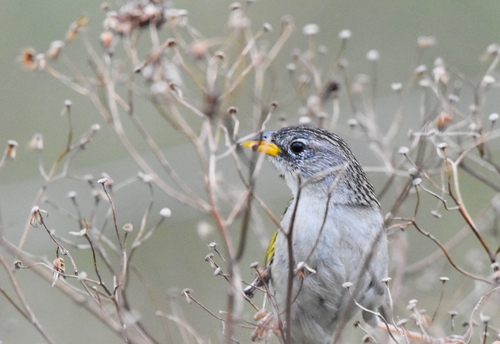 Lesser Grass-Finch
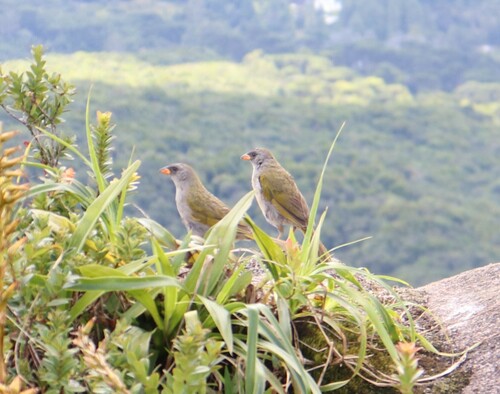 Great Pampa-Finch
In short
The most reliable field mark between Lesser Grass-Finch and Great Pampa-Finch is the head pattern: Lesser Grass-Finch has a grayish face with a pale supercilium and thin eye-ring, while Great Pampa-Finch shows a bold dark mask from the lores past the eye on an otherwise gray head. Juvenile Lesser Grass-Finches have a yellowish wash and streaked breast, which is not matched in Pampa-Finch. Structurally, Great Pampa-Finch is much bulkier, with a thicker bill and heavier build. Both species have greenish tones and streaked upperparts, but the Pampa-Finch is larger, longer-tailed, and has a more robust jizz. In flight or perched, focus on the face pattern and bill size for the quickest separation.
Identification tips
- Head pattern is key: Look for the bold dark mask on Great Pampa-Finch (lores to past eye) versus the grayish face, pale supercilium, and thin eye-ring of Lesser Grass-Finch. This is the most reliable mark at all ages.
- Juvenile Lesser Grass-Finch: If you see a bird with a yellowish wash to the upperparts, yellowish face and underparts, and streaks on the breast, it's a juvenile Lesser Grass-Finch. Pampa-Finch juveniles are not described as yellowish or streaky-breasted.
- Bill size and shape: Great Pampa-Finch has a noticeably longer and thicker bill than Lesser Grass-Finch. If the bill looks chunky and robust, it's likely a Pampa-Finch.
- Body size and jizz: Pampa-Finch is almost twice as heavy and visibly bulkier. If the bird looks large and hefty for a grass-finch, it's probably a Pampa-Finch. Lesser Grass-Finch is more slender and delicate.
- Upperpart streaking: Both can be streaked above, but Lesser Grass-Finch has greenish-brown with thin black streaks (rump less streaked), while Pampa-Finch is grass-green with variable-width dark streaks. Some Pampa-Finch subspecies lack streaks entirely.
- Wing coloration: Lesser Grass-Finch shows brownish wings with wide bright green edges; Pampa-Finch's wings are grass-green with broad blackish tertial centers.
- Tail pattern: Both have long tails, but Pampa-Finch's central tail feathers are greenish, with the rest dusky and wide grass-green edges. Lesser Grass-Finch's tail has dark centers and grayish brown edges.
- Underparts: Lesser Grass-Finch is pale grayish white below, with buff flanks and streaks on flanks/vent. Pampa-Finch is mostly gray below, paler on throat, with an off-white belly and vent often tinged cinnamon-brown.
- Bill and leg color: Both have orange bills with black culmen, but Pampa-Finch's is thicker/longer. Leg color is variable but not strongly diagnostic.
- Sexes similar: Neither species shows sexual dimorphism in plumage, so do not rely on sex for ID.
- Perched vs. in flight: Both species have long tails and similar structure in flight, but Pampa-Finch's bulk and bill size are apparent even in brief views.
- Habitat overlap: Both occur in similar open grassy habitats—do not use habitat alone to separate them.
- Subspecies variation: Some Pampa-Finch subspecies (olivascens, catamarcana) have less streaking or more yellowish/grayish tones, but the masked face and thick bill remain consistent.
- Voice: Not described in the notes; do not use vocalizations for separation here.
- Pitfalls: Do not rely on green tones or general streaking alone, as both can show these. Focus on face pattern, bill size, and overall bulk for the most reliable separation.
Size
Great Pampa-Finch is substantially larger and heavier: 20.5–23 cm long and 45–47 g, compared to Lesser Grass-Finch's 18–20 cm and 18.5–22 g. The Pampa-Finch is nearly twice as heavy, with a noticeably thicker and longer bill. Both have long tails, but the Pampa-Finch's is proportionally longer. In the field, the Pampa-Finch appears bulkier and more robust, while Lesser Grass-Finch is slimmer and more delicate.
Plumage
- Juvenile/immature birds: Juvenile Lesser Grass-Finch shows a buffy yellow wash to the upperparts, yellowish face and underparts, and streaks on the breast—features not described for any age of Great Pampa-Finch. Young Pampa-Finches are not specifically described, but lack mention of yellow or breast streaking.
- Adult head pattern: Lesser Grass-Finch has a mostly grayish face with a pale supercilium, thin whitish eye-ring, and darker lores, giving a subtle, open-faced look. Great Pampa-Finch has a bold dark mask from the lores past the eye, creating a much more striking, masked appearance.
- Upperparts: Both species have streaked upperparts, but Lesser Grass-Finch's are greenish-brown with black streaks (thinner on rump), while Pampa-Finch's are grass-green with dark streaks of varying width. Some Pampa-Finch subspecies lack upperpart streaking (olivascens).
- Wings: Lesser Grass-Finch has brownish wings with wide bright green edges; Pampa-Finch's wings are mostly grass-green with wide blackish centers on the tertials.
- Tail: Both have long tails, but Pampa-Finch's central feathers are greenish, others dusky with wide green edges; Lesser Grass-Finch's tail feathers have dark centers and grayish brown edges.
- Underparts: Lesser Grass-Finch is pale grayish white below, with buff flanks and streaks on flanks and vent. Pampa-Finch is mostly gray below, paler on throat, off-white belly/vent often with cinnamon-brown wash.
- Bill and legs: Both have orange bills with black culmen, but Pampa-Finch's is longer and thicker. Leg color is similar, but some Pampa-Finch subspecies have brighter yellow to orange legs.
Behaviour
Both species are grassland birds, often seen foraging low or on the ground. Great Pampa-Finch, being larger and heavier, often appears more deliberate and robust in movement, while Lesser Grass-Finch is lighter and more agile. Both may perch on grass stems or shrubs, but the Pampa-Finch's heavier build is notable when seen side by side.
Habitat
Both species overlap widely in range (Argentina, Brazil, Paraguay, Uruguay), and both are grassland specialists. Great Pampa-Finch also occurs in Bolivia. Habitat alone is not diagnostic, as both favor open grassy areas and shrubby grasslands.