
Least Flycatcher vs Hammond's Flycatcher
Empidonax minimus versus Empidonax hammondii
Play a quiz with Least Flycatcher and Hammond's Flycatcher
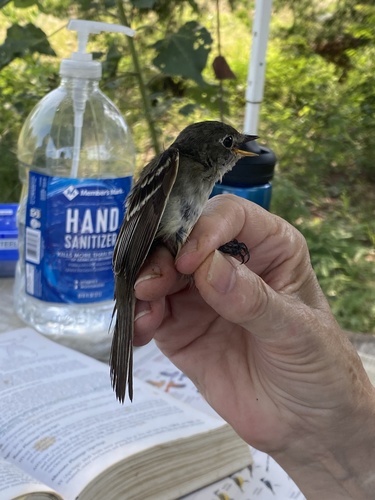 Least Flycatcher
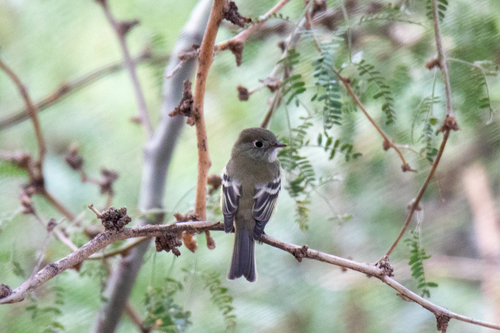 Hammond's Flycatcher
In short
Least Flycatcher and Hammond's Flycatcher are both small Empidonax flycatchers with similar proportions and classic Empid field marks, making visual separation difficult, especially in immature plumages. The most reliable field marks are subtle differences in plumage brightness, bill shape, and, for some birds, the tone of the underparts and face. Least Flycatcher is slightly brighter and more olive above, with a shorter, yellow-based bill, while Hammond's Flycatcher is grayer, with a small, narrow bill and a more gray-washed breast. Both species have prominent white eye rings and wing bars, but details of bill structure and subtle color differences are key. Voice and habitat are often more reliable than plumage for field separation.
Identification tips
- Juvenile and Immature Wing Bars: Both species have two white wing bars, but immatures of Hammond's Flycatcher tend to have broader, more buffy wing bars, while Least's are slightly darker with a tawny/olive hue. This is subtle and not always reliable in the field.
- Bill Shape and Color: Least Flycatcher has a short bill with a distinctly yellowish lower mandible. Hammond's Flycatcher has a small, narrow bill that is generally darker and less obviously yellow-based. Females Hammond's may show a shorter, wider bill, but this is subtle.
- Face and Eye Ring: Both have bold white eye rings, but Hammond's often appears to have a more contrasting face due to a gray wash on the breast and sides of the head. Least's face is brighter and more olive-toned.
- Underparts Color: Least Flycatcher is whiter below, with a clean, pale belly. Hammond's Flycatcher shows a gray wash across the breast and yellowish flanks, giving a slightly dingier look.
- Upperparts Tone: Least is brighter olive-gray above, while Hammond's is more uniformly grayish-olive, sometimes appearing duskier, especially in poor light.
- Tail and Wing Structure: Both have short tails and similar wing shapes. Hammond's may appear slightly longer-winged and shorter-tailed, but this is not a strong field mark.
- Behavioral Cues: Least Flycatcher is often more aggressive and vocal, especially during breeding. Hammond's is more likely to forage quietly higher in the canopy.
- Habitat Context: In the East, Least Flycatcher is expected in open woods and edges. Hammond's is a bird of mature coniferous forests in the West. Out of range, be cautious with visual IDs.
- Vocalizations: Listen for the "che-bec" of Least Flycatcher. Hammond's song is more complex and hoarse, but not given on migration or wintering grounds.
- Seasonal Overlap: During migration, both species can occur outside their core breeding ranges. Use a combination of subtle plumage, structure, and habitat cues when voice is unavailable.
- Sex Differences: Female Hammond's may have a slightly shorter, wider bill, but this is not a reliable field mark without direct comparison.
- Clustered Breeding: Least Flycatcher often breeds in clusters and is highly territorial; Hammond's is more solitary in dense forest.
- Plumage Pitfalls: Both species can appear very similar in poor light or at a distance. Focus on bill color, underparts tone, and habitat for best results.
- No Strong Flight Pattern Differences: Neither species shows a distinctive upperwing pattern in flight that is diagnostic for age or species.
- When in Doubt, Use Voice and Habitat: For Empidonax, especially these two, vocalizations and habitat are often more reliable than plumage alone.
Size
Both species are very similar in size, each measuring about 12–14 cm in length and with comparable wingspans (Least: 19–22 cm, Hammond's: ~22 cm). The Least Flycatcher averages about 10.7 g in mass, while Hammond's Flycatcher is reported at 8–12 g, so there is significant overlap. In the field, size is not a reliable separator between these two.
Plumage
Immature birds of both species look much like adults but have slightly broader and darker wing bars, with a tawny or buff wash (Least) or more buffy overall (Hammond's). For all ages, Least Flycatcher is generally brighter olive-gray above and whiter below, while Hammond's is grayer overall with a more pronounced gray wash on the breast and yellowish sides of the belly. Both have two white wing bars and a bold white eye ring, but Hammond's may show a slightly more contrasting face due to the gray wash. Juvenile and first-fall birds of both species can appear very similar, but Hammond's tends to have broader, more buffy wing bars and a slightly duskier face. Neither species shows strong upperwing pattern differences in flight that are diagnostic for age, so perched views are usually required.
Behaviour
Both species are classic Empidonax in behavior: they perch upright, sally out to catch insects, and flick their tails and wings. Least Flycatcher is noted for being especially territorial and aggressive during breeding, often found in clusters and defending small territories. Hammond's Flycatcher often forages higher in the canopy, perching in the upper parts of coniferous trees and sometimes hovering to glean insects. In mixed Empidonax flocks, Least may appear slightly more active and vocal, while Hammond's is quieter and more retiring.
Habitat
Habitat is a strong clue: Least Flycatcher breeds in open woodlands, edges, and second-growth forests across eastern and central North America, while Hammond's Flycatcher is a bird of mature coniferous and mixed forests in the West. If you find a small Empidonax in dense fir or aspen forest in the Rockies or Pacific Northwest, Hammond's is far more likely. In the East, Least is the default Empidonax in suitable habitat. During migration, ranges can overlap, so context is helpful but not always definitive.
Voice
Vocalizations are among the most reliable field marks. Least Flycatcher gives a sharp, repeated "che-bec" or "chebecker" call, which is distinctive and often the easiest way to confirm its identity. Hammond's Flycatcher has a hoarse, multi-part song ("ssilit, greeep, silit, pweet") and a sharp "peek" call, but does not sing on migration or wintering grounds. If you hear the classic "che-bec," it's a Least; otherwise, voice is less helpful outside the breeding season.