

Leach's Storm-Petrel vs Sooty Shearwater
Hydrobates leucorhous versus Ardenna grisea
Play a quiz with Leach's Storm-Petrel and Sooty Shearwater
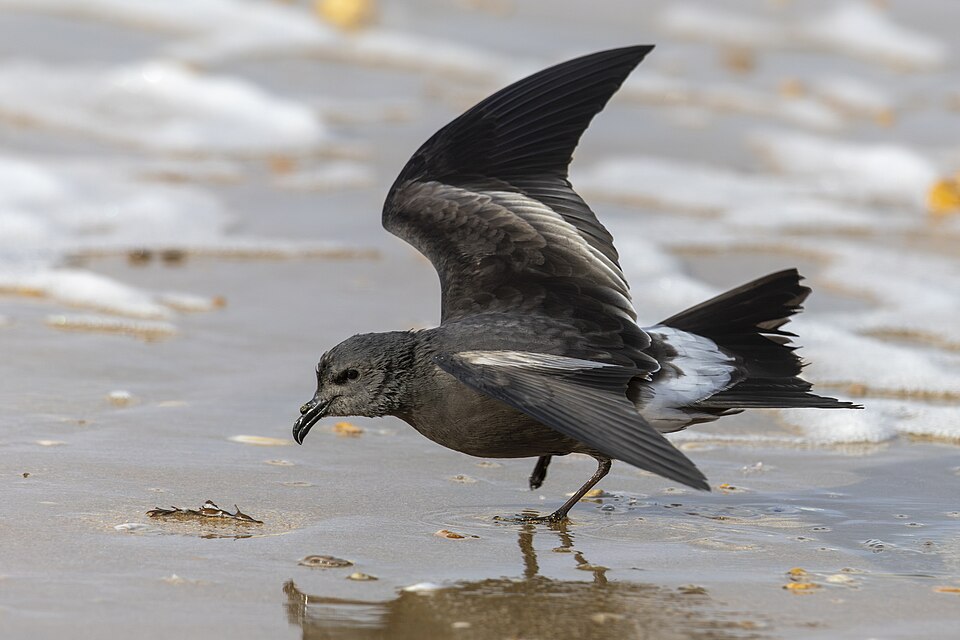 Leach's Storm-Petrel
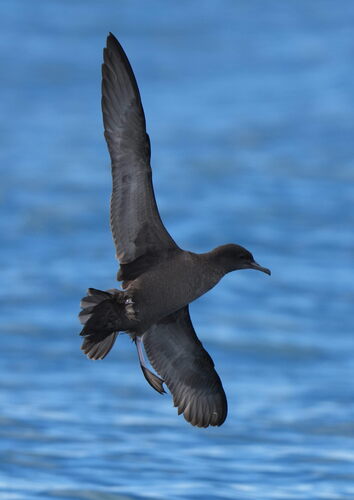 Sooty Shearwater
In short
The most reliable field mark to separate Leach's Storm-Petrel from Sooty Shearwater is size and flight style: Leach's is a tiny, fluttery, bat-like seabird with a white rump (except rare dark-rumped birds), while Sooty Shearwater is much larger, with a powerful, direct, gliding flight and no white on the rump. In good light, Sooty Shearwater shows a silvery underwing flash, absent in Leach's. If you see a small, buoyant bird pattering on the water with a forked tail and white rump, it's Leach's; a long-winged, chocolate-brown bird shearing low over the waves is Sooty Shearwater. Be careful with dark-rumped Leach's, which can cause confusion in the Pacific, but size and flight style remain strong clues.
Identification tips
- Size: Sooty Shearwater is more than twice the length and wingspan of Leach's Storm-Petrel. If the bird looks small, sparrow-sized, it's not a shearwater.
- Flight style: Leach's has a fluttery, erratic, bat-like flight with frequent wingbeats and pattering on the water; Sooty Shearwater glides on stiff wings, with deep, powerful wingbeats and long, low shearing glides.
- Rump pattern: Leach's typically shows a bold white rump (with a possible dark central line), diagnostic unless you have a rare dark-rumped individual (mainly in the Pacific south of California). Sooty Shearwater never shows a white rump at any age.
- Underwing: Sooty Shearwater shows a silvery stripe along the center of the underwing in good light; Leach's does not.
- Tail shape: Leach's has a distinctly forked tail, especially obvious in flight; Sooty Shearwater's tail is wedge-shaped and never forked.
- Bill and head: Both have dark bills, but Sooty Shearwater's bill is proportionally longer and heavier; Leach's has a small, delicate bill.
- Plumage shade: Sooty Shearwater is uniformly dark chocolate-brown (almost black in poor light), while Leach's is blackish with a paler face and white rump.
- Group size: Sooty Shearwaters often occur in large flocks, especially during migration; Leach's are usually solitary or in small groups.
- Feeding behavior: Leach's often patters on the water's surface, picking at food; Sooty Shearwater plunges or dives, rarely pattering.
- Habitat context: If you see a bird from shore in a massive flock, it's likely Sooty Shearwater; Leach's is rarely seen in such numbers.
- Geographic pitfalls: In the Pacific, dark-rumped Leach's can be confused with other dark storm-petrels, but Sooty Shearwater is always much larger and lacks a white rump.
- Perched/roosting: Sooty Shearwater can stand and walk on land; Leach's can only shuffle briefly to its burrow, rarely seen walking.
- Voice: Not useful at sea; both are silent away from colonies.
- Season: Both migrate widely, but Sooty Shearwater's migration is more spectacular and often involves visible flocks.
- When in doubt: If you cannot judge size, focus on flight style and rump pattern—white rump and fluttery flight point to Leach's, large size and gliding flight to Sooty Shearwater.
Size
Leach's Storm-Petrel is much smaller: 18–21 cm in length with a 43–48 cm wingspan [wikipedia]. Sooty Shearwater is more than twice as long and has a wingspan over twice as broad: 40–51 cm in length, 94–110 cm wingspan [wikipedia]. Even at a distance, Sooty Shearwater looks much larger and longer-winged, often described as 'small albatross-like' in flight, while Leach's is a tiny, delicate bird.
Plumage
- Juvenile/Immature/Adult Leach's Storm-Petrel: All ages are mostly blackish, but show a distinctive white rump, often with a dark central line; the white rump is the classic field mark, though rare dark-rumped birds occur in the Pacific south of California. The upperwing has a paler grey-brown bar on the secondary coverts, which may be visible in good light. The face is slightly paler than the rest of the body. Tail is distinctly forked, especially in flight.
- Sooty Shearwater (all ages): Uniformly dark chocolate-brown overall, appearing almost black in poor light. No white rump at any age. In good light, shows a silvery central stripe on the underwing, which Leach's never shows. Tail is wedge-shaped, not forked. At no age does Sooty Shearwater show a pale rump or paler face.
Behaviour
Leach's Storm-Petrel has a fluttering, erratic flight, often pattering on the water's surface as it picks food, with frequent changes of direction and a buoyant, bat-like jizz. It rarely glides for long. Sooty Shearwater, in contrast, has a powerful, direct flight with long, stiff-winged glides close to the water, often banking and 'shearing' from side to side with few wingbeats. Sooty Shearwaters may be seen in large flocks, while Leach's are usually solitary or in small groups.
Habitat
Both species are pelagic and seen offshore, but Sooty Shearwaters are often observed in immense flocks during migration, especially in upwelling zones or nearshore waters rich in food. Leach's Storm-Petrel is more likely to be seen singly or in small numbers, often farther offshore. On land, Leach's is strictly nocturnal at colonies and rarely seen away from the burrow, while Sooty Shearwater is more visible at breeding sites.
Voice
Leach's Storm-Petrel is generally silent at sea, with calls only at breeding colonies at night. Sooty Shearwater is also silent at sea, but can be very vocal (coos, croaks) at breeding grounds. Vocalizations are not useful for separation at sea.