

Latham's Snipe vs Common Snipe
Gallinago hardwickii versus Gallinago gallinago
Play a quiz with Latham's Snipe and Common Snipe
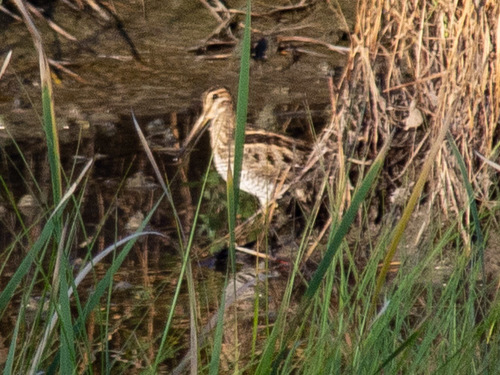 Latham's Snipe
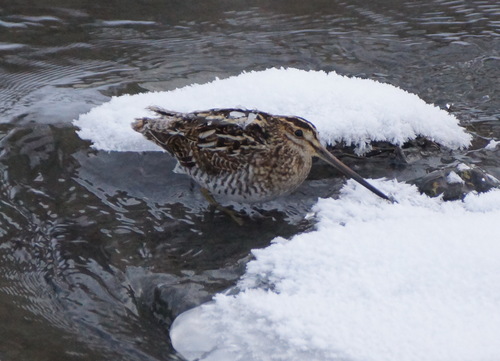 Common Snipe
In short
The most reliable field mark between Latham's Snipe and Common Snipe is overall size: Latham's Snipe is noticeably larger and heavier, with a bulkier appearance both perched and in flight. Both species share cryptic brown, buff, and white plumage with bold head stripes and long straight bills, making them very similar at a glance. However, Latham's Snipe averages longer in body and wingspan, and is heavier-bodied. In the field, subtle differences in structure and proportion are often more useful than plumage, as both can show similar patterns, especially in worn or immature birds. Vocalizations and habitat preferences may also help, but are not always diagnostic.
Identification tips
- Size is the most consistent separator: Latham's Snipe is distinctly larger and heavier than Common Snipe. Use this when you have a direct comparison or experience with both species.
- Bulk and structure: Latham's Snipe appears bulkier and longer-winged, especially in flight. Common Snipe is more compact and shorter-winged.
- Bill length: Both have very long, straight bills, but Latham's Snipe's bill may appear proportionally longer due to its larger size. This is subtle and not always reliable.
- Head pattern: Both show bold pale stripes above and below a dark eye-stripe. Common Snipe's stripes are described as straw-yellow; Latham's Snipe is similar, and this is not a strong separator.
- Upperpart pattern: Both have cryptic, mottled brown, black, buff, and white upperparts. No clear difference is described for age or season.
- Underparts: Common Snipe is pale below; Latham's Snipe is similar, with no distinctive difference noted.
- Wing shape: Both have pointed wings. Latham's Snipe's wingspan is longer, but this is only apparent with experience or in direct comparison.
- Tail shape and display: Common Snipe males perform a 'drumming' display flight, producing a unique sound with the tail. If you see or hear this, it's diagnostic for Common Snipe.
- Flight behavior: Both flush only when closely approached and fly in zig-zags. Flight jizz is similar, but Latham's Snipe may appear heavier and more powerful in flight.
- Habitat: Both use similar wetland habitats. In Australia, Latham's Snipe is the default snipe; in Europe and much of Asia, Common Snipe is more likely.
- Season and location: Latham's Snipe is migratory and found in Australia and East Asia, especially during the non-breeding season. Common Snipe is widespread in the Old World.
- Vocalizations: Only Common Snipe is described as making the 'drumming' sound in display. Both are otherwise quiet when flushed.
- Group size: Both are usually solitary or in small groups; this is not a reliable separator.
- Plumage pitfalls: Immature and adult plumages are very similar between the two, with no age-specific upperwing or tail pattern differences described. Do not rely on subtle color tones.
- When in doubt: If you cannot judge size or see a display flight, identification may not be possible in the field. Use location, season, and probability to inform your best guess, but be honest about uncertainty.
Size
Latham's Snipe is significantly larger: body mass averages about 153 g compared to the Common Snipe's 120 g. Latham's Snipe measures 29–33 cm in length with a 50–54 cm wingspan, while Common Snipe is 25–27 cm long with a 44–47 cm wingspan. This size difference is often visible in direct comparison or with experience, but can be subtle if seen singly. Latham's Snipe is also bulkier and longer-winged, which can be apparent in flight or when perched among other waders.
Plumage
Both species have cryptic, intricately patterned upperparts with black, brown, buff, and white, and bold pale stripes on the head. There is no mention of age-specific upperwing or tail pattern differences in the sources for these two species, so juvenile and adult plumages are similar in field marks. Common Snipe shows straw-yellow stripes above and below a dark eye-stripe, and pale underparts; Latham's Snipe is described as similar but slightly larger and with no mention of distinctive plumage differences. Both have pointed wings and long, straight dark bills. Subtle differences in tone or richness of the breast and upperparts may exist, but are not emphasized as reliable in the sources.
Behaviour
Both species are shy, well-camouflaged, and flush only when closely approached, flying off in zig-zag patterns. Common Snipe males perform a distinctive 'winnowing' or 'drumming' display flight during courtship, producing a unique sound with their tail feathers. Latham's Snipe is migratory and may be seen singly or in small groups, often in wet grassland or marshy areas. Foraging behavior is similar, probing in soft mud for invertebrates.
Habitat
Common Snipe breeds in marshes, bogs, tundra, and wet meadows across the Old World, favoring soft muddy ground with dense cover. Latham's Snipe is migratory along the East Asian–Australasian Flyway and is found in similar wetland habitats, especially in Australia and East Asia. Both can occur in overlapping habitats, so context alone is rarely diagnostic, though Latham's Snipe is the expected snipe in Australia during the non-breeding season.
Voice
Common Snipe is notable for the male's 'drumming' or 'winnowing' display flight, producing a bleating sound with the tail feathers, especially in the breeding season. This sound is distinctive and not reported for Latham's Snipe in the provided sources. Both species are generally quiet when flushed, with Common Snipe uttering a sharp 'scape, scape' call. Latham's Snipe's vocalizations are not detailed in the sources, so voice is not a reliable separator unless the display flight is observed.