

Lark Sparrow vs Lark Bunting
Chondestes grammacus versus Calamospiza melanocorys
Play a quiz with Lark Sparrow and Lark Bunting
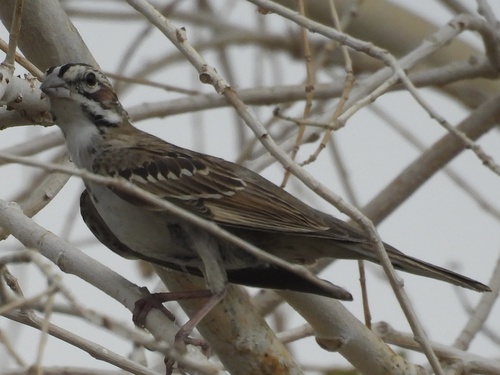 Lark Sparrow
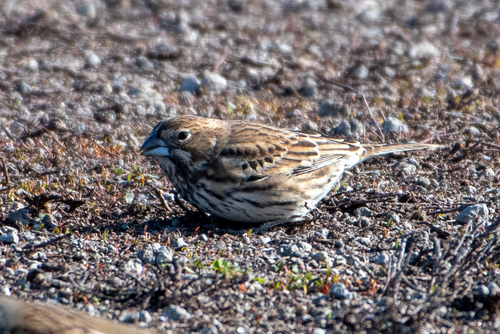 Lark Bunting
In short
The most reliable field mark between Lark Sparrow and Lark Bunting is the Lark Sparrow's striking head pattern: bold chestnut cheek patches, white eyebrow and crown stripes, and a central breast spot, which are absent in Lark Bunting. Immature Lark Sparrows show streaked underparts and a duller version of the adult's head pattern, while Lark Buntings (especially breeding males) are mostly black with a large white wing patch, and females/immatures are plainer brownish birds with less distinct markings. In flight, Lark Sparrows show white tail corners, while Lark Buntings show a prominent white wing patch (in males) and lack the Lark Sparrow's crisp tail pattern. Structure is also helpful: Lark Sparrows are slimmer and longer-tailed, while Lark Buntings are chunkier. Habitat overlap is possible, but Lark Buntings are more tied to open grasslands.
Identification tips
- Head pattern (all ages): Lark Sparrow has a bold, contrasting head with chestnut cheek patches, white eyebrow and crown stripes. Lark Bunting (female/immature) has a plain, streaky face with no strong pattern; male is all black with no head pattern.
- Breast spot (adult Lark Sparrow): Look for a dark central spot on otherwise white underparts. Lark Bunting lacks this spot at all ages.
- Underpart streaking (immatures): Immature Lark Sparrows have streaked underparts and a duller version of the adult's head pattern. Lark Bunting immatures are streaky below but lack the Lark Sparrow's facial pattern and breast spot.
- Tail pattern (all ages, in flight): Lark Sparrow shows white corners on a dark tail, visible in flight or when fanned. Lark Bunting lacks white tail corners; its tail is plain.
- Wing patch (adult male Lark Bunting): Breeding male Lark Bunting is black with a large white wing patch, obvious in flight or when perched. Lark Sparrow never shows a white wing patch.
- Overall color (adult males): Lark Sparrow is brown and white with a patterned head; male Lark Bunting is almost all black with a white wing patch.
- Bill shape: Lark Sparrow has a typical sparrow bill, medium-sized and conical. Lark Bunting's bill is heavier and more robust, especially in males.
- Body shape and posture: Lark Sparrow is slimmer and longer-tailed, often appearing more elongated. Lark Bunting is chunkier, with a shorter tail and a more upright stance.
- Song: Lark Sparrow's song starts with two clear notes, then buzzes/trills; Lark Bunting's is a mix of whistles and trills, lacking the clear introductory notes.
- Call: Lark Sparrow gives a thin 'sit'; Lark Bunting gives a soft 'hoo.'
- Habitat: Lark Sparrow tolerates more varied open habitats, including cultivated fields and areas with scattered bushes. Lark Bunting is more restricted to open grasslands and prairies.
- Flocking: Lark Buntings may form loose colonies in breeding season; Lark Sparrows are more solitary or in small groups.
- Distraction display: Lark Sparrow females may perform distraction displays near the nest; Lark Bunting does not.
- Sexual dimorphism: Lark Bunting shows strong sexual dimorphism (males black, females/immatures brownish); Lark Sparrow sexes are similar.
- Juvenile confusion: If you see a streaky, brownish bird with a dull but patterned face and white tail corners, it's likely a juvenile Lark Sparrow. If the face is plain and the bird is chunkier, consider Lark Bunting.
Size
Lark Sparrow is fairly large for a sparrow: 15–17 cm (5.9–6.7 in) long, 24–33 g (0.8–1.2 oz), with an 11 in (28 cm) wingspan [wikipedia]. Lark Bunting is described as medium-sized, but no direct measurements are given in the notes. In practice, both are similar in size, but Lark Bunting may appear stockier and more robust, while Lark Sparrow is slimmer and more elongated, especially in the tail.
Plumage
Immature Lark Sparrows are brown above with streaked underparts and a duller, but still patterned, head (white eyebrow and crown stripes, chestnut cheek patches). Adults have a boldly marked head, white underparts with a dark central spot, and a dark tail with white corners. In flight, the white tail corners are distinctive at all ages. Lark Bunting breeding males are almost entirely black with a large white wing patch, which is obvious in flight and when perched. Females and immatures are brownish and streaked, lacking the Lark Sparrow's crisp head pattern and central breast spot; they also lack the white tail corners, and their wing patch is much less conspicuous or absent. Thus, for all ages: Lark Sparrow = patterned head and white tail corners; Lark Bunting = plain face, no white tail corners, and (in males) a big white wing patch.
Behaviour
Both species forage on the ground and may form flocks outside the breeding season. Lark Sparrows often feed in low bushes as well as on the ground, and are known for their distraction displays near the nest. Lark Buntings show more aerial display during breeding, with males singing in flight and descending to advertise territory. Lark Buntings are more likely to be seen in loose colonies during breeding, while Lark Sparrows are more solitary or in small groups.
Habitat
Both species nest on the ground in grassy or open habitats. Lark Sparrows use a wider range of open habitats, including grasslands and cultivated fields, sometimes with scattered bushes. Lark Buntings are more strictly tied to open grasslands and prairies, especially in the central and western parts of North America. Overlap is possible in mixed grassland regions, but Lark Bunting is less likely in cultivated or brushy areas.
Voice
Lark Sparrow's song is two clear notes followed by a mix of buzzes and trills; its flight call is a thin 'sit' [wikipedia]. Lark Bunting's song is a mix of whistles and trills, and its call is a soft 'hoo' [wikipedia]. Both have complex songs, but Lark Sparrow's song starts with clear notes and is more varied, while Lark Bunting's is more whistled and less buzzy. Calls are quite different: Lark Sparrow's is thin and sharp, Lark Bunting's is soft and rounded.