

Large Elaenia vs Sooty Tyrannulet
Elaenia spectabilis versus Serpophaga nigricans
Play a quiz with Large Elaenia and Sooty Tyrannulet
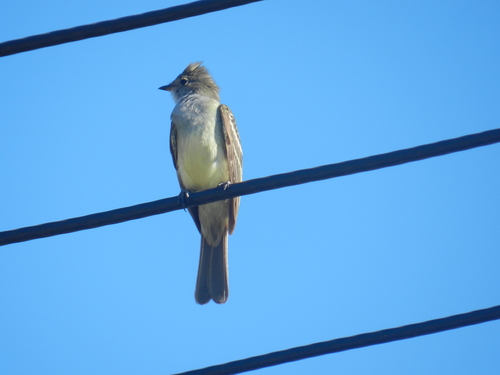 Large Elaenia
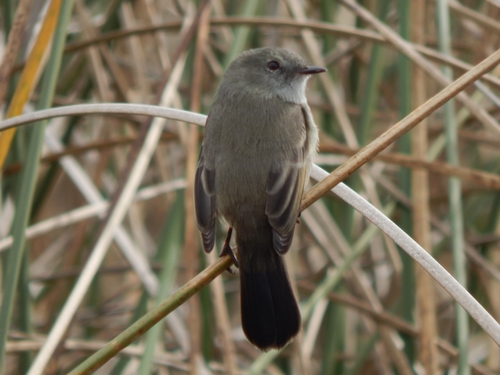 Sooty Tyrannulet
In short
The most reliable way to separate Large Elaenia from Sooty Tyrannulet in the field is by size and overall structure: Large Elaenia is much bigger and bulkier, with a prominent small crest and three bold white wingbars, while Sooty Tyrannulet is tiny, compact, and dark, with a shorter tail and only two faint wingbars. If you see the birds in flight or perched, focus on the number and brightness of wingbars, the presence or absence of a crest, and the overall color tone: Large Elaenia is olive above with yellow below, Sooty Tyrannulet is sooty gray with a black tail and pale underparts. Habitat can also help, as Sooty Tyrannulet is closely tied to water and brushy edges, while Large Elaenia is more generalist. Voice is different, but structure and plumage are usually enough for separation.
Identification tips
- Size is the quickest check: Large Elaenia is nearly twice as long and many times heavier than Sooty Tyrannulet. If the bird looks small and dainty, it's not Large Elaenia.
- Crest presence: Large Elaenia has a small but visible crest (sometimes flattened), while Sooty Tyrannulet's crown is only slightly darker and lacks a true crest.
- Wingbars: Count the wingbars—Large Elaenia shows three bold white wingbars on the wing coverts, Sooty Tyrannulet only two, and these are pale gray and less distinct.
- Underparts color: Large Elaenia has yellowish belly and undertail coverts, contrasting with its olive-gray breast; Sooty Tyrannulet is pale gray below, with no yellow.
- Tail color: Sooty Tyrannulet has a black tail, while Large Elaenia's tail is dusky but not jet black.
- Bill color: Large Elaenia has a black bill with a pale pinkish base to the mandible; Sooty Tyrannulet's bill is entirely black.
- Head pattern: Large Elaenia's head is olive-brown with little or no white in the crest; Sooty Tyrannulet has a darker crown with a partially visible white crown stripe, but this is usually faint.
- Wing panel: The whitish base to the flight feathers in Sooty Tyrannulet can give a pale panel effect, but it's subtle and not as striking as Large Elaenia's wingbars.
- Behavior: Sooty Tyrannulet is constantly moving, making short flights and wagging its tail; Large Elaenia is more sedate and upright, often remaining still for long periods.
- Habitat: If the bird is near water or in riparian brush, Sooty Tyrannulet is more likely; Large Elaenia is more versatile in habitat.
- Voice: If you hear a canary-like song or sharp 'teek', it's Sooty Tyrannulet. Large Elaenia's voice is not described here.
- Sex and age: Both species are sexually monomorphic; no seasonal or sex-based plumage differences are described. Juvenile Sooty Tyrannulet is not known, so use adult marks for all ages.
- Iris color: Both species have dark irises, not useful for separation.
- Leg color: Both have black legs and feet, not diagnostic.
- Pitfall: In poor light, Sooty Tyrannulet's pale underparts can look yellowish—always check size, wingbars, and behavior to confirm ID.
Size
Large Elaenia is dramatically larger, measuring 16.5–18 cm in length and weighing 20–35 g [wikipedia], compared to the Sooty Tyrannulet's 12 cm and 9 g [wikidata]. In the field, Large Elaenia looks robust and long-bodied, while Sooty Tyrannulet is noticeably petite and delicate. The difference is so pronounced that even at a distance, Large Elaenia appears almost twice the bulk of Sooty Tyrannulet. Tail and bill are both proportionally longer and stouter in Large Elaenia, adding to the impression of size.
Plumage
No age-specific flight marks are described for either species, and juveniles of Sooty Tyrannulet are not documented. For adults and older immatures, Large Elaenia shows three distinct white wingbars (from white-tipped coverts) on dusky wings, a dark grayish olive back, and a mostly olive-brown head with a small, often inconspicuous crest. Its underparts are yellowish, especially on the belly and undertail. In contrast, Sooty Tyrannulet is overall dark gray with a brownish tinge above, paler below, and a darker crown. It has only two pale gray wingbars, which are less conspicuous, and the flight feathers closest to the body are whitish. The tail is black, and the chin is whitish. Sooty Tyrannulet lacks the yellow underparts and the third wingbar of Large Elaenia. Both species have dark irises, black bills, and black legs, but Large Elaenia's bill base is pale pinkish, while Sooty Tyrannulet's is all black.
Behaviour
Large Elaenia typically perches upright and still, often in open or semi-open areas, and may sally for insects from a prominent perch. Sooty Tyrannulet is much more active and restless, making frequent short flights between perches and often wagging its tail while foraging. Sooty Tyrannulet rarely lands on the ground and is often seen darting out over water to catch insects. The difference in jizz is striking: Large Elaenia is methodical and deliberate, Sooty Tyrannulet is quick and fidgety.
Habitat
Large Elaenia is found in a wide range of habitats across much of South America, including open woodlands, forest edges, and secondary growth, from Argentina to Colombia and Ecuador [wikipedia]. Sooty Tyrannulet, by contrast, is closely associated with water—streams, rivers, and brushy areas near water bodies, often in agricultural landscapes or near human structures like bridges. It is much less likely to be found far from water, though it can occur in forests away from water on occasion. If you see a small, dark flycatcher near water, Sooty Tyrannulet is more likely; a large, crested flycatcher in drier or more varied habitats points to Large Elaenia.
Voice
Sooty Tyrannulet has a distinctive song: a series of short notes followed by higher-pitched, canary-like notes, and a sharp 'teek' call. It also produces quiet trills and chatters between pairs and more complex calls when interacting with fledglings. Large Elaenia's voice is not described in the provided notes, so vocalization is only diagnostic if you hear the Sooty Tyrannulet's characteristic song or calls.