

Lappet-faced Vulture vs Variable Hawk
Torgos tracheliotos versus Geranoaetus polyosoma
Play a quiz with Lappet-faced Vulture and Variable Hawk
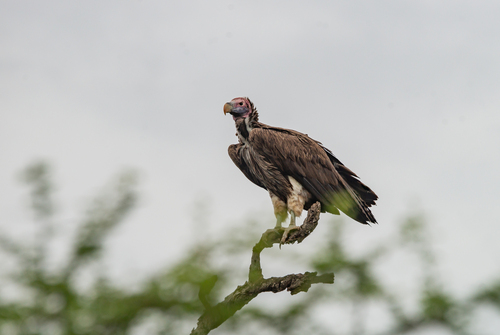 Lappet-faced Vulture
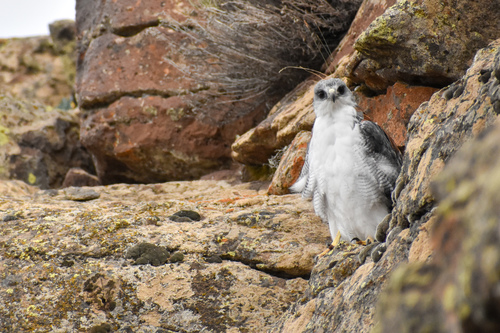 Variable Hawk
In short
The most reliable field mark to separate Lappet-faced Vulture from Variable Hawk is sheer size and structure: the vulture is a massive, heavy-bodied bird with a huge, bare, colorful head and broad wings, while the hawk is much smaller, with a feathered head, slimmer proportions, and a variable but never vulture-like plumage. In flight, the vulture’s underwings are dark with contrasting white thighs, while the hawk (regardless of morph) shows a white tail with a bold black band and paler, barred underwings. The vulture’s enormous bill and fleshy head folds are visible even at distance, especially when perched. Confusion is most likely with dark-morph hawks at a distance, but the vulture’s bulk and unique head are unmistakable up close.
Identification tips
- Size is the first check: Lappet-faced Vulture is gigantic, with a wingspan up to 2.9 m and a bulk that dwarfs any Variable Hawk. If the bird looks as large as a small eagle or bigger, it is not a Variable Hawk. This mark is reliable at any age or season.
- Head structure: Vulture has a bare, colorful head with fleshy lappets and a massive, pale bill. Variable Hawk always has a feathered head and a proportionally much smaller bill. Use this at any distance where head detail is visible.
- Tail pattern in flight: Variable Hawk always shows a white tail with a bold black subterminal band, visible from above and below. Lappet-faced Vulture never shows this pattern; its tail is dark and lacks a contrasting band. This is the best mark for hawks in flight, all ages.
- White thighs: Lappet-faced Vulture has strongly contrasting white thigh feathers, visible in flight and often when perched. Variable Hawk never shows this feature.
- Underwing pattern: In flight, Variable Hawk has pale underwings with fine barring and a broad black tip; Lappet-faced Vulture’s underwings are dark, broad, and lack the hawk’s pattern.
- Plumage variability: Variable Hawk is extremely polymorphic, but no morph ever shows the vulture’s combination of blackish upperparts, white thighs, and bald head. Dark-morph hawks may appear all dark but will still show the white tail band and feathered head.
- Bill size and shape: The vulture’s bill is massive, deep, and pale, adapted for tearing flesh. The hawk’s bill is much smaller and more typical of Buteos.
- Wing shape in flight: Vulture’s wings are very broad, with serrated tips and a parallel leading edge; hawk’s wings are broad but less massive and more pointed.
- Perched posture: Vulture sits heavily, often hunched, with long legs and a huge head. Hawk perches more upright and appears much slimmer.
- Feeding behavior: Vultures are seen at carcasses or feeding on dead animals; hawks are seen hunting live prey or perched scanning for movement.
- Habitat and range: If observed in Africa or Arabia, it is almost certainly a vulture; in South America, a hawk. In zoos or vagrant situations, use other marks.
- Sex/age confusion: Female Variable Hawks may have reddish backs, but this never overlaps with the vulture’s plumage or structure. Juvenile/immature hawks still show the white tail band.
- Flight style: Vultures soar with wings held flat or slightly raised, appearing heavy and slow; hawks soar more buoyantly and may flap more frequently.
- Head color: Vulture’s head color varies by region but is always bare and striking; hawk’s head is always feathered, regardless of morph.
- Social context: Vultures may gather in groups at carcasses; hawks are usually solitary or in pairs.
Size
Lappet-faced Vulture is one of the largest raptors in the world, measuring 95–115 cm in length with a wingspan of 2.5–2.9 m and weighing 4.4–13.6 kg [wikipedia][avonet]. In contrast, Variable Hawk is a large Buteo but much smaller: 45–62 cm long, wingspan 113–151 cm, weight 0.8–1.8 kg [wikipedia]. The vulture is at least twice as long and up to ten times heavier than the hawk. Even at a distance, the vulture’s wings appear broader and longer, and its body is much bulkier. No Variable Hawk, even the largest morphs, approaches the vulture’s size.
Plumage
- Juvenile/immature flight (upperwing/underwing):
- Lappet-faced Vulture (all ages): In flight, shows dark upperparts with strongly contrasting white thigh feathers; underparts range from white to buff-brown, but always with a bald, colorful head. The wings are broad, with serrated-looking tips and a strong contrast between blackish coverts and white thighs. No pale tail band or black subterminal band present [wikipedia].
- Variable Hawk (all ages/morphs): Always shows a white tail with a bold black subterminal band, and underwings that are pale with fine dark barring and a broad black tip. Upperparts and underparts are highly variable (from dark grey to whitish to reddish), but the tail pattern is consistent and diagnostic [wikipedia].
- Adult perched:
- Lappet-faced Vulture: Blackish above, white thighs, bald head with colorful skin and fleshy folds (lappets). Bill is massive and pale. Arabian birds are dark brown above, African birds more blackish with brown lines. Underside white to buff-brown. Head color varies by region but always bare and striking [wikipedia].
- Variable Hawk: Feathered head, no bare skin. Plumage is highly variable, but never has the vulture’s white thighs or bald, colorful head. Females often have reddish-brown back, males more grey, but both sexes always have the white tail with black band [wikipedia].
- Pitfalls:
- Dark-morph Variable Hawks may appear all dark at a distance, but never have the vulture’s white thighs or bare head. No Variable Hawk shows the vulture’s massive bill or fleshy head folds.
Behaviour
Lappet-faced Vultures are primarily scavengers, often seen soaring high or perched near carcasses, but they also hunt live prey (especially young or weak animals) and can be seen dropping from perches onto prey [wikipedia]. They are dominant at carcasses and may drive off other vultures. Variable Hawks are active hunters, soaring over open country or perched on posts and trees, preying on small mammals, birds, and invertebrates. They rarely scavenge and are not seen at carcasses. The vulture’s behavior is more social at food sources, while the hawk is typically solitary or in pairs.
Habitat
Lappet-faced Vulture is found in open, arid or semi-arid habitats across Africa and Arabia, often in savannas, deserts, and open plains [wikipedia]. Variable Hawk is widespread in open habitats of western and southern South America, from lowland steppes to high-elevation puna and páramo, and is absent from Africa and Arabia [wikipedia]. Thus, range alone is usually diagnostic, but in captivity or vagrant situations, habitat preference may help: vultures in Africa/Arabia, hawks in South America.