

Lapland Bunting vs Snow Bunting
Calcarius lapponicus versus Plectrophenax nivalis
Play a quiz with Lapland Bunting and Snow Bunting
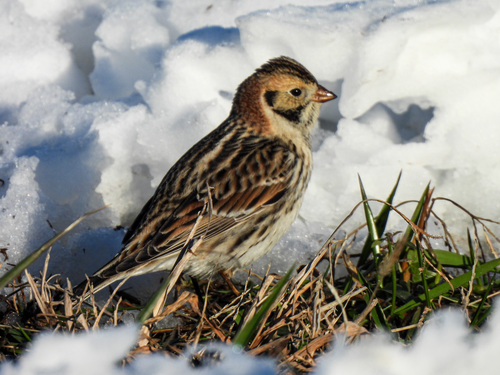 Lapland Bunting
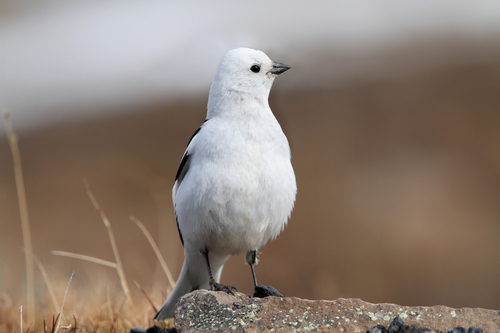 Snow Bunting
In short
The most reliable field mark between Lapland Bunting and Snow Bunting is the amount and placement of white in the wing: Snow Bunting shows extensive white in the wings (especially obvious in flight), while Lapland Bunting has much less white, with darker wings overall. In winter or immature plumages, both can appear streaky and brownish, but Lapland Bunting always retains a chestnut nape and more streaked upperparts, while Snow Bunting is paler and often shows orangey-brown feather fringes. Structurally, Snow Bunting is larger and longer-winged, with a slightly heavier build. Bill color and pattern can help: Lapland Bunting typically has a yellow bill, while Snow Bunting’s bill is yellow with a black tip (all black in breeding males). Habitat overlap is possible in winter, but Lapland Bunting is more likely in grassy or weedy fields, while Snow Bunting prefers open, often snow-covered ground. Calls are similar, but Lapland Bunting’s is drier and more rattling, while Snow Bunting’s is more liquid and rippling.
Identification tips
- Wing pattern in flight: Snow Bunting of all ages shows extensive white in the wings and tail, especially obvious when the bird is flying; Lapland Bunting has much less white, with darker wings and only small pale panels. This is the single most reliable mark, especially for immatures and winter birds.
- Chestnut nape: Lapland Bunting, in all plumages, shows a chestnut nape; Snow Bunting never does. This is visible in perched birds and can be a clincher at close range.
- Back streaking: Lapland Bunting has a heavily streaked back in all plumages, while Snow Bunting’s back is paler with broad orangey-brown fringes in winter and less streaked overall.
- Bill color: Lapland Bunting’s bill is yellow in all plumages; Snow Bunting’s bill is yellow with a black tip in most birds, but turns all black in breeding males. This mark is subtle but useful at close range.
- Breeding male plumage: Male Lapland Bunting in summer has a black head and throat, white eyestripe, and chestnut nape; male Snow Bunting is mostly white with black wingtips and back. These are unlikely to be confused in full breeding plumage.
- Female/immature plumage: Female and immature Lapland Buntings are plainer orange-brown on the head, browner on the back, but always with a chestnut nape and more streaking. Female/immature Snow Buntings have black wingtips and brown-fringed back feathers, with a paler, less streaked look.
- Size and structure: Snow Bunting is larger and bulkier, with a longer wingspan and a heavier build, especially noticeable in flight. Lapland Bunting is smaller and more compact.
- Legs and feet: Snow Bunting has feathered tarsi (legs), an adaptation to cold; Lapland Bunting does not. This is rarely visible in the field but can help at very close range.
- Habitat preference: Lapland Bunting is more likely in grassy or weedy fields, while Snow Bunting prefers open, often snow-covered or barren ground. Use this as a supporting clue, not a primary mark.
- Behavior: Snow Bunting often runs or hops on open ground, sometimes in large flocks; Lapland Bunting is less likely to be seen in large, open, snowy expanses and more often in smaller groups.
- Vocalizations: Listen for a drier, rattling call in Lapland Bunting versus a more liquid, rippling call in Snow Bunting. This is subtle and best used as a supporting mark.
- Seasonal changes: Snow Bunting does not undergo a full spring moult; instead, the breeding plumage appears as brown fringes wear off to reveal black and white. Lapland Bunting moults more conventionally. This affects how worn or fresh the plumage appears in spring.
- White in tail: Snow Bunting shows more white in the tail, especially in flight; Lapland Bunting’s tail is darker with less white.
- Flock composition: Mixed flocks are possible, but Snow Bunting flocks are often larger and more conspicuous in open areas, while Lapland Buntings are more often in smaller groups or singly.
- Pitfalls: In poor light or at a distance, both can appear brownish and streaky; always try to see the wing pattern in flight and check for the chestnut nape on perched birds.
Size
Snow Bunting is the larger of the two, with a wingspan of 32–38 cm (13–15 in) and a weight of 30–40 g. Lapland Bunting is smaller, with a wingspan of 22–29 cm (8.7–11.4 in) and a weight of 22.3–33.1 g. Both are about 15–16 cm in length, but Snow Bunting appears bulkier and longer-winged, especially in flight. This size difference is subtle but can be noticeable with direct comparison or in mixed flocks.
Plumage
The most diagnostic plumage difference is in the wing pattern, especially in flight. Snow Bunting of all ages and sexes shows extensive white in the wings and tail, with black wingtips and a mostly white underwing; this is especially striking in adult males but visible in all plumages. Lapland Bunting, by contrast, has much less white in the wing, with darker, more uniformly brown or blackish wings and only small pale panels. In winter and immature plumages, Lapland Bunting has a chestnut nape and a heavily streaked back, while Snow Bunting shows broad orangey-brown fringes on the back feathers, giving a paler and less streaked appearance. Breeding male Lapland Bunting has a black head and throat, white eyestripe, and chestnut nape, while breeding male Snow Bunting is mostly white with black wingtips and back. Female and non-breeding Snow Buntings have black wingtips and brown-fringed back feathers, while Lapland Bunting females and immatures are plainer orange-brown on the head and browner on the back, but always with a chestnut nape. Bill color is also helpful: Lapland Bunting’s bill is yellow, while Snow Bunting’s is yellow with a black tip (all black in breeding males).
Behaviour
Both species are ground-dwelling and forage on the ground, but Snow Bunting is more likely to be seen running or hopping on open, often snow-covered ground, sometimes in large flocks. Lapland Bunting forages more in grassy or weedy areas and is less likely to be seen in large, open, snowy expanses. Both species can flush in flocks, but Snow Bunting’s flight is more undulating and shows more white flashes in the wings. Lapland Bunting tends to forage for seeds in winter and switches to insects in the breeding season, often feeding in the same area for a while before moving on.
Habitat
In winter, both species can overlap in open country, but Lapland Bunting favors grassy fields, weedy stubble, and tundra edges, while Snow Bunting prefers very open, often snow-covered or barren ground, including beaches, ploughed fields, and windswept hills. Snow Bunting is more likely to be found in exposed, treeless areas, especially in large flocks, while Lapland Bunting is more associated with areas that have some vegetation cover.
Voice
Both species have similar calls, but Lapland Bunting’s call is described as drier and more rattling, while Snow Bunting’s is more liquid and rippling. Snow Bunting’s song is a brief, loud warble, often given from a perch or in flight display, and is unique to each male. Calls are usually heard in flight or when birds are on the ground. In the field, the difference can be subtle, but the quality of the call (drier vs. more liquid) can help with identification if seen poorly.