

Lapland Bunting vs Little Bunting
Calcarius lapponicus versus Emberiza pusilla
Play a quiz with Lapland Bunting and Little Bunting
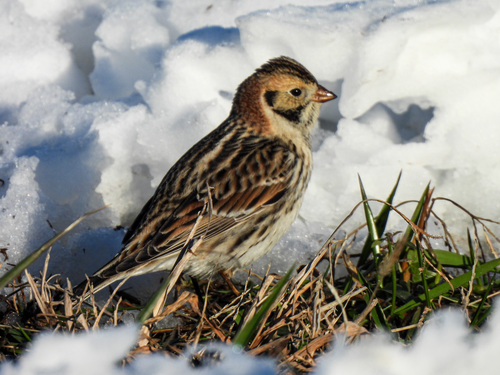 Lapland Bunting
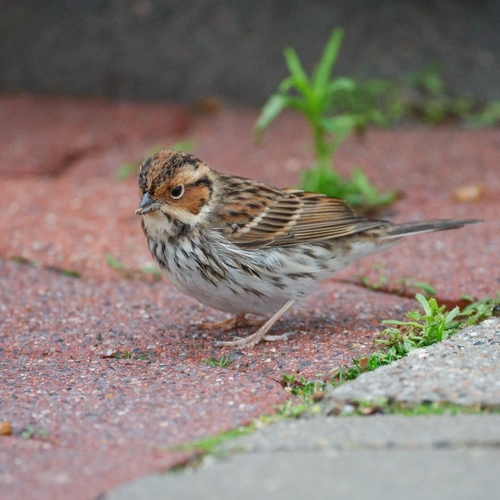 Little Bunting
In short
The most reliable field mark between Lapland Bunting and Little Bunting is overall structure and head pattern: Lapland Bunting is noticeably larger and more robust, with a thick, yellowish bill and (in breeding males) a striking black head and chestnut nape, while Little Bunting is smaller, more delicate, with a fine bill and a neat chestnut face framed by a white malar stripe and black crown stripes. In non-breeding or immature plumages, Lapland Bunting still shows a chunkier build and chestnut nape, while Little Bunting maintains its crisp, small-bunting look and distinctive facial pattern. Both species can show streaked underparts, but the Lapland Bunting is heavier and bulkier, especially in flight. Separation is most challenging in autumn and winter, when both species are drab and streaky, but careful attention to size, bill shape, and face pattern will resolve most confusion.
Identification tips
- Size and structure: Lapland Bunting is noticeably larger and heavier than Little Bunting. If the bird looks robust, broad-bodied, and thick-billed, suspect Lapland Bunting; if it is small, slim, and fine-billed, suspect Little Bunting. This holds for all ages and seasons.
- Bill shape and color: Lapland Bunting has a thick, yellowish seed-eater’s bill, while Little Bunting has a fine, delicate bill. Bill color is most obvious at close range.
- Head pattern (breeding males): Male Lapland Bunting in summer is unmistakable with a black head and throat, white supercilium, and chestnut nape. Little Bunting never shows a black head or throat.
- Head pattern (all other plumages): Little Bunting always shows a neat chestnut face, white malar stripe, black crown stripes, and a fine dark border to the rear of the cheek. Lapland Bunting (female, non-breeding, or immature) has a broader, less defined orange-brown head and chestnut nape, lacking the crisp facial markings of Little Bunting.
- Nape color: Chestnut nape is a feature of both, but in Lapland Bunting it is broader and more extensive, especially in males; in Little Bunting, the chestnut is confined to the face and cheek area.
- Underparts: Both species can show white underparts with streaking, but Lapland Bunting’s streaking is heavier and more extensive on the back, while Little Bunting’s is finer and mostly on the breast and flanks.
- Back and wing pattern: Lapland Bunting has a heavily streaked black-grey back in breeding plumage; Little Bunting’s back is less heavily marked and lacks the robust look.
- Flight impression: Lapland Bunting appears heavy and powerful in flight, with broad wings; Little Bunting is quick, light, and agile.
- Habitat context: In open, arctic or tundra-like habitats, Lapland Bunting is more likely; in woodland edge, shrubby, or hedged areas, Little Bunting is more expected.
- Vocalization: If you hear a sharp 'zik' or the rolling 'siroo-sir-sir-siroo' song, it is Little Bunting. Lapland Bunting’s calls are not described here.
- Seasonal context: Lapland Bunting is a circumpolar arctic breeder, so in Eurasia outside the breeding season, it is the only Calcarius longspur present; Little Bunting is a widespread Emberiza bunting of northern forests.
- Sex differences: Both species are sexually similar outside of breeding male Lapland Bunting, which is much more striking.
- Group size: Lapland Bunting may be seen in larger flocks, especially in open fields, while Little Bunting is often solitary or in small groups.
- Feeding behavior: Lapland Bunting forages in the open, often on the ground; Little Bunting prefers cover and edges.
- Pitfalls: Immature and non-breeding Lapland Buntings can appear drab and streaky, resembling Little Bunting at a glance, but will always be larger, chunkier, and lack the crisp facial pattern of Little Bunting.
Size
Lapland Bunting is significantly larger and heavier: 15–16 cm in length and 22–33 g in weight, compared to Little Bunting’s 12–14 cm and 15.4 g. This size difference is often obvious in the field, especially if both species are seen together or near familiar reference birds. Lapland Bunting appears robust and broad-bodied, with a thick, seed-eater’s bill, while Little Bunting is noticeably smaller, slimmer, and more delicate, with a fine bill. In flight, Lapland Bunting gives a heavier, more powerful impression, while Little Bunting is quick and light.
Plumage
No age-specific upperwing or flight pattern marks are described for either species, so separation relies on head and body plumage. Adult male Lapland Bunting in summer is unmistakable: black head and throat, white supercilium, chestnut nape, and white underparts with a heavily streaked back. Females and non-breeding birds are plainer but retain the chestnut nape and a broad, orange-brown head, with a thick bill and generally more robust appearance. Little Bunting of all ages and sexes shows a neat chestnut face with a white malar stripe, black crown stripes, and a fine dark border to the rear of the cheek; the underparts are white with dark streaks on the breast and flanks. The facial pattern in Little Bunting is crisp and compact, while Lapland Bunting’s is broader and less sharply defined outside of breeding males. Both can show streaked underparts, but Lapland Bunting’s streaking is usually heavier and more extensive on the back.
Behaviour
Lapland Bunting forages mainly on the ground, often in open areas, and may be seen moving in flocks, especially outside the breeding season. It tends to feed for a period in one spot before flying off to new areas. Little Bunting is also a ground forager but is more likely to be found in cover or at the edge of scrub, often singly or in small groups. Lapland Bunting appears more robust and less restless than the quick, active Little Bunting.
Habitat
Lapland Bunting is an arctic breeder, typically found in open tundra or grassy habitats during the breeding season, and moves to open fields, stubble, and weedy areas in winter. Little Bunting breeds in taiga and mixed woodland edges, and in migration or winter is often found in shrubby or wooded habitats, hedgerows, and thickets. In Eurasia, Lapland Bunting is the only Calcarius longspur, while Little Bunting is a typical Emberiza bunting of northern forests.
Voice
Little Bunting has a distinctive sharp 'zik' call and a rolling, musical song described as 'siroo-sir-sir-siroo.' Lapland Bunting’s calls and songs are not described in the provided notes, so vocal separation is only reliable for Little Bunting’s call and song. If you hear the 'zik' or the characteristic song, it points to Little Bunting.