

Motmot

Lanner Falcon vs Peregrine Falcon

Falco biarmicus versus Falco peregrinus

Play a quiz with Lanner Falcon and Peregrine Falcon
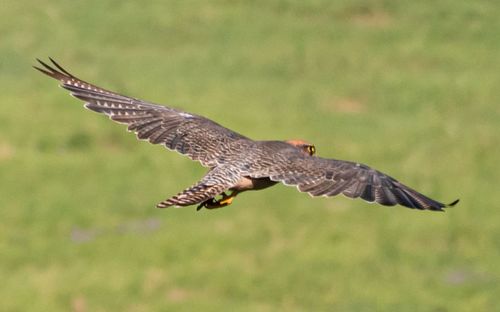
Lanner Falcon (Falco biarmicus) Lanner Falcon
Peregrine Falcon (Falco peregrinus) Peregrine Falcon

Media

Loading…

In short

The most reliable field mark between Lanner and Peregrine Falcons is the head pattern: adult Peregrines show a bold black helmet with a strong malar stripe, while Lanners have a paler, reddish nape and less defined facial markings. Juvenile Lanners can look quite like Sakers, but still lack the Peregrine's crisp face. In flight, both are large falcons, but the Lanner often appears longer-winged and less compact. Habitat can help: Lanners prefer open savannah and grasslands, while Peregrines are more often found near cliffs, coasts, or urban areas. Both are similar in size, so focus on structure and head pattern for confident separation.

Identification tips

  1. Head pattern is key: Adult Peregrine Falcons have a bold black helmet and strong malar stripe, giving a hooded look. Lanner Falcons have a paler head with a reddish nape and less defined facial markings; this is visible in all ages but especially in adults.
  2. Juvenile confusion: Juvenile Lanners are browner and streaked, resembling Saker Falcons, but still lack the Peregrine's crisp black helmet and malar stripe. If the head is pale and the nape is reddish, it's a Lanner, not a Peregrine.
  3. Upperparts color: Adult Peregrines are blue-grey above with clean barring below; Lanners (Eurasian) are slate or brown-grey, African birds paler blue-grey. Lanner's upperparts are never as dark or as cleanly blue-grey as typical Peregrines.
  4. Underparts: Peregrines have barred white underparts, while Lanners (especially northern birds) are streaked on the breast. Streaking vs. barring can help, but is variable in juveniles.
  5. Facial contrast: Look for the strong contrast of the Peregrine's face—dark helmet and malar stripe—versus the Lanner's more blended, paler face with reddish tones.
  6. Structure in flight: Lanner Falcons often appear longer-winged and less compact than Peregrines, especially when soaring. Peregrines look stockier and more powerful, with broader bases to the wings.
  7. Perched jizz: Lanners may look slimmer and longer-tailed when perched, while Peregrines appear more robust and short-tailed.
  8. Habitat context: Lanners are most likely in open savannah, grasslands, or arid country; Peregrines are more likely near cliffs, coasts, or cities. If seen in an urban area or on a coastal cliff, Peregrine is more likely.
  9. Behavior: If you see mutual soaring or synchronized power-dives by a pair, Lanner is more likely. If you see a high-speed stoop or prey taken in mid-air, Peregrine is more likely, though both can perform aerial hunts.
  10. Voice: Only the Lanner's harsh 'wray-e' is described; if heard, it may support Lanner, but lack of vocalization is not helpful.
  11. Sexual dimorphism: Only Peregrine is noted as strongly sexually dimorphic (females much larger), but this is hard to judge in the field without direct comparison.
  12. Seasonal movement: Lanners are mostly resident with local movements; Peregrines may be more migratory, especially in northern regions.
  13. Pitfall—Saker confusion: Juvenile Lanners can look like Sakers, but Sakers have a paler crown and even less defined face than Lanner; Peregrines never show this combination.
  14. Plumage hybrids: Beware of hybrid 'perilanners' in falconry areas, which may show intermediate features.
  15. Size: Both are similar in size; do not rely on size alone for separation.

Size

Both species are large falcons, close in overall size. Lanner Falcon measures 43–50 cm in length with a wingspan of 95–105 cm [wikipedia]. Peregrine Falcon is described as 'crow-sized' and is sexually dimorphic, with females larger than males, but no precise measurements are given in the notes for direct comparison. In the field, size alone is not a reliable separator between these two, especially at a distance or in flight.

Plumage

Juvenile Lanner Falcons are browner above and resemble Saker Falcons, with a reddish back to the head and less sharply defined head-side patterns. Their upperparts are slate grey or brown-grey (Eurasian) or paler blue-grey (African), and the breast is streaked in northern birds. Juvenile Peregrines (not described in detail here) typically show a brownish cast and streaked underparts but always retain the strong dark helmet and malar stripe. Adult Peregrines have a blue-grey back, barred white underparts, and a black head with a distinctive malar stripe. Lanners lack this strong facial contrast, showing a paler, reddish nape and less defined facial markings. In all ages, the Lanner's head is paler and less hooded than the Peregrine's. In flight, both show pointed wings, but Lanner can look longer-winged and less compact, especially when soaring.

Behaviour

Both species hunt birds and bats, often in open country. Lanners are noted for mutual soaring and synchronized flight displays before breeding; pairs may power-dive together. Peregrines are famous for their high-speed stoop, often hunting at dawn and dusk, and can take prey in mid-air with a powerful strike. Peregrines are also known to hunt nocturnally in cities and sometimes contour-hunt or even pursue prey on foot, though this is rare. Both species pluck prey before eating. Lanners are more resident, with only local dispersal, while Peregrines may be more migratory or dispersive depending on region.

Habitat

Lanner Falcons are most common in open savannah, grasslands, and sour grasslands, ranging from forest edge to desert, but generally avoid dense forests. In South Africa, they shift between grasslands and more arid habitats seasonally. Peregrine Falcons require open space for hunting and are often found near cliffs, coasts, marshes, fields, tundra, and increasingly in urban areas. Lanners are less likely to be seen in urban or coastal environments compared to Peregrines.

Voice

The only vocalization described is the Lanner's harsh 'wray-e'. No details are given for Peregrine Falcon calls in these notes, so voice is not a reliable separator here.

Submit a better description

Use the same sections as the comparison. Your text is published immediately.

The most reliable field mark between Lanner and Peregrine Falcons is the head pattern: adult Peregrines show a bold black helmet with a strong malar stripe, while Lanners have a paler, reddish nape and less defined facial markings. Juvenile Lanners can look quite like Sakers, but still lack the Peregrine's crisp face. In flight, both are large falcons, but the Lanner often appears longer-winged and less compact. Habitat can help: Lanners prefer open savannah and grasslands, while Peregrines are more often found near cliffs, coasts, or urban areas. Both are similar in size, so focus on structure and head pattern for confident separation.

  1. Head pattern is key: Adult Peregrine Falcons have a bold black helmet and strong malar stripe, giving a hooded look. Lanner Falcons have a paler head with a reddish nape and less defined facial markings; this is visible in all ages but especially in adults.
  2. Juvenile confusion: Juvenile Lanners are browner and streaked, resembling Saker Falcons, but still lack the Peregrine's crisp black helmet and malar stripe. If the head is pale and the nape is reddish, it's a Lanner, not a Peregrine.
  3. Upperparts color: Adult Peregrines are blue-grey above with clean barring below; Lanners (Eurasian) are slate or brown-grey, African birds paler blue-grey. Lanner's upperparts are never as dark or as cleanly blue-grey as typical Peregrines.
  4. Underparts: Peregrines have barred white underparts, while Lanners (especially northern birds) are streaked on the breast. Streaking vs. barring can help, but is variable in juveniles.
  5. Facial contrast: Look for the strong contrast of the Peregrine's face—dark helmet and malar stripe—versus the Lanner's more blended, paler face with reddish tones.
  6. Structure in flight: Lanner Falcons often appear longer-winged and less compact than Peregrines, especially when soaring. Peregrines look stockier and more powerful, with broader bases to the wings.
  7. Perched jizz: Lanners may look slimmer and longer-tailed when perched, while Peregrines appear more robust and short-tailed.
  8. Habitat context: Lanners are most likely in open savannah, grasslands, or arid country; Peregrines are more likely near cliffs, coasts, or cities. If seen in an urban area or on a coastal cliff, Peregrine is more likely.
  9. Behavior: If you see mutual soaring or synchronized power-dives by a pair, Lanner is more likely. If you see a high-speed stoop or prey taken in mid-air, Peregrine is more likely, though both can perform aerial hunts.
  10. Voice: Only the Lanner's harsh 'wray-e' is described; if heard, it may support Lanner, but lack of vocalization is not helpful.
  11. Sexual dimorphism: Only Peregrine is noted as strongly sexually dimorphic (females much larger), but this is hard to judge in the field without direct comparison.
  12. Seasonal movement: Lanners are mostly resident with local movements; Peregrines may be more migratory, especially in northern regions.
  13. Pitfall—Saker confusion: Juvenile Lanners can look like Sakers, but Sakers have a paler crown and even less defined face than Lanner; Peregrines never show this combination.
  14. Plumage hybrids: Beware of hybrid 'perilanners' in falconry areas, which may show intermediate features.
  15. Size: Both are similar in size; do not rely on size alone for separation.

Both species are large falcons, close in overall size. Lanner Falcon measures 43–50 cm in length with a wingspan of 95–105 cm [wikipedia]. Peregrine Falcon is described as 'crow-sized' and is sexually dimorphic, with females larger than males, but no precise measurements are given in the notes for direct comparison. In the field, size alone is not a reliable separator between these two, especially at a distance or in flight.

Juvenile Lanner Falcons are browner above and resemble Saker Falcons, with a reddish back to the head and less sharply defined head-side patterns. Their upperparts are slate grey or brown-grey (Eurasian) or paler blue-grey (African), and the breast is streaked in northern birds. Juvenile Peregrines (not described in detail here) typically show a brownish cast and streaked underparts but always retain the strong dark helmet and malar stripe. Adult Peregrines have a blue-grey back, barred white underparts, and a black head with a distinctive malar stripe. Lanners lack this strong facial contrast, showing a paler, reddish nape and less defined facial markings. In all ages, the Lanner's head is paler and less hooded than the Peregrine's. In flight, both show pointed wings, but Lanner can look longer-winged and less compact, especially when soaring.

Both species hunt birds and bats, often in open country. Lanners are noted for mutual soaring and synchronized flight displays before breeding; pairs may power-dive together. Peregrines are famous for their high-speed stoop, often hunting at dawn and dusk, and can take prey in mid-air with a powerful strike. Peregrines are also known to hunt nocturnally in cities and sometimes contour-hunt or even pursue prey on foot, though this is rare. Both species pluck prey before eating. Lanners are more resident, with only local dispersal, while Peregrines may be more migratory or dispersive depending on region.

Lanner Falcons are most common in open savannah, grasslands, and sour grasslands, ranging from forest edge to desert, but generally avoid dense forests. In South Africa, they shift between grasslands and more arid habitats seasonally. Peregrine Falcons require open space for hunting and are often found near cliffs, coasts, marshes, fields, tundra, and increasingly in urban areas. Lanners are less likely to be seen in urban or coastal environments compared to Peregrines.

The only vocalization described is the Lanner's harsh 'wray-e'. No details are given for Peregrine Falcon calls in these notes, so voice is not a reliable separator here.

Discard your changes?

You have unsaved edits. If you leave now, those changes will be lost.

Lanner Falcon · Peregrine Falcon · My Tricky Birds