

Knob-billed Duck vs Red-headed Weaver
Sarkidiornis melanotos versus Anaplectes rubriceps
Play a quiz with Knob-billed Duck and Red-headed Weaver
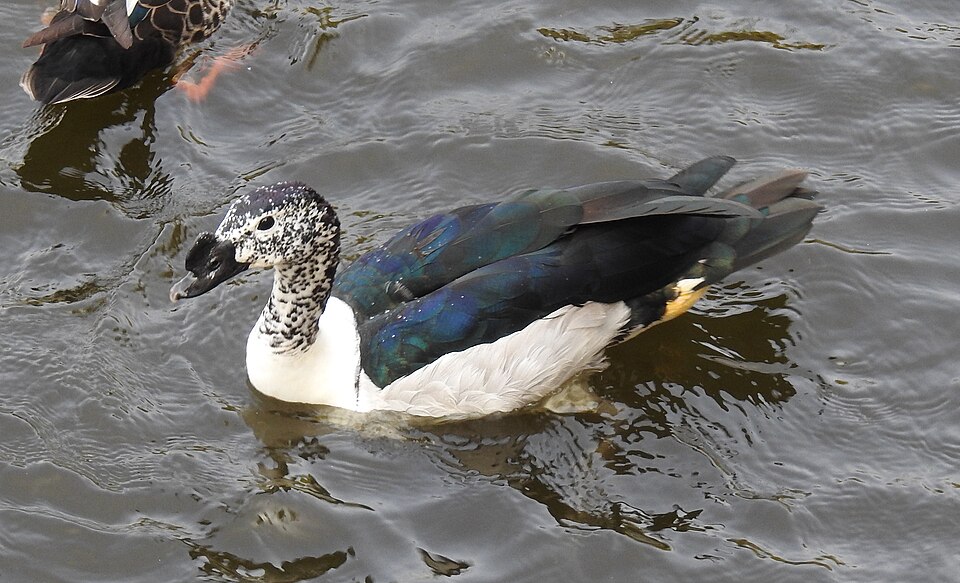 Knob-billed Duck
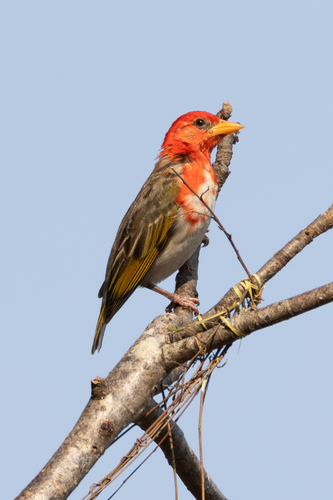 Red-headed Weaver
In short
The Knob-billed Duck is a massive, heavy-bodied waterfowl with a white, freckled head and glossy dark upperparts, while the Red-headed Weaver is a much smaller, slender songbird with a pointed bill and, in males, a striking red head. Immature Knob-billed Ducks can be confusingly dull and brownish, but their size and water-loving habits are unmistakable compared to the arboreal, insect-hunting weaver. If you see a large duck with a white neck and dark back, especially with a bill knob (male), it is the duck; any small, tree-foraging bird with a red or yellow head is the weaver. Flight, habitat, and overall structure are the quickest ways to separate these two.
Identification tips
- Size and Structure: The Knob-billed Duck is enormous compared to the Red-headed Weaver—if the bird is duck-sized or larger, it cannot be the weaver. Even a juvenile duck dwarfs any weaver.
- Bill Shape: Knob-billed Ducks have a broad, flat duck bill; adult males have a large black knob. Red-headed Weavers have a slender, pointed bill, never with a knob.
- Head Pattern (Adult Males): Male Knob-billed Ducks have a white head with dark speckling and a prominent black knob on the bill. Male Red-headed Weavers (northern) have a vivid red head; southern females have yellow heads. No weaver shows a white, freckled head or bill knob.
- Underparts: Adult ducks have pure white underparts and neck, contrasting with glossy dark upperparts. Weavers have a white belly but always with a colored (red, brown, or yellow) head and brown wings.
- Upperparts and Iridescence: The duck's back and wings are glossy blue-black with greenish and bluish iridescence, especially on the secondaries. The weaver's wings are plain brown with some yellow accents in southern females.
- Juvenile/Immature Plumage: Young Knob-billed Ducks are dull buff below and brown above, with a brown eyestripe, but remain much larger and heavier than any weaver. Immature weavers are always small, slender, and arboreal.
- Habitat: Ducks are always near water—lakes, swamps, wetlands. Weavers are in trees, bushes, or gardens, rarely near open water.
- Behavior: Ducks swim, dabble, graze, and sometimes perch in trees but are never seen foraging in foliage. Weavers actively forage among leaves and branches, often hanging upside-down or probing bark.
- Flight: Ducks are heavy, with slow, powerful wingbeats and broad wings; weavers are quick, agile, and fluttery, with short, rounded wings.
- Voice: Ducks are mostly silent, giving only a low croak when flushed. Weavers may sing or call, especially in the breeding season.
- Nesting: Duck nests are in tree holes or tall grass near water. Weaver nests are suspended, stick-built, often with a long entrance tunnel, and never near water.
- Sexual Dimorphism: Male ducks are much larger than females and have the bill knob; in weavers, males are more brightly colored (red or yellow heads), but both sexes are small and slender.
- Pitfalls: Immature Knob-billed Ducks may look drab and could be mistaken for another large waterbird, but never for a small, arboreal weaver. No age or sex of weaver resembles a duck in any context.
- Context: If you see a bird in a flock on open water, it is a duck. If you see a bird foraging in a tree, especially upside-down, it is a weaver.
- Local Abundance: Both species can be locally common, but their habitats never overlap closely—use context as a strong clue.
Size
Size is the most immediate separator: the Knob-billed Duck is one of the largest ducks, with an average body mass around 1616 g and a length of 56–76 cm [wikidata, wikipedia]. In contrast, the Red-headed Weaver is a small passerine, much lighter and more compact (exact mass not provided but typical of weavers, i.e., <50 g). Even immature Knob-billed Ducks are vastly larger than any weaver, and their bulk is obvious both in flight and at rest.
Plumage
Juvenile and immature Knob-billed Ducks are dull buff below and on the face and neck, with brown upperparts and a brown eyestripe, which can make them look superficially like a large, drab waterbird. However, they always show a much larger, heavier structure and a pale, often whitish, underbody compared to the weaver. Adults have a white head with dark spots, a pure white neck and underparts, and glossy blue-black upperparts with iridescent secondaries. Males have a prominent black knob on the bill.
Red-headed Weaver males in the north have a vivid red head and white belly, with brown wings; females are drabber, with brown or yellowish heads (southern birds) and yellow accents on the wings. The weaver's bill is pointed and slender, unlike the broad duck bill. No age or sex of the weaver ever resembles a duck in plumage or structure. There are some minor race differences in belly and wing edging, but these do not overlap with the duck's appearance.
In flight, the duck shows broad wings and a heavy body, while the weaver is quick and agile, with short, rounded wings and a pointed bill always visible.
Behaviour
Knob-billed Ducks are typically seen swimming or grazing near water, sometimes perching in trees but rarely far from wetlands. They are often in flocks, especially outside the breeding season, and may be silent or give a low croak when flushed. Red-headed Weavers are active, arboreal songbirds, foraging for insects on leaves, branches, and bark, often hanging upside-down or probing clusters of dead leaves. They are usually solitary or in pairs, sometimes in small groups, and never swim or dabble. Their nest is a suspended, stick-built structure, sometimes with a long entrance tunnel.
Habitat
Knob-billed Ducks are found in tropical and subtropical wetlands, lakes, and swamps across Sub-Saharan Africa, Madagascar, and parts of South Asia and Indochina. They are almost always near water, especially open freshwater. Red-headed Weavers inhabit a wide range of wooded habitats throughout the Afrotropics, from savanna trees to bushland and even gardens, but are not associated with open water. If seen away from water, it is almost certainly the weaver; if on water, the duck.
Voice
Knob-billed Ducks are mostly silent, with only a low croak when flushed. Red-headed Weavers are typical songbirds and may give a variety of calls and songs, though specific vocalizations are not detailed in the notes. Any complex song or chatter points to the weaver.