

Motmot

King Penguin vs Emperor Penguin

Aptenodytes patagonicus versus Aptenodytes forsteri

Play a quiz with King Penguin and Emperor Penguin
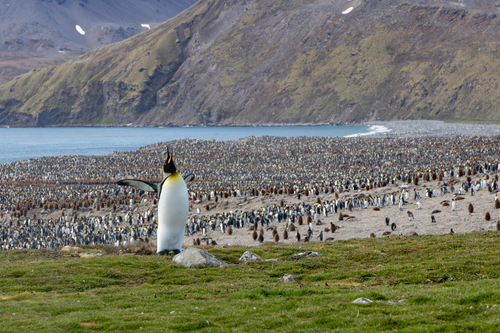
King Penguin (Aptenodytes patagonicus) King Penguin
Emperor Penguin (Aptenodytes forsteri) Emperor Penguin

Media

Loading…

In short

The most reliable field mark between King and Emperor Penguins is the color and shape of the cheek and upper breast patches in adults: King Penguins show a solid, bright orange cheek patch and more orange on the upper chest, while Emperor Penguins have a yellow and white cheek patch and a paler yellow upper breast. Size is also a strong clue, as Emperor Penguins are much larger and heavier, but beware overlap with large King Penguins. Juvenile and chick plumages are also distinct, with Emperor chicks showing a silver-grey down and black head with a white mask, while King Penguin chicks are uniformly brown and fluffy. Both species are flightless and superficially similar in structure, so careful attention to plumage and size is essential for confident separation.

Identification tips

  1. Cheek patch color (adults): King Penguins have a solid, vivid orange cheek patch; Emperor Penguins show a yellow and white patch. This is the single most reliable plumage mark in adults.
  2. Upper breast color: King's upper chest is more orange, while Emperor's is pale yellow. Look for this difference in good light.
  3. Size: Emperor Penguins are much taller and heavier than King Penguins. Use this when birds are side by side or with known objects for scale, but beware lone large Kings.
  4. Chick plumage: Emperor chicks are silver-grey with a black head and white mask; King chicks are uniformly brown and fluffy. This is a strong mark for young birds.
  5. Juvenile face: Juvenile Emperor Penguins have white auricular patches, chin, and throat; King juveniles lack the white mask and are more uniformly dark-faced.
  6. Bill color: Both have colorful lower mandibles, but Emperor's is more pink or lilac, King's is more orange. This is subtle and best used in close views.
  7. Head and throat: Adult Emperor Penguins have a sharply defined black head, chin, and throat; King Penguins' dark areas are less extensive.
  8. Habitat: Emperor Penguins breed only in Antarctica on sea ice; King Penguins are found on sub-Antarctic islands. Use this as a strong context clue.
  9. Behavior: Both species walk and toboggan similarly; behavioral differences are not reliable for field ID.
  10. Sex differences: Both species are sexually monomorphic in plumage; size differences are minor and not useful for field separation.
  11. Seasonal variation: Emperor Penguin plumage fades to brown in the Antarctic summer before molt, but this is subtle and not a primary field mark.
  12. Flipper/wing pattern: No distinctive upperwing marks separate these species at any age.
  13. Vocalizations: Calls are not diagnostic for field separation between these two species.
  14. Molting: Large, heavy birds with faded plumage in late summer in Antarctica are likely Emperor Penguins; molting King Penguins are found on sub-Antarctic islands.
  15. Mixed colonies: These species do not naturally occur together; any mixed group is likely in captivity or a rare vagrant situation.

Size

Emperor Penguins are the largest living penguins, with adults standing 100–120 cm tall and weighing 22–45 kg, often towering over King Penguins, which stand 70–100 cm and weigh 9.3–18 kg (occasionally up to 20 kg before molt) [wikipedia][wikidata]. Even the largest King Penguin is shorter and lighter than a typical Emperor Penguin. In the field, this size difference is striking when both are seen together, but can be harder to judge at a distance or with lone birds. Both sexes are similar in size, though males average slightly larger in both species.

Plumage

No distinctive upperwing or flight pattern marks separate these species, as both are flightless and have similar flipper structure. For age-specific plumage: Emperor Penguin chicks are covered in silver-grey down with a striking black head and white facial mask, while King Penguin chicks are uniformly brown and fluffy. Juvenile Emperor Penguins have white auricular (ear) patches, chin, and throat, with a black bill, whereas King Penguin juveniles are less well described but lack the white mask of Emperor chicks. In adults, the King Penguin's cheek patch is a solid, vivid orange, and the upper chest is more orange-toned, while the Emperor Penguin shows a yellow and white cheek patch and a paler yellow upper breast. Both have colorful lower mandibles, but Emperor's is more pinkish, King's more orange. The sharply delineated black head, chin, and throat of adult Emperor Penguins contrast with the King's less extensive dark areas.

Behaviour

Both species are flightless and use their flippers for swimming. King Penguins are known for 'porpoising' and have a slightly faster average swimming speed (6.5–10 km/h) compared to other penguins, but this is not a reliable field mark. On land, both species alternate between walking with a waddling gait and tobogganing on their bellies. There are no major behavioral differences visible to a field observer that reliably separate the two, though Emperor Penguins are adapted to endure the harsh Antarctic winter, with males fasting for over two months while incubating eggs.

Habitat

Emperor Penguins are strictly Antarctic, breeding on sea ice and never venturing far north. King Penguins breed on sub-Antarctic islands and rarely, if ever, overlap with Emperor Penguins in the wild. If you see a penguin in the deep Antarctic interior, it is almost certainly an Emperor; on sub-Antarctic islands or northern edges of the Southern Ocean, it is likely a King Penguin. Context is a strong clue, but vagrants and captive birds can complicate this.

Voice

Both species are generally silent at sea and vocalize primarily at colonies. Their calls are not typically diagnostic in the field for most observers, though King Penguin males and females can be separated by call. No practical vocal differences are described for field identification between these two species.

Submit a better description

Use the same sections as the comparison. Your text is published immediately.

The most reliable field mark between King and Emperor Penguins is the color and shape of the cheek and upper breast patches in adults: King Penguins show a solid, bright orange cheek patch and more orange on the upper chest, while Emperor Penguins have a yellow and white cheek patch and a paler yellow upper breast. Size is also a strong clue, as Emperor Penguins are much larger and heavier, but beware overlap with large King Penguins. Juvenile and chick plumages are also distinct, with Emperor chicks showing a silver-grey down and black head with a white mask, while King Penguin chicks are uniformly brown and fluffy. Both species are flightless and superficially similar in structure, so careful attention to plumage and size is essential for confident separation.

  1. Cheek patch color (adults): King Penguins have a solid, vivid orange cheek patch; Emperor Penguins show a yellow and white patch. This is the single most reliable plumage mark in adults.
  2. Upper breast color: King's upper chest is more orange, while Emperor's is pale yellow. Look for this difference in good light.
  3. Size: Emperor Penguins are much taller and heavier than King Penguins. Use this when birds are side by side or with known objects for scale, but beware lone large Kings.
  4. Chick plumage: Emperor chicks are silver-grey with a black head and white mask; King chicks are uniformly brown and fluffy. This is a strong mark for young birds.
  5. Juvenile face: Juvenile Emperor Penguins have white auricular patches, chin, and throat; King juveniles lack the white mask and are more uniformly dark-faced.
  6. Bill color: Both have colorful lower mandibles, but Emperor's is more pink or lilac, King's is more orange. This is subtle and best used in close views.
  7. Head and throat: Adult Emperor Penguins have a sharply defined black head, chin, and throat; King Penguins' dark areas are less extensive.
  8. Habitat: Emperor Penguins breed only in Antarctica on sea ice; King Penguins are found on sub-Antarctic islands. Use this as a strong context clue.
  9. Behavior: Both species walk and toboggan similarly; behavioral differences are not reliable for field ID.
  10. Sex differences: Both species are sexually monomorphic in plumage; size differences are minor and not useful for field separation.
  11. Seasonal variation: Emperor Penguin plumage fades to brown in the Antarctic summer before molt, but this is subtle and not a primary field mark.
  12. Flipper/wing pattern: No distinctive upperwing marks separate these species at any age.
  13. Vocalizations: Calls are not diagnostic for field separation between these two species.
  14. Molting: Large, heavy birds with faded plumage in late summer in Antarctica are likely Emperor Penguins; molting King Penguins are found on sub-Antarctic islands.
  15. Mixed colonies: These species do not naturally occur together; any mixed group is likely in captivity or a rare vagrant situation.

Emperor Penguins are the largest living penguins, with adults standing 100–120 cm tall and weighing 22–45 kg, often towering over King Penguins, which stand 70–100 cm and weigh 9.3–18 kg (occasionally up to 20 kg before molt) [wikipedia][wikidata]. Even the largest King Penguin is shorter and lighter than a typical Emperor Penguin. In the field, this size difference is striking when both are seen together, but can be harder to judge at a distance or with lone birds. Both sexes are similar in size, though males average slightly larger in both species.

No distinctive upperwing or flight pattern marks separate these species, as both are flightless and have similar flipper structure. For age-specific plumage: Emperor Penguin chicks are covered in silver-grey down with a striking black head and white facial mask, while King Penguin chicks are uniformly brown and fluffy. Juvenile Emperor Penguins have white auricular (ear) patches, chin, and throat, with a black bill, whereas King Penguin juveniles are less well described but lack the white mask of Emperor chicks. In adults, the King Penguin's cheek patch is a solid, vivid orange, and the upper chest is more orange-toned, while the Emperor Penguin shows a yellow and white cheek patch and a paler yellow upper breast. Both have colorful lower mandibles, but Emperor's is more pinkish, King's more orange. The sharply delineated black head, chin, and throat of adult Emperor Penguins contrast with the King's less extensive dark areas.

Both species are flightless and use their flippers for swimming. King Penguins are known for 'porpoising' and have a slightly faster average swimming speed (6.5–10 km/h) compared to other penguins, but this is not a reliable field mark. On land, both species alternate between walking with a waddling gait and tobogganing on their bellies. There are no major behavioral differences visible to a field observer that reliably separate the two, though Emperor Penguins are adapted to endure the harsh Antarctic winter, with males fasting for over two months while incubating eggs.

Emperor Penguins are strictly Antarctic, breeding on sea ice and never venturing far north. King Penguins breed on sub-Antarctic islands and rarely, if ever, overlap with Emperor Penguins in the wild. If you see a penguin in the deep Antarctic interior, it is almost certainly an Emperor; on sub-Antarctic islands or northern edges of the Southern Ocean, it is likely a King Penguin. Context is a strong clue, but vagrants and captive birds can complicate this.

Both species are generally silent at sea and vocalize primarily at colonies. Their calls are not typically diagnostic in the field for most observers, though King Penguin males and females can be separated by call. No practical vocal differences are described for field identification between these two species.

Discard your changes?

You have unsaved edits. If you leave now, those changes will be lost.

King Penguin · Emperor Penguin · My Tricky Birds