

Inca Dove vs Common Ground Dove
Columbina inca versus Columbina passerina
Play a quiz with Inca Dove and Common Ground Dove
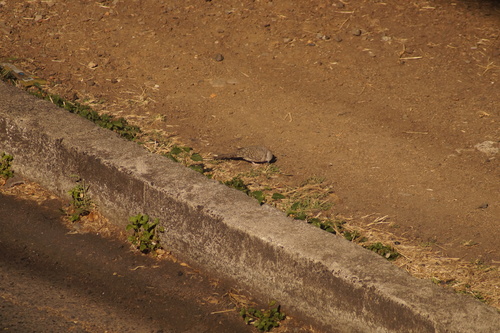 Inca Dove
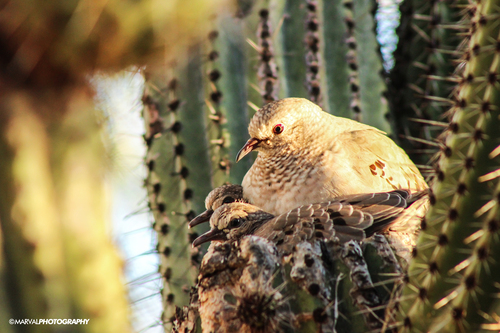 Common Ground Dove
In short
The most reliable field mark to separate Inca Dove from Common Ground Dove is the tail: Inca Dove has a long, square-tipped tail with conspicuous white edges, while Common Ground Dove’s tail is very short and lacks bold white edging. In flight, Inca Dove shows reddish underwings and white tail sides, whereas Common Ground Dove flashes chestnut in the primaries and wing borders, with a much shorter tail. Both species have scaled body patterns, but Inca Dove is more slender and longer overall. Bill color and facial pattern also help: Common Ground Dove has a yellow bill with a black tip and pinkish face, unlike the plain-faced Inca Dove.
Identification tips
- Tail length and pattern: Inca Dove’s tail is long and square-tipped with bold white edges, visible both perched and in flight. Common Ground Dove’s tail is very short, lacks strong white edges, and is similar in color to the back. This is the single best field mark in all ages and seasons.
- Flight marks: Inca Dove flashes reddish underwings and white tail sides in flight. Common Ground Dove shows chestnut in the primaries and wing borders, but its tail remains short and plain. Look for these contrasts when birds flush.
- Body shape: Inca Dove is slender, elongated, and appears longer-necked, while Common Ground Dove is compact and round-bodied. This is most obvious when birds are side by side.
- Scaling pattern: Both species have scaled-looking plumage, but Inca Dove’s is more extensive and regular across the entire body. Common Ground Dove’s scaling is mostly on the head and upper breast, with the rest of the body browner and less patterned.
- Bill and face: Common Ground Dove has a yellow bill with a black tip and pinkish feathers around the base. Inca Dove’s bill is dark and its face is plain gray-brown, lacking any pinkish or yellow tones.
- Sexual dimorphism: Only Common Ground Dove shows clear sex differences: males have slate-gray crowns and pink-gray bellies, females are grayer and more uniform. Inca Dove does not show obvious sex differences.
- Wing coverts and spotting: Common Ground Dove has brown coverts and wing feathers with black spots, especially visible at close range. Inca Dove’s wings are plain gray-brown with scaling but no black spots.
- Vocalizations: If you hear a repeated, rising-pitch whoop, it’s Common Ground Dove. Inca Dove’s voice is not described here, so use this only to confirm Common Ground Dove.
- Behavior: Inca Dove may be seen in large communal huddles or flocks, especially in winter, sometimes forming pyramid-shaped roosts. Common Ground Dove is usually solitary or in small groups.
- Takeoff sound: Inca Dove’s wings make a quiet rattling noise on takeoff, which is absent in Common Ground Dove.
- Habitat context: Inca Dove is more likely in urban or suburban settings, Common Ground Dove in open fields and scrub, but both can overlap.
- Size: Inca Dove is larger and more elongated, but beware of overlap and use in combination with other marks.
- Subspecies variation: Common Ground Dove shows regional plumage differences, but these do not overlap with Inca Dove’s marks. Focus on tail, flight, and bill for separation.
- Pitfalls: At a distance, both can look scaled and brownish. Always check tail length and edge, flight marks, and bill color for confirmation.
- Age/season: No unique juvenile upperwing patterns are described for either species, so use adult marks for all ages.
Size
Inca Dove is noticeably larger and more elongated: 16.5–23 cm long, 30–58 g, and a wingspan of 28.5–32 cm [wikipedia][avonet]. Common Ground Dove is the smallest dove in the US, at 15–18 cm, 26–40 g, and a 27 cm wingspan [wikipedia][avonet]. Inca Dove’s longer tail and more slender build accentuate this size difference, especially when the two are seen together. However, overlap in length and mass means size alone is not always diagnostic at a distance.
Plumage
- Juvenile/immature flight: No unique juvenile upperwing patterns are described for either species, but flight marks are critical. Inca Dove of all ages shows reddish underwings and prominent white tail edges that flare in flight. Common Ground Dove of all ages flashes chestnut in the primaries and wing borders, but its tail is short and lacks strong white edges.
- Perched: Both species have scaled-looking body plumage, but Inca Dove’s scaling is more extensive and regular over the entire body, while Common Ground Dove has it mostly on the head and upper breast. Common Ground Dove’s back and wings are brown with black spots, and the face is pinkish with a yellow-and-black bill. Inca Dove is gray-brown overall, with a plain face and dark bill.
- Sex/age variation: Common Ground Dove males have slate-gray crowns and pink-gray bellies, while females are grayer and more evenly colored. Inca Dove shows little sexual dimorphism.
- Tail: Inca Dove’s tail is long, square-tipped, and edged with white; Common Ground Dove’s tail is very short and similar in color to the back, lacking bold white edges.
Behaviour
Both species spend much time on the ground, but Inca Dove is more likely to be seen in communal huddles during winter, forming pyramid-shaped groups for warmth. Inca Dove often flocks outside its territory, sometimes in groups of up to 100. Common Ground Dove is more solitary or in small groups, rarely forming large flocks. Inca Dove’s takeoff is accompanied by a quiet rattling wing noise, while Common Ground Dove’s flight is silent.
Habitat
Both species overlap in the southern US and Mexico, but Common Ground Dove has a broader range into the Caribbean and northern South America. Inca Dove is more likely in urban, suburban, and open dry habitats, while Common Ground Dove favors open ground, fields, and scrub. Habitat is not always diagnostic due to overlap, but Inca Dove is more likely in built-up areas.
Voice
Common Ground Dove gives a series of soft, rising-pitch whoops, often repeated and distinctive. Inca Dove’s vocalizations are not described in the provided notes, so voice is only diagnostic if Common Ground Dove’s call is heard.